Cost Breakdown: Different Types of Concrete Driveways in 2026
Analyze 2026 costs for different types of concrete driveways. Compare broom finish, stamped, and exposed aggregate pricing, plus hidden installation fees.
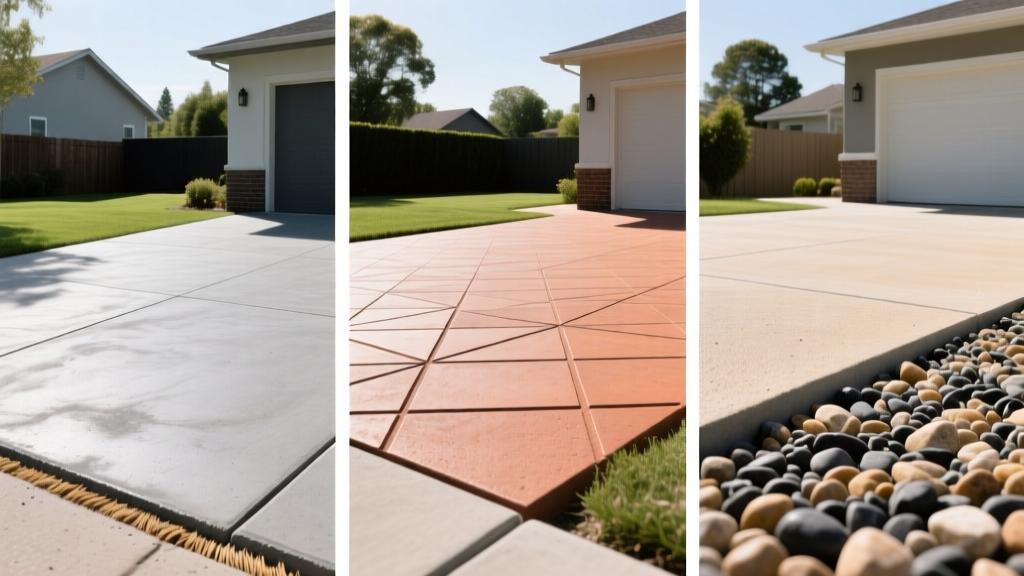
Calculating the true cost of a concrete driveway requires looking far beyond the base price per square foot. In 2026, material stabilization and regional labor variations mean that the price gap between a basic utility slab and a high-end architectural surface can exceed 300%. This guide provides a granular cost breakdown of the different types of concrete driveways, detailing material adders, structural requirements, and long-term lifecycle expenses to help you budget accurately.
The Baseline: Standard Broom Finish Concrete Costs
A standard broom-finish driveway remains the most cost-effective and durable option for residential applications. The textured surface provides essential slip resistance, while the underlying mix design ensures longevity.
2026 Baseline Pricing: Broom Finish
- Average Installed Cost: $8.50 to $12.00 per square foot
- Concrete Mix: 4,000 PSI with 5% to 8% air-entrainment for freeze-thaw resistance
- Thickness: 4 inches minimum (5 inches recommended for heavy truck traffic)
- Reinforcement: 3/8-inch rebar grid at 24-inch on-center, or 6x6 W1.4xW1.4 welded wire mesh
According to the Portland Cement Association, air-entrainment is non-negotiable in climates with freezing temperatures. The microscopic air bubbles give expanding water a place to go, preventing surface spalling. Skipping this $0.15 per square foot admixture upgrade is a primary cause of premature driveway failure in northern regions.
Upgrading the Surface: Decorative Concrete Driveway Pricing
When evaluating the different types of concrete driveways, decorative finishes introduce significant material and labor multipliers. These processes require specialized crews and precise timing, which drives up the 2026 labor rates (averaging $75 to $110 per hour for decorative specialists).
| Driveway Type | 2026 Cost per Sq. Ft. | Key Material Adders | Labor Complexity |
|---|---|---|---|
| Exposed Aggregate | $12.00 - $16.50 | Surface retarder, decorative stone seed, specialized wash-off equipment | Moderate (requires precise wash-off timing) |
| Stained / Dyed | $10.50 - $15.00 | Acid or water-based stains, clear acrylic or polyurethane sealer | Moderate (requires surface prep and multi-coat application) |
| Stamped Concrete | $18.00 - $28.00 | Color hardener, antique release agent, stamping mats, high-solids sealer | High (requires a large crew working rapidly before initial set) |
| Polished Concrete | $16.00 - $24.00 | Densifiers, diamond grinding pads, stain guard (rare for exterior driveways due to slip hazards) | High (multi-day mechanical grinding process) |
Deep Dive: The True Cost of Stamped Concrete
Stamped concrete is the most expensive of the standard decorative options because it essentially involves pouring two layers of material. The base slab is poured normally, but the surface receives a broadcast application of color hardener (adding $1.50 to $2.50 per square foot in materials alone). The antique release agent prevents the polyurethane stamping mats from sticking to the wet concrete, while also providing secondary color contrast. Because the crew must stamp the entire driveway before the concrete undergoes its initial set, you are paying for a larger, highly coordinated team.
Structural Upgrades: When to Pay for High-PSI and Rebar
The different types of concrete driveways also vary by structural capacity. If you plan to park RVs, boat trailers, or heavy commercial work trucks on your driveway, a standard 4,000 PSI mix on a 4-inch base will crack under the concentrated axle loads.
Furthermore, the National Ready Mixed Concrete Association emphasizes that proper subgrade preparation is just as critical as the concrete itself. A 4-inch to 6-inch base of compacted 3/4-inch minus crushed stone is mandatory. If your soil is heavy clay, budget an additional $0.50 to $0.85 per square foot for a non-woven geotextile fabric separator to prevent the clay from migrating into the aggregate base and compromising drainage.
Hidden Cost Drivers in Driveway Installation
Contractor estimates often highlight the concrete pouring cost while burying site-prep expenses in the fine print. When budgeting for your project, ensure these 2026 line items are explicitly accounted for:
- Demo and Haul-Away: Removing an existing asphalt or concrete driveway costs $3.50 to $6.00 per square foot. Disposal fees at local landfills have risen sharply, often adding $50 to $85 per ton.
- Excavation and Grading: If your site requires significant cut-and-fill to achieve a 2% minimum slope for water runoff, expect to pay $2.00 to $4.50 per square foot for earthmoving.
- Formwork and Finishing: Complex driveways with curves, radii, or multiple joints require custom bending of form boards, increasing carpentry labor by 15% to 20%.
- Saw Cutting Control Joints: Essential for controlling where the concrete cracks. Budget $0.40 to $0.75 per linear foot. Joints should be cut to a depth of 25% of the slab thickness within 12 to 24 hours of pouring.
- Permitting: Municipal right-of-way permits for driveway aprons connecting to the street typically range from $150 to $450 in 2026, depending on local zoning laws.
Lifecycle Cost Analysis: 30-Year ROI by Driveway Type
The initial installation price is only half the financial equation. Decorative driveways require rigorous maintenance schedules to protect the investment. Below is a 30-year lifecycle cost projection for a standard 600-square-foot residential driveway.
| Driveway Type | Initial Install (600 sq ft) | 30-Year Maintenance Cost | Total 30-Year Cost |
|---|---|---|---|
| Broom Finish (4000 PSI) | $6,000 | $900 (Sealing every 5 years, minor patching) | $6,900 |
| Exposed Aggregate | $8,400 | $1,800 (Sealing every 3 years to prevent stone pop-out) | $10,200 |
| Stamped Concrete | $13,200 | $3,600 (Mandatory resealing every 2-3 years, color fading touch-ups) | $16,800 |
As the data illustrates, stamped concrete costs nearly 2.5 times more than a broom finish over a 30-year horizon. The high-solids acrylic sealers used on stamped driveways degrade under UV exposure and vehicle tire friction, requiring reapplication every 24 to 36 months at a cost of $400 to $600 per application.
Decision Framework: Matching Budget to Driveway Type
Use this practical framework to select the right concrete type based on your specific site conditions and financial parameters:
- Choose Broom Finish if: Your primary goal is maximum durability and lowest lifecycle cost, you live in a region with severe winter freeze-thaw cycles, or your budget is strictly capped below $10 per square foot.
- Choose Exposed Aggregate if: You want a natural, slip-resistant surface that hides dirt and oil stains well, and you are willing to pay a 30% premium over broom finish for enhanced curb appeal without the intense maintenance of stamped patterns.
- Choose Stamped Concrete if: You are integrating the driveway with high-end architectural elements (like a stone-clad home), budget is secondary to aesthetics, and you are committed to a strict bi-annual resealing schedule to prevent UV fading and surface delamination.
Frequently Asked Questions
How long should I wait before driving on a new concrete driveway?
Standard 4,000 PSI concrete reaches approximately 70% of its design strength in 7 days. You can drive passenger vehicles on it after one week, but wait a full 28 days before parking heavy RVs or commercial trucks to allow the slab to achieve its maximum compressive strength and prevent edge cracking.
Is fiber mesh reinforcement worth the extra cost?
Synthetic macro-fibers (like polypropylene) cost about $0.10 to $0.20 per square foot and are excellent for reducing plastic shrinkage cracking during the initial curing phase. However, they do not replace rebar or wire mesh for structural load-bearing capacity. For the best performance in 2026, use fiber mesh in the mix design alongside a traditional rebar grid.
Written by
Marcus ChenMarcus Chen is a licensed structural engineer (PE) and building materials analyst with over 12 years of experience across residential, commercial, and industrial construction. He holds a Master of Science in Civil Engineering from UC Berkeley and spent six years at Thornton Tomasetti before transitioning to independent consulting and technical writing. Marcus specializes in material selection for seismic-prone regions, concrete reinforcement strategies, and lifecycle cost analysis. His work has been cited by the American Concrete Institute (ACI) and the Structural Engineers Association of California (SEAOC). When he is not on a job site or at his desk, you will find him hiking the Sierra Nevada or restoring a 1920s craftsman bungalow in Oakland, CA.
More from Marcus Chen
View all
Construction Cost
How Much Did the Eiffel Tower Cost to Build?
How much did the Eiffel Tower cost to build in 1889? We adjust for inflation and compare its budget to modern skyscraper construction.
Aug 4, 2026

Fire Resistance
What Is a Fire Resistant Material? Testing & Certification Guide
Discover what is a fire resistant material through ASTM and UL testing. Learn how fire ratings, certifications, and assemblies work in construction.
Aug 4, 2026

Construction Cost
How Much Did the Burj Khalifa Cost to Build?
How much did the Burj Khalifa cost to build? We break down the $1.5B project and extract 5 money-saving strategies for your next build.
Jul 30, 2026