Sidewalk Pavers vs Concrete: Troubleshooting Settlement & Cracks
Compare sidewalk pavers vs concrete for repairability. Learn troubleshooting steps, fix costs, and how to resolve settling, heaving, and cracks.

The Mechanics of Sidewalk Failure: Rigid vs. Flexible Systems
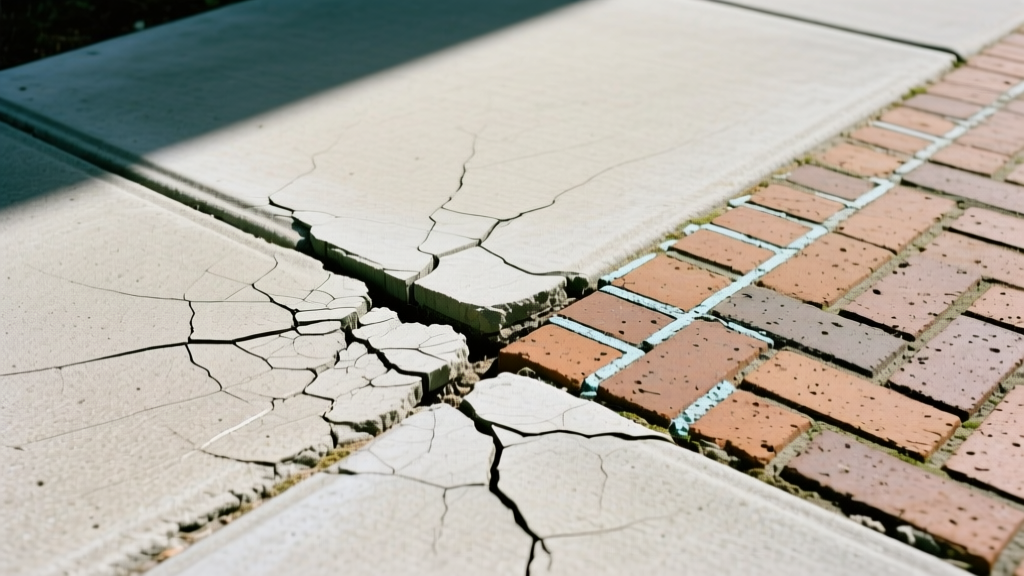
When evaluating sidewalk pavers vs concrete from a maintenance perspective, you are fundamentally choosing between a rigid monolithic structure and a flexible interlocking system. Poured concrete sidewalks fail structurally; when the subgrade shifts, the slab cracks or tilts. Interlocking concrete pavers (ICP) fail systemically; the individual units rarely break, but the base aggregate, joint sand, or edge restraints degrade, causing spreading or localized settling.
According to the U.S. Access Board, any vertical displacement exceeding 0.25 inches constitutes an ADA-compliant trip hazard. Addressing these hazards requires vastly different troubleshooting protocols depending on the material installed. Below is a comprehensive diagnostic and repair framework for both systems.
Failure Mode Diagnostic Matrix
| Failure Symptom | Poured Concrete Cause | Paver System Cause | Severity Level |
|---|---|---|---|
| Vertical Displacement (Heave/Settlement) | Frost heave, expansive clay, or washout under slab | Base aggregate migration or ant/rodent excavation | High (Trip Hazard) |
| Surface Degradation | Spalling due to chloride intrusion or freeze-thaw | Efflorescence or surface abrasion from snowplows | Low (Cosmetic) |
| Lateral Spreading / Gapping | N/A (Monolithic) | Edge restraint failure or joint sand washout | Medium (Structural) |
| Fracturing / Cracking | Tree root intrusion or thermal expansion stress | Paver snapping under point-loads (rare, ASTM C936 compliant) | High (Structural) |
Troubleshooting Poured Concrete Sidewalks
Differential Settlement and Frost Heave
When a concrete slab sinks or tilts, the subgrade has failed. Historically, mudjacking (pumping a cementitious slurry under the slab) was the standard fix. However, slurry weighs approximately 100 lbs per cubic foot, which can exacerbate settlement in weak soils.
The Modern Fix: Polyurethane Foam Jacking. Contractors drill 5/8-inch holes through the slab and inject a two-part, high-density closed-cell polyurethane resin. The foam expands, lifting the slab with precision, and cures in 15 minutes. Crucially, the foam adds only 2 to 4 lbs per cubic foot of weight to the subgrade and is impervious to water washout. Expect to pay between $8.00 and $14.00 per square foot for polyjacking in 2026, compared to $4.00 to $6.00 for traditional mudjacking.
Transverse and Longitudinal Cracking
Cracks wider than 1/8-inch allow water infiltration, which accelerates subgrade erosion. Do not use rigid epoxies for exterior sidewalk repairs; thermal expansion will cause the concrete to crack adjacent to the repair.
- Use a diamond-blade angle grinder to route the crack, creating a 1/2-inch wide by 1/2-inch deep reservoir.
- Clean the channel with compressed air to remove silica dust.
- Insert a closed-cell backer rod for cracks deeper than 1/2-inch.
- Fill with a self-leveling, elastomeric polyurethane sealant (e.g., Sika Sikaflex-11 CS or MasterSeal NP 1). These products accommodate up to 25% joint movement without losing adhesion.
Surface Spalling and Scaling
Spalling occurs when water trapped in the surface pores freezes and expands, popping the surface mortar off. This is often caused by improper finishing (trapping bleed water) or inadequate air-entrainment (target is 5% to 7% air content per Portland Cement Association guidelines). For localized spalling, clean the area with a muriatic acid wash (1 part acid to 10 parts water), neutralize, and apply a polymer-modified concrete resurfacer at a minimum thickness of 1/8-inch.
Troubleshooting Interlocking Concrete Pavers
Edge Restraint Failure and Lateral Spreading
If pavers are separating and weeds are invading the joints, the edge restraint has failed. Pavers rely on interlock, which requires rigid confinement. Plastic edging degrades under UV exposure and extreme freeze-thaw cycles, eventually snapping or pulling away from the spikes.
The Fix: Remove the perimeter pavers and excavate the trench. Install a structural composite or heavy-duty aluminum restraint (e.g., PermaEdge or SnapEdge). Anchor the restraint using 10-inch galvanized or stainless-steel spikes driven every 12 inches. Critical detail: The spikes must penetrate undisturbed native soil or a concrete curb; if they only penetrate the loose base aggregate, the restraint will fail again within two seasons.
Joint Sand Washout and Weed Intrusion
Standard silica joint sand washes out during heavy rain or power washing, destroying the interlock friction that distributes loads across the pavement matrix. According to Interlocking Concrete Pavement Institute (ICPI) tech specs, joint sand is the primary structural component transferring shear forces between units.
The Fix: Use a stiff bristle broom and a specialized joint-cleaning tool to remove degraded sand and organic matter to a depth of at least 1 inch. Replace it with a high-quality polymeric sand (e.g., Alliance Gator Maxx G2). Polymeric sand contains water-activated polymers that bind the grains together, resisting washout and preventing ant excavation. Warning: The pavers must be bone-dry before application. Any surface moisture will activate the polymer prematurely, creating a permanent, hazy film on the paver surface that requires chemical stripping to remove.
Base Settlement and Potholing
Localized sinking (potholing) in a paver field indicates a failure in the base aggregate, often due to poor drainage or organic decomposition beneath the geotextile fabric.
The Fix:
- Pry up the affected pavers using two flathead screwdrivers or specialized paver pulling tools.
- Excavate the compromised base material down to the subgrade.
- Verify the integrity of the geotextile separation fabric; patch any tears.
- Backfill with 3/4-inch open-graded or densely graded crushed stone (ASTM D2940), compacting in 4-inch lifts using a vibratory plate compactor (minimum 3,000 lbs of compactive force).
- Re-lay the 1-inch bedding sand and reinstall the pavers in the exact herringbone or running bond pattern to maintain interlock.
Long-Term Repair Economics: 20-Year Lifecycle
"While poured concrete has a lower initial installation cost, interlocking pavers offer a significantly lower lifecycle maintenance cost in regions with severe freeze-thaw cycles due to their flexible, modular nature." — ICPI Lifecycle Analysis Report
Lifecycle Cost Breakdown (Per 1,000 Sq. Ft.)
- Poured Concrete Initial Install: $8,000 - $12,000
- Poured Concrete 20-Yr Repairs: $3,500 - $6,000 (Slab jacking, crack sealing, eventual partial demolition)
- Paver System Initial Install: $14,000 - $22,000
- Paver System 20-Yr Repairs: $1,200 - $2,500 (Polymeric sand replenishment, edge restraint replacement, localized base patching)
Note: When a concrete slab reaches the end of its structural life, removal and disposal cost an additional $3 to $5 per square foot. Pavers can be salvaged, and the base simply re-graded and reused.
Decision Framework: When to Repair vs. Replace
Use this diagnostic flow to determine the most economically viable action for your damaged walkway:
- Assess Displacement: Is the vertical trip hazard greater than 2 inches?
- Yes (Concrete): Polyjacking may not provide enough lift without fracturing the slab. Plan for full-depth demolition and replacement.
- Yes (Pavers): Pull the pavers, add base aggregate, compact, and reinstall. Repair is highly viable.
- Evaluate Surface Area Damage: Is spalling present on more than 30% of the concrete surface?
- Yes: Resurfacing will likely delaminate within 3-5 years due to underlying freeze-thaw micro-fractures. Replace the slab.
- Check Root Intrusion: Are tree roots actively lifting the walkway?
- Action: Never pour new rigid concrete over active root zones. The roots will shatter the new slab within 5 years. Switch to a flexible paver system, which can be easily lifted, roots pruned or capped, and pavers re-laid without leaving a permanent scar.
Ultimately, choosing between sidewalk pavers vs concrete for repair scenarios depends on your willingness to perform modular maintenance versus accepting the eventual need for heavy demolition. Concrete requires less frequent attention, but when it fails, the repairs are invasive and expensive. Pavers demand periodic joint and edge maintenance, but structural failures are almost always localized and fully reversible.
Written by
Priya KapoorPriya Kapoor is a real estate market analyst and construction economics researcher with expertise in housing affordability, development feasibility, and infrastructure investment. She holds a Master of Regional Planning from Cornell University and previously worked as a senior analyst at CBRE's Investment Properties group, where she modeled returns for $4B in mixed-use development pipelines. Priya now runs an independent research practice advising developers, municipalities, and REITs on construction cost forecasting and market timing. She publishes the quarterly "BuildMat Market Pulse" report tracking material price indices across 12 commodity categories. Based in Austin, TX, Priya serves on the board of Habitat for Humanity Austin and is a marathon runner.
More from Priya Kapoor
View all
Construction Cost
Cost to Build a 1600 Sq Ft Home in 2026: Full Breakdown
Accurate 2026 cost to build a 1600 sq ft home—material, labor, and regional pricing breakdowns included. Plan your budget with real-time estimates.
Aug 11, 2026

Wood & Lumber
Name the Types of Wood for Pressure Treatment and Preservation
Learn how to name the types of wood best suited for pressure treatment. Compare species treatability, chemical retention levels, and 2026 preservation costs.
Aug 4, 2026

Stone & Masonry
Stone Veneer Suppliers Lindenhurst: 2026 Cost Analysis
Analyze 2026 stone veneer costs in Lindenhurst, NY. Compare local supplier pricing, delivery fees, and Suffolk County installation labor rates.
Aug 4, 2026