How to Match ASTM Cement Types to Specific Building Scenarios
Learn how to match ASTM cement types to specific building scenarios. Compare Type I, II, III, and V for structural, marine, and cold-weather projects.
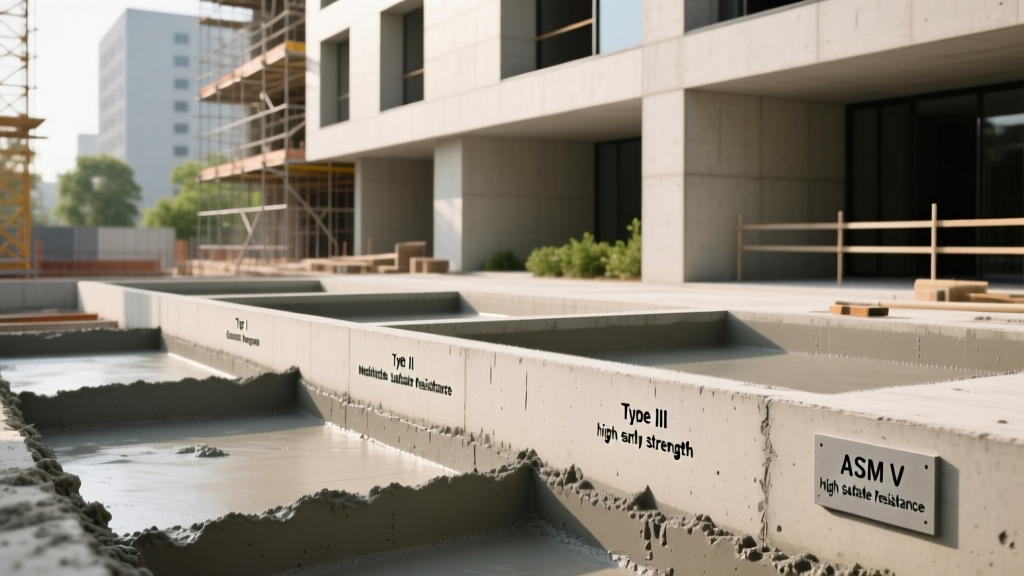
Selecting the correct Portland cement is a chemical and structural decision, not merely a supply chain convenience. While general contractors often default to whatever is available at the local batch plant, mismatching cement chemistry to environmental exposure is a primary cause of premature concrete degradation. Under the ASTM C150 standard specification, Portland cement is classified into distinct types based on the proportions of four primary Bogue compounds: tricalcium silicate (C3S), dicalcium silicate (C2S), tricalcium aluminate (C3A), and tetracalcium aluminoferrite (C4AF). Understanding these compounds is the prerequisite for accurate scenario matching.
The Chemical Basis of Cement Performance
Before matching cement to a scenario, you must understand what drives early strength, late strength, and chemical vulnerability. C3S hydrates rapidly, providing the critical early strength required to strip formwork. C2S hydrates slowly, contributing to long-term structural integrity. C3A is the most reactive compound; it generates high heat during hydration and is highly vulnerable to sulfate attack. C4AF contributes little to strength but lowers the clinkering temperature during manufacturing and imparts the standard gray color.
Application-Fit Matrix: Core ASTM C150 Types
The following matrix provides a rapid decision framework for matching the five primary ASTM C150 cement types to specific environmental and scheduling scenarios.
| Cement Type | C3A Limit | Ideal Scenario | Avoid When |
|---|---|---|---|
| Type I | No limit | Standard interior slabs, non-exposed structural columns, residential driveways. | Soils with >0.10% water-soluble sulfates; mass pours requiring low heat. |
| Type II | < 8.0% | Bridge piers in moderate sulfate soils, large footings requiring moderate heat control. | Severe marine exposure; extreme cold-weather pours needing rapid set. |
| Type III | No limit | Cold-weather flatwork, precast manufacturing, emergency roadway repairs. | Mass concrete pours (dams, thick mats) due to high heat of hydration cracking. |
| Type IV | < 7.0% | Massive gravity dams, thick raft foundations where thermal cracking is the primary risk. | Any project requiring early form removal or fast-track scheduling. |
| Type V | < 5.0% | Marine pilings, wastewater treatment tanks, foundations in high-sulfate alkali soils. | Standard residential builds (unnecessary cost premium and slower early strength). |
Specialty Cements for Niche Scenarios
Standard Portland cements do not cover every architectural or structural requirement. For specialized applications, alternative ASTM standards govern the material chemistry.
Masonry Cement (ASTM C91)
Never use standard Type I Portland cement for historic brick repointing or standard CMU (concrete masonry unit) laying. Type I is too hard, too rigid, and lacks the workability required for mortar. Masonry cement (typically Type N or Type S) incorporates air-entraining agents and plasticizers. For historic masonry restoration, specify Type O masonry cement, which has a high lime content and low compressive strength, allowing the mortar to act as a sacrificial element that accommodates thermal movement without cracking the historic brick.
White Portland Cement
Manufactured by replacing iron and magnesium oxides with raw materials like kaolin clay, white cement eliminates the C4AF compound that causes gray coloration. It is strictly specified for architectural precast panels, terrazzo flooring, and exposed aggregate finishes. According to data tracked by the NIST Cement and Concrete Reference Laboratory, white cement achieves similar structural performance to Type I but requires significantly higher energy to produce, resulting in a steep cost premium.
Real-World Scenario Walkthroughs
Scenario A: Coastal Retaining Wall in Tidal Zone
The Challenge: A cast-in-place retaining wall exposed to seawater splash and high-sulfate tidal mud.
The Match: Type V Portland cement, supplemented with a 20% Class F fly ash replacement (ASTM C618).
The Rationale: Type V restricts C3A to under 5%, preventing the initial ettringite sulfate attack. However, seawater also introduces chlorides, which attack the steel rebar, not the cement paste. Therefore, the cement type must be paired with a low water-cement ratio (0.40 max) and supplementary cementitious materials (SCMs) like fly ash or slag to densify the pore structure and block chloride ingress. The Federal Highway Administration mandates this dual-defense approach for all marine bridge substructures.
Scenario B: Fast-Track Commercial Flooring in Winter
The Challenge: Pouring a 10,000 sq. ft. warehouse slab in December with an ambient temperature of 28°F (-2°C), requiring power troweling within 6 hours to meet the schedule.
The Match: Type III (High Early Strength) cement.
The Rationale: Type III is ground much finer than Type I, increasing the surface area for rapid hydration. This generates a high heat of hydration, which is actually beneficial in cold weather as it protects the slab from freezing during the critical first 24 hours. Warning: If this same Type III cement were used in a 3-foot-thick elevator pit mat during July, the trapped heat would exceed 160°F internally, causing severe thermal differential cracking.
2026 Procurement Realities and Cost Variables
Material selection must account for current market availability and pricing. As of 2026, the transition toward lower-carbon materials has impacted traditional cement supply chains.
- Type I/II (General Purpose): $14.00 - $18.00 per 94 lb bag. Widely available; often blended as Type I/II at the plant to reduce inventory overhead.
- Type III (High Early): $19.00 - $24.00 per bag. Subject to regional shortages in winter months when cold-weather demand spikes.
- Type V (Sulfate Resistant): $22.00 - $28.00 per bag. Often requires a 4-week lead time for delivery unless you are located near agricultural or coastal hubs with high baseline demand.
- White Portland Cement: $38.00 - $48.00 per bag. Highly specialized; usually ordered in full pallet quantities with strict moisture-barrier packaging.
The Terminology Trap: Cement vs. Concrete
A frequent failure point in construction procurement is the conflation of cement and concrete. Cement is the dry, powdery binder (the 'flour'). Concrete is the composite structural material comprising cement, water, fine aggregates (sand), and coarse aggregates (gravel). When an engineer specifies '5,000 psi concrete,' they are dictating the performance of the final composite mix design, not just the cement type. Always verify whether the project specifications are calling for a specific ASTM cement type (the ingredient) or a specific compressive strength and slump profile (the final concrete mix).