Comparing the Best Types of Concrete Finishes for Patios Against Pavers and Stone
Compare the best types of concrete finishes for patios, weighing stamped, exposed aggregate, and polished options against pavers and natural stone.

The Core Dilemma: Poured Concrete Finishes vs. Modular Alternatives
Selecting a patio surface requires balancing upfront capital, long-term maintenance, and regional climate constraints. While modular alternatives like interlocking concrete pavers and natural flagstone dominate high-end landscaping, poured concrete remains the most structurally continuous and cost-effective option. The critical variable that elevates a basic slab into a premium outdoor living space is the surface treatment. Understanding the specific types of concrete finishes for patios—and how they perform against modular alternatives—dictates the 30-year lifecycle cost of your project.
- Choose Stamped Concrete if you want the aesthetic of natural stone at 50% of the cost, and accept resealing every 2-3 years.
- Choose Exposed Aggregate for high-traction, low-maintenance surfaces in wet or icy climates.
- Choose Concrete Pavers if ground heave or tree root intrusion is a known issue, allowing for modular replacement.
- Choose Natural Stone only if budget is secondary to bespoke aesthetics and you have access to skilled masons.
Deep Dive: 4 Primary Types of Concrete Finishes for Patios
1. Stamped Concrete (The Chameleon)
Stamped concrete utilizes polyurethane stamping mats pressed into freshly poured concrete to replicate ashlar slate, cobblestone, or wood grain. The process relies heavily on colored hardeners (broadcast onto the surface) and liquid or powdered antiquing release agents to prevent the mats from sticking while adding secondary color highlights.
- Mix Design Requirements: Minimum 4,000 PSI compressive strength with a low slump (4 to 5 inches) to support the weight of the stamping crew without the mats sinking too deeply.
- Jointing: Control joints must be cut to a depth of 25% of the slab thickness within 12 hours of pouring to mitigate random cracking, which is highly visible on stamped surfaces.
- Maintenance: Requires an acrylic solvent-based sealer (e.g., SuperSeal 25 or Eagle Armor Seal) reapplied every 24 to 36 months to prevent UV degradation and color fading.
2. Exposed Aggregate (The Textured Workhorse)
This finish involves removing the top layer of cement paste to reveal the underlying aggregate (typically 3/8-inch to 1/2-inch pea gravel or decorative river rock). Contractors apply a chemical surface retarder immediately after screeding, which delays the setting of the top 1/4 inch of concrete. The next day, the surface is washed with a pressure washer and stiff brush to expose the stone.
- Slip Resistance: Exceptional. The exposed stones provide a high coefficient of friction, making it ideal for pool decks and patios in high-rainfall regions.
- Edge Case Warning: If the washing is delayed too long (beyond 24 hours in warm weather), the paste cures too hard, resulting in a patchy, uneven exposure. Timing is entirely dependent on ambient temperature and humidity.
3. Broom Finish (The Budget Standard)
The most economical and ubiquitous finish, achieved by dragging a stiff-bristled push broom across freshly floated concrete. The ridges created provide excellent traction.
- Execution Timing: The broom must be applied when the concrete has stiffened enough that a thumb pressed into the surface leaves an indentation of exactly 1/4 inch. Brooming too early collapses the ridges; brooming too late tears the surface paste.
- Durability: Highly durable, but the ridges can trap dirt and organic debris over time, requiring periodic power washing to prevent moss or algae growth in shaded areas.
4. Polished and Sealed Concrete (The Modern Minimalist)
While more common indoors, exterior polished concrete utilizes heavy-duty planetary grinders equipped with diamond-impregnated segments to mechanically hone the surface. For patios, contractors typically stop at a 400-grit resin polish to maintain some slip resistance, followed by a penetrating lithium silicate densifier and a breathable, UV-stable polyaspartic topcoat.
Head-to-Head Comparison Matrix
How do the various types of concrete finishes for patios stack up against traditional modular alternatives? The following matrix evaluates 2026 market realities.
| Material / Finish | Avg. Installed Cost (per sq. ft.) | Expected Lifespan | Maintenance Burden | Repairability |
|---|---|---|---|---|
| Stamped Concrete | $14 - $18 | 25 - 30 years | High (Reseal every 2-3 yrs) | Poor (Cracks are highly visible) |
| Exposed Aggregate | $10 - $14 | 30+ years | Low (Optional clear seal) | Moderate (Patching is noticeable) |
| Broom Finish | $6 - $9 | 30+ years | Very Low | Moderate |
| Concrete Pavers | $16 - $25 | 40+ years | Moderate (Weed control, polymeric sand) | Excellent (Individual replacement) |
| Natural Stone (Bluestone) | $28 - $45 | 50+ years | Low | Good (Mortar joint repair) |
Failure Modes and Edge Cases: What Contractors Won't Tell You
Understanding the specific failure modes of poured concrete versus modular alternatives is crucial for long-term satisfaction. According to guidelines published by the Portland Cement Association, environmental factors dictate the success of any concrete installation.
Plastic Shrinkage Cracking in Stamped Concrete
When wind speeds exceed 15 mph and humidity drops below 40% during the stamping process, moisture evaporates from the surface faster than bleed water can rise. This causes plastic shrinkage cracking—micro-fissures that ruin the illusion of stamped stone. The Fix: Contractors must apply an evaporation reducer (such as Master Builders E-CON) immediately after screeding, before the color hardener is broadcast.
Efflorescence: Concrete vs. Pavers
Efflorescence (the white, powdery salt deposit) plagues both poured concrete and concrete pavers. However, on interlocking concrete pavers, efflorescence naturally wears away from the surface due to foot traffic and rain, and the joints allow moisture to escape laterally. On sealed stamped concrete, if moisture becomes trapped beneath a non-breathable acrylic sealer, efflorescence will cause the sealer to blister and delaminate, requiring a complete chemical stripping and costly reapplication.
Ground Heave and Tree Roots
Poured concrete is a monolithic slab. If a tree root grows beneath it, or if the subgrade experiences frost heave, the slab will crack or tilt. The American Concrete Institute recommends rigorous subgrade compaction and the use of expansion joints, but modular pavers inherently solve this problem. Pavers shift with the ground and can be unzipped, the subgrade re-leveled, and the pavers reinstalled without a trace of repair.
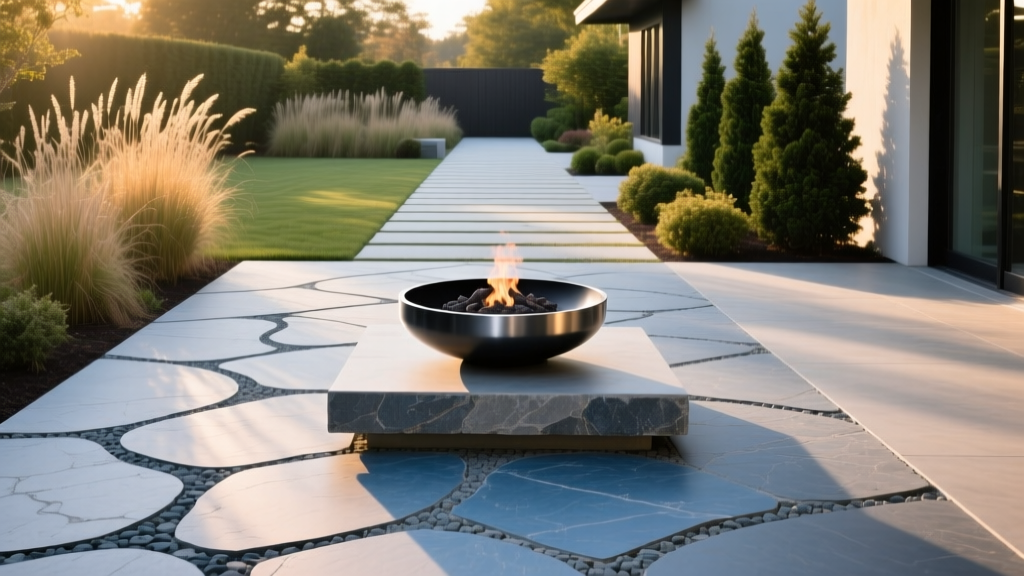
Cost Breakdown: 2026 Market Rates for Patio Surfacing
When budgeting for a 400-square-foot patio, the material cost is only half the equation. Site preparation, excavation, and base materials heavily influence the final price.
400 Sq. Ft. Patio Project Estimates (2026)
- Broom Finish Concrete: $2,400 - $3,600 (Includes 4-inch slab, gravel base, basic forming)
- Exposed Aggregate: $4,000 - $5,600 (Adds retarder chemicals, specialized washing labor, clear seal)
- Stamped Concrete: $5,600 - $7,200 (Adds color hardeners, release agents, stamping crew, acrylic seal)
- Concrete Pavers: $6,400 - $10,000 (Requires deeper excavation, 6-8 inches of crushed stone base, geotextile fabric, polymeric sand)
- Natural Bluestone (Dry-laid): $11,200 - $18,000 (High material cost, skilled masonry labor, stone dust base)
Final Verdict: Matching the Finish to Your Climate and Budget
The optimal choice among the types of concrete finishes for patios depends entirely on your environmental constraints and maintenance tolerance. If you reside in a freeze-thaw climate (USDA Zones 3-6), ensure your contractor utilizes an air-entrained concrete mix (5% to 7% air content) to provide microscopic expansion chambers for freezing water, regardless of the finish chosen.
For homeowners seeking the absolute lowest lifecycle cost with minimal maintenance, a broom finish or exposed aggregate patio is unbeatable. For those prioritizing high-end aesthetics without the premium price tag of natural stone, stamped concrete offers the best visual ROI, provided you commit to the mandatory resealing schedule. Finally, if your property features heavy clay soils prone to seasonal shifting or mature trees with aggressive root systems, bypass poured concrete entirely and invest in concrete pavers to ensure your patio remains level and repairable for decades.
Written by
Marcus ChenMarcus Chen is a licensed structural engineer (PE) and building materials analyst with over 12 years of experience across residential, commercial, and industrial construction. He holds a Master of Science in Civil Engineering from UC Berkeley and spent six years at Thornton Tomasetti before transitioning to independent consulting and technical writing. Marcus specializes in material selection for seismic-prone regions, concrete reinforcement strategies, and lifecycle cost analysis. His work has been cited by the American Concrete Institute (ACI) and the Structural Engineers Association of California (SEAOC). When he is not on a job site or at his desk, you will find him hiking the Sierra Nevada or restoring a 1920s craftsman bungalow in Oakland, CA.
More from Marcus Chen
View all
Construction Cost
How Much Did the Eiffel Tower Cost to Build?
How much did the Eiffel Tower cost to build in 1889? We adjust for inflation and compare its budget to modern skyscraper construction.
Aug 4, 2026

Fire Resistance
What Is a Fire Resistant Material? Testing & Certification Guide
Discover what is a fire resistant material through ASTM and UL testing. Learn how fire ratings, certifications, and assemblies work in construction.
Aug 4, 2026

Construction Cost
How Much Did the Burj Khalifa Cost to Build?
How much did the Burj Khalifa cost to build? We break down the $1.5B project and extract 5 money-saving strategies for your next build.
Jul 30, 2026