Choosing Concrete for Bird Baths: Mix Specs and Durability Ratings
Discover the exact mix specifications, compressive strength, and freeze-thaw ratings needed when selecting concrete for bird baths to ensure longevity.
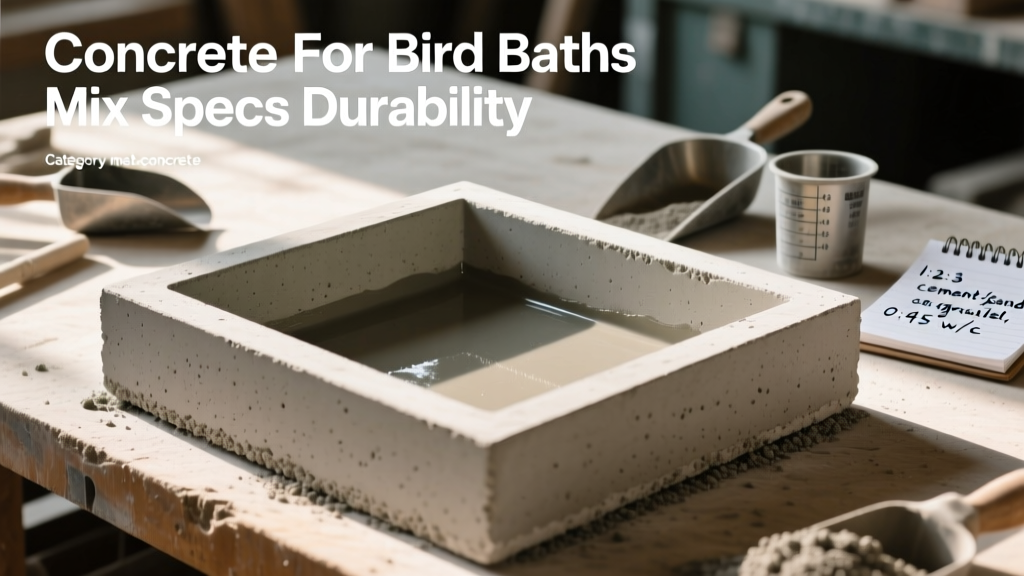
Core Performance Specifications for Bird Bath Concrete
Standard hardware-store bagged concrete mixes frequently fail when used for shallow, water-holding vessels exposed to extreme weather. A bird bath basin represents a unique structural challenge: it features thin cross-sections, constant water immersion, and high tensile stress at the pedestal junction. To achieve a lifespan exceeding 15 years without spalling or cracking, the concrete mix must adhere to strict performance ratings and material specifications.
Compressive and Tensile Strength Targets
For cast-in-place or precast bird baths, the concrete must achieve a minimum compressive strength of 4,000 psi (pounds per square inch) at 28 days. While compressive strength is easily achieved with standard Portland cement, the critical failure point in bird baths is tensile stress. The basin bowl acts as a cantilevered shell; when filled with 2 gallons of water (approximately 16.6 lbs) and subjected to wind loads or accidental impacts, the bottom center and the pedestal neck experience severe tension.
To mitigate this, the mix design must incorporate micro-reinforcement. Polypropylene fibers (dosed at 1.5 lbs per cubic yard) or alkali-resistant (AR) glass fibers are required to control plastic shrinkage cracking and increase the modulus of rupture (flexural strength) by up to 40%. Standard wire mesh is too rigid and prone to rusting if exposed during the troweling of the smooth basin interior.
Water-Cement Ratio and Permeability
Permeability is the primary enemy of outdoor concrete vessels. A high water-cement (w/c) ratio leaves a network of capillary pores that draw water into the matrix via capillary action. For bird bath applications, the w/c ratio must be strictly maintained between 0.40 and 0.45. This low ratio produces a dense, nearly impermeable paste but results in a stiff mix that is difficult to trowel into a smooth, birdbath-friendly bowl shape.
To maintain workability without adding water, a polycarboxylate-based high-range water reducer (HRWR) or superplasticizer must be used. This allows the mix to flow into intricate molds while maintaining the low w/c ratio necessary to prevent water ingress and subsequent freeze-thaw damage.
Freeze-Thaw Durability & ASTM C666 Ratings
In climates where temperatures drop below freezing, water trapped in the concrete matrix expands by 9% upon crystallization. According to the Portland Cement Association, this expansion generates internal hydraulic pressures that exceed the tensile strength of the concrete, causing the surface to scale and spall. Because a bird bath basin is designed to hold water, the concrete is perpetually saturated, making it highly vulnerable to this mechanism.
To survive northern winters, the concrete must be air-entrained. Air-entraining admixtures (AEAs) create a microscopic network of non-connecting, spherical voids (10 to 500 micrometers in diameter) that act as pressure relief valves for expanding ice. The target air content for a bird bath exposed to constant moisture and freezing is 5% to 7%.
Climate Zone Specification Matrix
| Climate Zone | Winter Severity | Target Air Content | Required ASTM C666 Durability Factor |
|---|---|---|---|
| Zone 1-3 (Northern US / Canada) | Severe (Continuous Freezing) | 6.0% - 7.0% | > 85 |
| Zone 4-5 (Midwest / Transition) | Moderate (Cyclic Freezing) | 5.0% - 6.0% | > 75 |
| Zone 6-8 (Southern US) | Mild (Rare Freezing) | 3.0% - 4.0% | > 60 |
Toxicity, Alkalinity, and Avian Health Standards
Concrete is inherently highly alkaline, with a fresh pH ranging from 12.5 to 13.5 due to the presence of calcium hydroxide (portlandite) produced during cement hydration. Birds are highly sensitive to water quality, and prolonged exposure to highly alkaline water or heavy metals (such as hexavalent chromium found in trace amounts in Portland cement) can cause severe health issues, including crop damage and feather degradation.
According to guidelines on avian hydration safety from the Cornell Lab of Ornithology, water sources must be free of chemical leachates. Therefore, a newly cast concrete bird bath cannot be used immediately. It requires a strict neutralization and sealing protocol to stabilize the pH and lock in any soluble compounds.
The pH Neutralization and Sealing Protocol
- Initial Cure (28 Days): Allow the concrete to cure fully. Keep the basin covered with damp burlap to ensure continuous hydration, which consumes free lime and reduces surface alkalinity.
- Acid Leaching (Days 29-35): Fill the basin with a solution of 1 part white vinegar to 10 parts water. Let it sit for 48 hours. The mild acetic acid will react with the surface calcium hydroxide, neutralizing the extreme pH. Scrub the basin and rinse thoroughly.
- Potable-Safe Sealing: Apply a penetrating silane/siloxane sealer. Crucially, the sealer must be certified to NSF/ANSI 61 standards for drinking water system components once fully cured. Avoid film-forming sealers like acrylics or epoxies, which will blister and peel under UV exposure and standing water, creating toxic microplastic flakes that birds may ingest.
GFRC: The Premium Specification for Commercial Bird Baths
For high-end landscaping, commercial installations, or intricate sculptural bird baths, Glass Fiber Reinforced Concrete (GFRC) is the superior material specification. Unlike traditional concrete, which relies on bulk mass for strength, GFRC utilizes a high-cement-content matrix reinforced with alkali-resistant (AR) glass fibers.
GFRC Mix Proportions and Performance
- Binder: 100% Portland Type I/II Cement (no large aggregates).
- Aggregate: 100% fine silica sand (passing #30 sieve) for a glass-smooth basin finish.
- Reinforcement: 4% to 5% AR glass fibers by weight. Standard fiberglass will degrade rapidly in the alkaline environment of cement; AR glass contains zirconium dioxide to resist this attack.
- Polymer: 5% acrylic polymer emulsion to reduce water absorption and eliminate the need for wet curing.
The primary advantage of GFRC for bird baths is weight reduction and structural integrity. A traditional cast concrete bird bath basin might weigh 60 to 80 lbs, requiring a massive pedestal and making shipping difficult. A GFRC basin, cast at a mere 3/4-inch thickness, achieves compressive strengths exceeding 6,000 psi while weighing less than 15 lbs. This allows for complex, thin-lipped, organic shapes that mimic natural stone or large leaves without the risk of edge-chipping.
Aggregate Sizing and Surface Troweling Specifications
The interior of a bird bath must be smooth enough to prevent algae from anchoring deeply into the pores, yet textured enough to provide grip for small songbirds like chickadees and finches. Standard concrete mixes utilize 3/4-inch or 1-inch coarse aggregate (gravel). When troweling a shallow bowl, these large stones will snag on the trowel, tearing the surface and creating a rough, unappealing finish.
The maximum aggregate size for a bird bath mix must be limited to 3/8-inch (pea gravel) or eliminated entirely in favor of manufactured sand. A mix utilizing 100% fine aggregate (concrete sand) allows for a burnished, dense surface finish achieved with a steel trowel. After the initial bleed water evaporates, a steel trowel pass compresses the surface paste, closing micro-cracks and reducing the surface permeability to near-zero. For added avian grip, a light sponge-float finish or a broadcast application of fine quartz sand on the shallow sloping edges provides the ideal footing for bathing birds without compromising the structural integrity of the basin.