Bag of Concrete Lifespan: Durability Analysis for DIY Builds
Discover the true lifespan of a bag of concrete. Learn how mixing ratios, curing, and environmental factors impact durability in DIY projects.
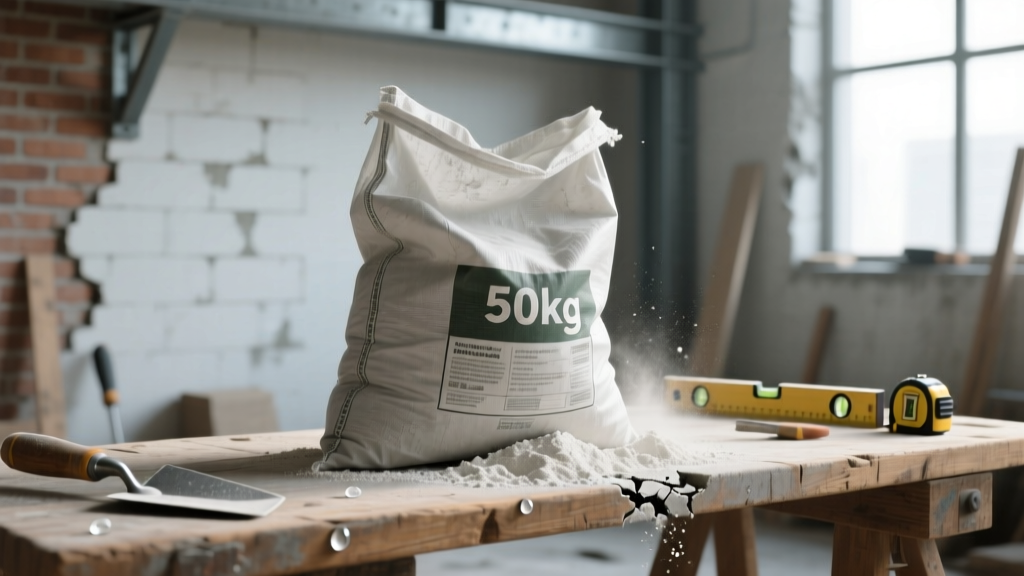
The Chemistry of Pre-Packaged Concrete
A standard 80-pound bag of concrete is a precisely engineered blend of Portland cement, fine sand, and coarse aggregate, manufactured to meet American Concrete Institute (ACI) standards and ASTM C387 specifications. When hydrated correctly, the chemical matrix of bagged concrete is virtually identical to that of ready-mix concrete delivered by a truck. However, the lifespan of a bag of concrete in real-world applications is rarely dictated by the material's inherent chemistry; it is almost entirely dependent on the mixing, placement, and curing execution by the end-user.
Expected Lifespan by Application Type
The durability of bagged concrete varies drastically based on structural load, environmental exposure, and subgrade preparation. Based on 2026 material performance data for high-strength mixes (4,000 to 5,000 PSI), the projected lifespans are as follows:
| Application | Expected Lifespan | Primary Failure Mode |
|---|---|---|
| Fence Posts (Below Grade) | 20 - 35 Years | Frost heave, water pooling at the concrete collar leading to wood rot or steel corrosion. |
| Walkways & Small Slabs | 30 - 50 Years | Surface scaling from de-icing salts, shrinkage cracking from poor jointing. |
| Deck Footings & Piers | 50+ Years | Rebar oxidation if concrete cover is less than 3 inches; subgrade settlement. |
| Non-Structural Pads (AC Units) | 15 - 25 Years | Spalling and corner chipping due to lack of subgrade compaction. |
The Air-Entrainment Deficit: A Critical Durability Flaw
The most significant durability oversight when using a bag of concrete in exterior environments is the lack of air entrainment. According to guidelines published by the National Ready Mixed Concrete Association (NRMCA), concrete exposed to freeze-thaw cycles must contain 4% to 8% microscopic air bubbles. These bubbles act as expansion chambers for freezing water, preventing internal hydraulic pressure from shattering the cement matrix.
Standard bagged concrete mixes do not contain air-entraining admixtures. If you pour a standard bag of concrete for an exterior walkway in a climate that experiences freezing temperatures, the surface will likely spall and scale within 3 to 5 winters. To achieve a 40-year lifespan in freeze-thaw regions, you must either purchase a specifically labeled 'Air-Entrained' bagged mix or manually dose the mixing water with a liquid air-entraining admixture at a rate of 1 to 2 fluid ounces per 80-pound bag.
Critical Failure Modes in DIY Mixing
1. Water-to-Cement Ratio Inflation
The most common catalyst for premature concrete failure is the addition of excess water to improve workability. A standard 80-pound bag of high-strength concrete requires exactly 3 to 3.5 quarts of water to achieve a water-to-cement (w/c) ratio of 0.45, yielding 5,000 PSI compressive strength. Adding just one extra quart of water pushes the w/c ratio past 0.60. This seemingly minor adjustment drops the compressive strength by nearly 40% and exponentially increases the capillary pore network, allowing water, chlorides, and sulfates to penetrate the slab and degrade it from within.
2. Inadequate Consolidation and Honeycombing
Because bagged concrete is often mixed in small batches and placed in narrow forms (like post holes), DIY builders rarely consolidate the mix. Without rodding or vibration, trapped air pockets form against the formwork, creating 'honeycombing.' These voids expose the internal aggregate to moisture and reduce the effective load-bearing cross-section of the concrete, accelerating structural failure.
Step-by-Step Protocol for Maximum Durability
To ensure a bag of concrete reaches its maximum engineered lifespan, follow this strict placement protocol:
- Dry Agitation: Before opening, roll the bag of concrete on the ground for 60 seconds. Aggregate and cement separate during pallet transport; pre-mixing dry prevents weak spots.
- Precision Hydration: Pour 75% of the required water (approx. 2.5 quarts) into the mixer first, add the dry mix, and blend for 1 minute. Gradually add the remaining water until the mix resembles thick oatmeal. Never exceed 3.5 quarts per 80lb bag.
- Mechanical Mixing Time: Mix in a mechanical drum mixer for a minimum of 3 minutes after all ingredients are wet. Hand-mixing in a wheelbarrow is insufficient for achieving a uniform cement paste coating on all aggregate particles.
- Subgrade Preparation: Ensure the subgrade is compacted to 95% Proctor density. Pouring directly onto uncompacted topsoil guarantees differential settlement and subsequent tensile cracking.
- Consolidation: Use a piece of 1/2-inch rebar to repeatedly stab the wet concrete every 4 inches, especially near the edges of the form, to release trapped air.
Curing: The Hydration Imperative
Concrete does not 'dry'; it cures through an exothermic chemical reaction called hydration. If moisture evaporates from the surface faster than the bleed water rises, the hydration process halts, resulting in a weak, dusty surface prone to rapid abrasion and weathering.
"Properly cured concrete has an impermeable surface and can last over a century. Uncured concrete may lose up to 50% of its potential surface strength and will degrade rapidly under environmental stress." — U.S. Bureau of Reclamation Concrete Manual
For bagged concrete, continuous wet curing is mandatory. Cover the slab with 6-mil polyethylene sheeting or continuously mist it with a soaker hose for a minimum of 7 days. In 2026, liquid membrane-forming curing compounds are also highly effective for DIYers; apply a heavy coat immediately after the final trowel finish to seal in the mixing water.
Frequently Asked Questions
- Does an 80lb bag of concrete expire?
Yes. Portland cement is highly hygroscopic. If stored in a humid environment, a bag of concrete will absorb ambient moisture and pre-hydrate. If the bag feels hard or contains solid lumps that cannot be crushed between your fingers, the cement has degraded and will not achieve its rated PSI. Always use bags within 90 days of purchase. - Can I add rebar to a bag of concrete mix?
Yes, but concrete cover is critical. When placing rebar in a small footing mixed from bags, ensure there is a minimum of 3 inches of concrete between the steel and the surrounding soil. If rebar touches the dirt, moisture will wick up the steel, causing it to rust, expand, and spall the concrete from the inside out. - Is high-strength bagged concrete worth the extra cost?
Standard bagged concrete yields roughly 3,000 PSI, while high-strength variants (like Quikrete 5000) yield 5,000 PSI and cost approximately $1.50 to $2.00 more per bag. For structural footings, retaining wall deadmen, or driveways, the high-strength mix is mandatory for long-term durability. For non-structural fence posts, standard 3,000 PSI mix is sufficient.