What Type of Paint to Use on Concrete Statues: Top Coatings Compared
Discover what type of paint to use on concrete statues. We compare acrylics, epoxies, stains, and mineral silicates for outdoor and indoor durability.

The Chemistry of Concrete: Why Standard Paints Fail
Choosing the correct coating for a concrete statue is not a matter of aesthetics; it is a chemical engineering challenge. Freshly cast concrete possesses a highly alkaline environment, typically registering a pH between 12.5 and 13.5 due to the presence of calcium hydroxide (portlandite). When standard oil-based or alkyd paints are applied to this surface, the alkali attacks the ester bonds in the paint's binder. This chemical reaction, known as saponification, literally turns the paint into a water-soluble soap, resulting in immediate peeling and adhesive failure.
Furthermore, concrete is inherently porous. Outdoor statues constantly wick ground moisture and absorb rain. If a coating lacks a sufficient Moisture Vapor Transmission Rate (MVTR), trapped hydrostatic pressure will build up behind the paint film. During freeze-thaw cycles, this trapped water expands, causing the concrete surface to spall and the coating to delaminate in large sheets. According to the National Park Service guidelines on historic concrete preservation, breathability and alkali resistance are the two non-negotiable metrics for any surface treatment.
Head-to-Head Coating Comparison Matrix
Below is a technical comparison of the primary coating alternatives used for concrete statuary, evaluated on critical performance metrics.
| Coating Type | Breathability (MVTR) | Alkali Resistance | UV Stability | Best Application |
|---|---|---|---|---|
| 100% Acrylic Latex | High | High (with primer) | Excellent | Outdoor painted finishes |
| Mineral Silicate | Maximum | Maximum (chemically bonds) | Excellent | Historic/Antique outdoor looks |
| Acid Stain | Maximum | N/A (penetrates) | Good | Earthy, variegated tones |
| Two-Part Epoxy | None | Excellent | Poor (Yellows/Chalks) | Indoor statues only |
| Elastomeric Masonry | Low | High | Good | Bridging hairline cracks |
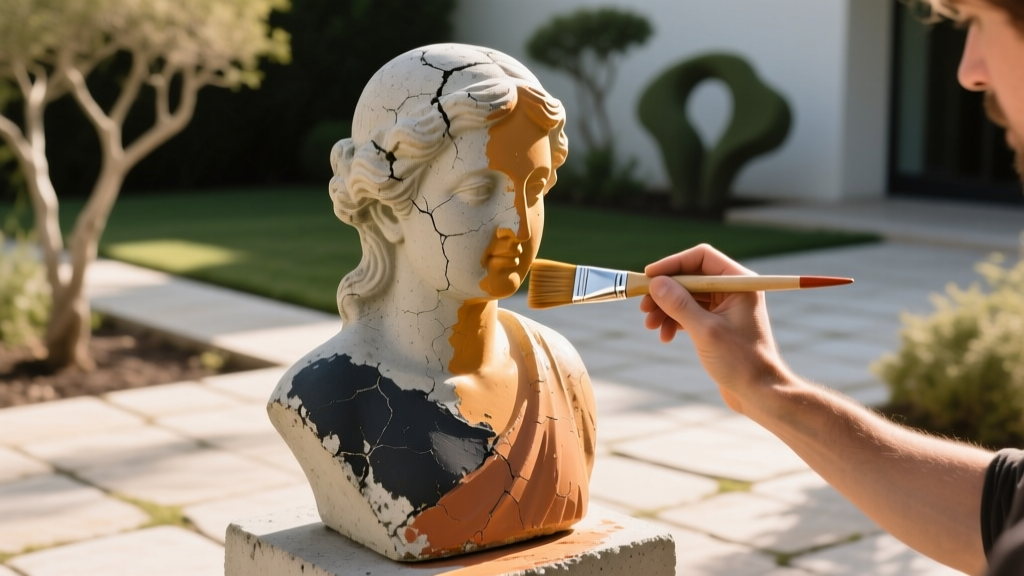
Deep Dive: Evaluating the Alternatives
1. 100% Acrylic Latex (The Outdoor Standard)
Modern 2026 formulations of exterior 100% acrylic latex paints (such as Sherwin-Williams A-100 or Benjamin Moore MoorGard) remain the most practical choice for statues requiring solid, opaque colors. Acrylic polymers are inherently alkaline-resistant and remain flexible across temperature fluctuations, allowing them to expand and contract with the concrete substrate without micro-cracking.
The Catch: Acrylics sit on the surface. They require an alkali-resistant primer, such as Sherwin-Williams Loxon or Zinsser Bulls Eye 1-2-3, to prevent the underlying concrete pH from degrading the topcoat over time. If the statue is placed directly on soil, moisture wicking from the base can still cause basal peeling if the bottom is not sealed with a penetrating silane/siloxane water repellent.
2. Mineral Silicate Paints (The Petrifying Alternative)
For high-end garden statuary or historical replicas, mineral silicate paints (e.g., Romabio or KEIM) offer unmatched longevity. Unlike acrylics that form a mechanical film, silicate paints utilize a potassium silicate binder that undergoes a process called petrification. The silicate chemically reacts with the calcium hydroxide in the concrete to form calcium silicate hydrate, effectively becoming part of the stone itself.
Advantage: They are completely UV-proof, will never peel or blister, and maintain 100% breathability. Water vapor escapes freely, eliminating freeze-thaw spalling risks. The Portland Cement Association frequently notes that silicate treatments preserve the natural micro-texture of concrete better than any film-forming polymer.
3. Acid Stains vs. Water-Based Dyes
If the goal is a translucent, natural stone appearance rather than a painted finish, stains are the alternative. Acid stains (containing metallic salts like iron chloride or copper sulfate) react chemically with the lime in the concrete to produce permanent, variegated earth tones. However, acid stains are highly unpredictable on older or weathered statues, as environmental leaching depletes the surface calcium hydroxide required for the reaction, resulting in patchy, washed-out colors.
Water-based penetrating dyes bypass the chemical reaction entirely, relying on nano-particles to lodge in the concrete pores. They offer a broader, more vibrant color palette and consistent coverage on weathered statues, though they require a high-quality UV-stable penetrating sealer to prevent fading over time.
4. The Epoxy Trap (Why to Avoid It Outdoors)
Two-part epoxy coatings are frequently misused by DIYers due to their reputation for extreme hardness and chemical resistance. While epoxies are impervious to alkali attack, they possess an MVTR of near zero. When applied to an outdoor concrete statue, any moisture entering through microscopic base cracks becomes trapped. Furthermore, standard epoxies lack UV stabilizers and will rapidly chalk and yellow when exposed to direct sunlight. Reserve epoxies strictly for indoor, climate-controlled concrete sculptures.
Step-by-Step Surface Preparation Protocol
The failure rate of concrete coatings is 90% attributable to improper surface preparation. Follow this exact protocol before applying any of the alternatives listed above:
- Curing Verification: Ensure new concrete statues have cured for a minimum of 28 days. Applying paint to 'green' concrete traps escaping moisture and guarantees blistering.
- Alkali Neutralization & Etching: Wash the statue with a solution of 1 part phosphoric acid to 10 parts water. This neutralizes surface efflorescence, lowers the surface pH, and opens the pores. Rinse thoroughly with a pressure washer (minimum 2000 PSI) and allow to dry for 48 hours.
- Priming (For Acrylics Only): Apply one coat of an alkali-resistant masonry primer. Do not thin the primer; it must build a dry-film thickness capable of blocking alkaline salts.
- Base Sealing: If the statue rests on bare earth or a wooden deck, flip it and apply a penetrating siloxane sealer to the unprimed bottom base to halt capillary moisture wicking.
Cost and Coverage Breakdown (2026 Estimates)
Budgeting for concrete statue restoration requires factoring in both material costs and the specialized prep work involved. The table below outlines average material costs for a standard medium-sized garden statue (approx. 30 sq. ft. of surface area).
| Material Category | Product Example | Cost per Gallon | Est. Total Material Cost (30 sq ft) |
|---|---|---|---|
| Alkali-Resistant Primer | Loxon Concrete & Masonry Primer | $65 - $80 | $25 (Quart required) |
| 100% Acrylic Topcoat | Benjamin Moore MoorGard Exterior | $75 - $95 | $30 (Quart required) |
| Mineral Silicate Paint | Romabio Classico Limewash / Silicate | $110 - $140 | $45 (Quart required) |
| Water-Based Stain + Sealer | Increte Systems Stain-Crete + Sealer | $90 - $120 | $60 (Combined Quart costs) |
Final Verdict: Matching the Coating to the Environment
There is no single 'best' paint; the correct choice depends entirely on the statue's environment and the desired aesthetic. For vibrant, opaque colors on outdoor statues subject to harsh weather, a 100% acrylic latex system over an alkali-resistant primer provides the best balance of flexibility, UV resistance, and cost. For premium, historic, or natural-stone aesthetics where zero peeling is acceptable, mineral silicate paints are the superior, albeit more expensive, alternative. Avoid epoxies outdoors, and reserve acid stains for newly cast, unweathered concrete where the chemical reaction can be reliably controlled.
Written by
David NakamuraDavid Nakamura is a licensed architect (AIA) and construction technology writer focused on sustainable building methods, mass timber engineering, and high-performance building envelopes. He holds a Master of Architecture from the University of Washington and is a certified Passive House Consultant (CPHC). David spent eight years at the Seattle firm Mithun, where he led the design of three LEED Platinum projects, before founding his own practice specializing in net-zero residential design. He serves on the editorial advisory board of GreenBuilder Magazine and has authored peer-reviewed papers on cross-laminated timber (CLT) connections for the Journal of Structural Engineering. In his spare time, David teaches woodworking at Pratt Fine Arts Center and kayaks the Puget Sound.
More from David Nakamura
View all
Construction Cost
Labor Cost to Build a Deck Per Sq Ft: 2026 Installation Guide
Discover the exact labor cost to build a deck per sq ft in 2026. This installation guide breaks down contractor rates, complexity factors, and hidden fees.
Aug 4, 2026

Construction Cost
How Much Does It Cost to Build a 3 Bedroom House? Financing Guide
Learn exactly how much it costs to build a 3 bedroom house and explore 2026 financing options, construction loan types, and budget frameworks for your build.
Aug 4, 2026

Construction Cost
Cost to Build a Tennis Court: 2026 Guide
How much does it cost to build a tennis court in 2026? Breakdowns for asphalt, concrete, and synthetic surfaces plus fencing and lighting.
Jul 30, 2026