Best Basement Flooring Options Over Concrete Waterproof Slabs
Discover the best basement flooring options over concrete waterproof slabs. Expert guide on mix design, moisture testing, and top material choices.

The Foundation: Designing a Waterproof Concrete Slab Mix
Most guides on basement flooring begin at the surface level, ignoring the critical substrate beneath. Selecting the right basement flooring options over concrete waterproof subfloors requires starting at the batching plant. A below-grade slab is constantly subjected to hydrostatic pressure and capillary moisture migration. If the concrete mix design is flawed, no surface flooring will survive long-term.
To create a truly waterproof slab, the mix must achieve a maximum water-to-cement (w/c) ratio of 0.40 to 0.45. Lowering the w/c ratio reduces the capillary pore network, but it also decreases workability. To compensate, polycarboxylate ether (PCE) superplasticizers are required. Furthermore, incorporating Supplementary Cementitious Materials (SCMs) like slag cement (replacing 30% to 50% of Portland cement) densifies the matrix and significantly lowers permeability.
According to guidelines established by the American Concrete Institute (ACI), proper curing is just as vital as the mix itself. A waterproof crystalline slab requires continuous moist curing for a minimum of 7 days to allow the crystalline network to fully propagate. Failure to cure the slab results in surface crazing, which compromises both the waterproofing and the mechanical bond for subsequent flooring adhesives.
Moisture Testing: The ASTM F2170 Mandate
Before installing any basement flooring options over concrete waterproof surfaces, quantitative moisture testing is non-negotiable. The outdated Calcium Chloride test (ASTM F1869) only measures moisture vapor emission at the top 1/2 inch of the slab and is no longer recognized by most flooring manufacturers for below-grade installations.
The industry standard is the in-situ Relative Humidity (RH) test per ASTM International's F2170 standard. This involves drilling holes into the slab and inserting calibrated digital probes. For a slab drying from one side (standard basement floor on grade), probes must be placed at 20% of the slab's total depth. For a suspended slab drying from two sides, probes go at 40% depth. After a 24-hour equilibration period, the readings dictate the flooring choice:
- Below 75% RH: Safe for most standard LVP, ceramic tile, and sheet vinyl installations.
- Below 65% RH: Required for direct-glue engineered hardwood and moisture-sensitive resilient adhesives.
- Above 80% RH: Indicates a failure in the slab's waterproofing design or an active hydrostatic leak. Do not proceed with flooring.
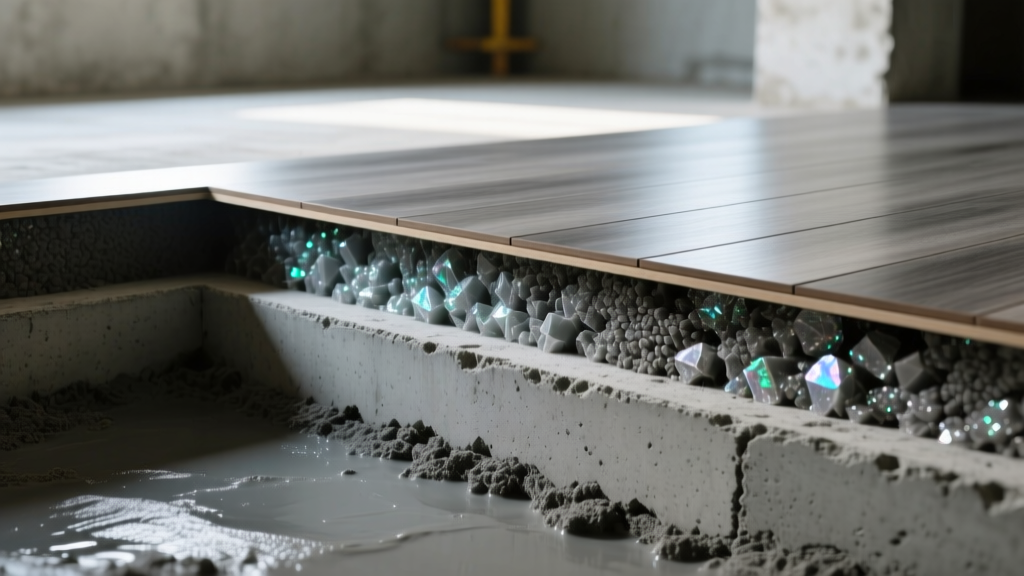
Top Basement Flooring Options Over Concrete Waterproof Subfloors
Once the slab mix is verified and RH levels are within tolerance, you can select the finish material. Below is a comparison matrix of the top performing materials for below-grade environments.
| Material Type | Cost per Sq. Ft. (Installed) | Moisture Tolerance | Installation Method |
|---|---|---|---|
| SPC Luxury Vinyl Plank | $5.50 - $9.00 | 100% Waterproof Core | Floating (Click-Lock) |
| Porcelain Tile | $11.00 - $18.00 | Impervious (<0.5% Absorption) | 100% Solids Epoxy Mortar |
| Engineered Hardwood | $10.00 - $16.00 | Moderate (Requires Vapor Retarder) | Full-Spread Urethane Adhesive |
1. Stone Plastic Composite (SPC) Luxury Vinyl
For basements, SPC (Stone Plastic Composite) rigid core vinyl vastly outperforms WPC (Wood Plastic Composite). The limestone-PVC core of SPC is dimensionally stable and will not expand or contract with the temperature fluctuations common in below-grade spaces. Look for products with a minimum 20-mil commercial-grade wear layer and an attached IXPE (irradiated cross-linked polyethylene) underlayment pad, which provides a thermal break against the cold concrete and resists mold growth. Because it floats, it accommodates minor slab irregularities without requiring extensive self-leveling compounds.
2. Porcelain Tile with 100% Solids Epoxy Mortar
Porcelain tile is fired at extreme temperatures, yielding a water absorption rate of less than 0.5% per ASTM C373, making the tile itself completely impervious. However, the vulnerability lies in the setting material. Standard cementitious thinset is porous and can transmit residual alkalinity and moisture from the concrete slab to the surface, causing efflorescence or degrading the grout. To prevent this, install porcelain over a waterproof basement slab using a 100% solids epoxy mortar (such as Laticrete Spectralock). Epoxy is chemically inert, completely waterproof, and bonds aggressively to dense, crystalline-treated concrete surfaces.
3. Engineered Hardwood with Moisture-Cure Urethane
While solid hardwood is strictly prohibited below grade, engineered hardwood can succeed if the National Wood Flooring Association (NWFA) protocols are followed. The planks must be glued directly to the concrete using a moisture-cure urethane adhesive (like Bona 850 or similar silane-modified polymers). These adhesives act as both a bond and a Class I vapor retarder. The engineered construction (a plywood or HDF core with a real wood veneer) provides cross-grain stability that resists the cupping and crowning that destroys solid wood in humid basement environments.
Critical Failure Modes and Edge Cases
Even with a perfect mix design and premium materials, specific edge cases can cause catastrophic flooring failures in basements:
- Alkali-Silica Reaction (ASR) Interference: If the concrete aggregate contains reactive silica, high-pH moisture migrating through the slab can trigger ASR. The resulting gel expansion causes micro-spalling at the surface, destroying the mechanical profile required for flooring adhesives. Always specify low-alkali cement (ASTM C150 Type II) for basement slabs receiving direct-glue flooring.
- Self-Leveling Compound Delamination: When flattening a slab for LVP or tile, contractors often use gypsum-based self-leveling underlayments (SLU). Gypsum is highly susceptible to moisture degradation. In below-grade applications, you must exclusively use Portland cement-based SLUs, primed with the manufacturer's exact acrylic primer specification to prevent the dry concrete from flash-absorbing the SLU's water.
Cost Breakdown: Admixtures vs. Flooring Materials
Investing in the concrete mix design yields massive dividends by preventing flooring replacement. Here is how the upfront costs compare to long-term remediation:
Upfront Premium for Waterproof Mix Design
Crystalline Admixture (e.g., Xypex/Kryton): Adds approximately $0.85 to $1.20 per square foot to the raw concrete cost (based on a standard 4-inch thick slab).
ASTM F2170 RH Testing: Roughly $150 - $250 per test location (minimum 3 required for standard basements).
Return on Investment: Prevents the $8 to $18 per square foot cost of tearing out and replacing moisture-destroyed engineered wood or mold-infested carpet pads.
Choosing the right basement flooring options over concrete waterproof substrates is a holistic process. By controlling the w/c ratio, utilizing crystalline admixtures, enforcing strict ASTM F2170 testing, and pairing the slab with dimensionally stable finish materials like SPC vinyl or epoxy-set porcelain, you ensure a below-grade space that remains dry, durable, and structurally sound for decades.
Written by
Priya KapoorPriya Kapoor is a real estate market analyst and construction economics researcher with expertise in housing affordability, development feasibility, and infrastructure investment. She holds a Master of Regional Planning from Cornell University and previously worked as a senior analyst at CBRE's Investment Properties group, where she modeled returns for $4B in mixed-use development pipelines. Priya now runs an independent research practice advising developers, municipalities, and REITs on construction cost forecasting and market timing. She publishes the quarterly "BuildMat Market Pulse" report tracking material price indices across 12 commodity categories. Based in Austin, TX, Priya serves on the board of Habitat for Humanity Austin and is a marathon runner.
More from Priya Kapoor
View all
Construction Cost
Cost to Build a 1600 Sq Ft Home in 2026: Full Breakdown
Accurate 2026 cost to build a 1600 sq ft home—material, labor, and regional pricing breakdowns included. Plan your budget with real-time estimates.
Aug 11, 2026

Wood & Lumber
Name the Types of Wood for Pressure Treatment and Preservation
Learn how to name the types of wood best suited for pressure treatment. Compare species treatability, chemical retention levels, and 2026 preservation costs.
Aug 4, 2026

Stone & Masonry
Stone Veneer Suppliers Lindenhurst: 2026 Cost Analysis
Analyze 2026 stone veneer costs in Lindenhurst, NY. Compare local supplier pricing, delivery fees, and Suffolk County installation labor rates.
Aug 4, 2026