Cost Breakdown for Every Type of Concrete Finish (2026)
Compare the 2026 cost of every type of concrete finish. Get exact pricing, labor breakdowns, and 10-year ROI data for broom, stamped, and polished slabs.
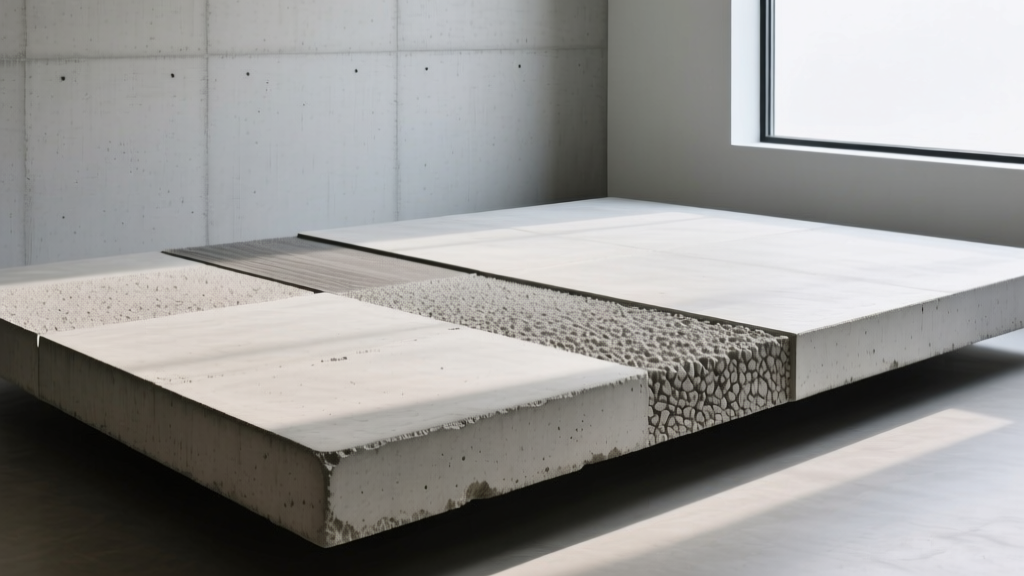
The True Cost of Concrete Finishes: Beyond the Square Foot Price
When budgeting for a new slab, contractors often quote a base price for a standard 4-inch pour. However, selecting the right type of concrete finish is where project budgets either remain stable or spiral out of control. The finish dictates not only the aesthetic appeal but also the required mix design, secondary labor, specialized tooling, and long-term maintenance cycles. In 2026, material inflation has stabilized, but skilled finishing labor remains at a premium, making the labor-to-material ratio the most critical factor in your cost breakdown.
2026 Quick Cost Snapshot
- Most Economical: Broom Finish ($4.50 - $6.50 / sq. ft.)
- Best Architectural Value: Exposed Aggregate ($9.00 - $13.00 / sq. ft.)
- Highest ROI for Interiors: Polished Concrete ($8.00 - $16.00 / sq. ft.)
- Premium Decorative: Stamped Concrete ($14.00 - $22.00+ / sq. ft.)
Comprehensive Cost Matrix by Type of Concrete Finish
The following matrix breaks down the 2026 national average installed costs. These figures assume a standard 4-inch thick slab with a 4000 PSI mix and wire mesh or fiber reinforcement, poured on a properly compacted subgrade.
| Finish Type | Material & Chemicals | Specialized Labor | Total Installed | Expected Lifespan |
|---|---|---|---|---|
| Broom Finish | $0.15 - $0.25 | $4.00 - $5.50 | $4.50 - $6.50 | 25-30 Years |
| Smooth Trowel | $0.15 - $0.25 | $5.00 - $7.00 | $5.50 - $8.00 | 25-30 Years |
| Exposed Aggregate | $0.80 - $1.20 | $8.00 - $11.00 | $9.00 - $13.00 | 20-25 Years |
| Polished (400-800 Grit) | $1.50 - $2.50 | $6.50 - $12.00 | $8.00 - $15.00 | Lifetime (Interior) |
| Acid Stained | $1.00 - $2.00 | $7.00 - $11.00 | $8.50 - $14.00 | 15-20 Years |
| Stamped (Single Pattern) | $2.00 - $3.50 | $12.00 - $18.00 | $14.00 - $22.00 | 20-25 Years |
Tiered Breakdown: Techniques, Materials, and Failure Modes
Tier 1: Basic Utility Finishes (Broom & Smooth Trowel)
The most common type of concrete finish for driveways, sidewalks, and municipal work is the broom finish. According to the Portland Cement Association, a broom finish is achieved by dragging a coarse-bristled push broom across the surface while the concrete is still in its plastic state. Because it requires no secondary chemicals or specialized power tools, the labor cost is minimal.
- Mix Requirement: 4000 PSI air-entrained mix (5-7% air content) for freeze-thaw resistance.
- Failure Mode: Brooming too early pulls excess bleed water and cement paste to the surface, creating a weak, flaky crust that will spall within two winters. Brooming too late results in a shallow, ineffective texture that offers zero slip resistance.
- Smooth Trowel Variant: Achieved using steel trowels. While inexpensive, it is strictly prohibited for exterior pedestrian surfaces due to severe slip hazards when wet. It is reserved for interior warehouses and garages.
Tier 2: Textured & Architectural Finishes (Exposed Aggregate)
Exposed aggregate reveals the natural stone within the mix, providing excellent traction and a highly durable surface. The cost jumps here due to the chemical retarders required.
- The Chemical Cost: Contractors must spray a surface retarder (such as Sika Antisol or W.R. Meadows E-Con) immediately after final finishing. This delays the set of the top 1/4 inch of cement paste.
- The Wash-Off Labor: The next morning, crews use high-pressure washers (minimum 2500 PSI) to strip the retarded paste. This adds 2 to 3 hours of secondary labor per 1,000 square feet.
- Edge Case Warning: If the ambient temperature drops below 50°F overnight, the retarder may fail to work properly, or the wash-off process will cause micro-cracking in the unhydrated cement matrix.
Tier 3: Premium Decorative Finishes (Stamped & Polished)
When clients want the look of natural stone or high-end terrazzo, stamped and polished finishes are the standard. As detailed by industry experts at The Concrete Network, these finishes require highly skilled artisans and expensive consumable materials.
Stamping isn't just about renting the rubber mats. A proper stamped slab requires a color hardener (broadcast and troweled into the surface at $0.40/sq. ft.) to increase surface compressive strength to 8,000 PSI, and an antiquing release agent ($0.25/sq. ft.) to prevent the stamps from sticking. Omitting the color hardener to save money guarantees that the stamped surface will wear away and dust within 3 years.
Polished Concrete Economics: Polishing is priced by the 'grit' level. A 400-grit hone (matte finish) requires fewer passes with planetary grinders (like Lavina or Husqvarna machines) and costs around $8/sq. ft. A 3000-grit mechanical polish (glass-like reflectivity) requires resin-bonded diamond pads and chemical densifiers (like Prosoco Consolideck LS), pushing the cost past $16/sq. ft.
Labor vs. Material: Where Your Budget Actually Goes
Unlike framing or drywall, where materials dominate the invoice, concrete finishing is heavily labor-weighted. For a premium stamped patio, the breakdown typically looks like this:
- Subgrade Prep & Forming (15%): Excavation, 4-inch compacted gravel base, and setting wood or aluminum forms.
- Ready-Mix Concrete & Pumping (25%): The raw 4000 PSI mix delivered by truck, plus a line pump if access is restricted.
- Primary Placement & Screeding (15%): Spreading the concrete and striking it off to grade.
- Specialized Finishing Labor (40%): The actual stamping, polishing, or staining process.
- Sealing & Detailing (5%): Applying the final protective coat.
Hidden Costs and Edge Cases That Blow Up Budgets
Contractors often exclude critical line items from initial estimates. When evaluating the cost of any type of concrete finish, ensure the following are explicitly addressed in the bid:
- Concrete Pumping Fees: If a ready-mix truck cannot back directly up to the pour site, a boom pump ($800 - $1,200 minimum mobilization) or line pump is required. This is rarely included in base square-foot pricing.
- Sawcut Control Joints: All exterior slabs require control joints cut to a depth of 25% of the slab thickness within 12 hours of pouring. Early-entry dry cutting (using Soff-Cut saws) costs an additional $0.35 to $0.60 per linear foot but prevents random, ugly cracking.
- Vapor Barriers for Interiors: If you are polishing an interior slab, a 15-mil polyethylene vapor barrier (like Stego Wrap) must be placed under the concrete to prevent moisture migration, which will destroy the polish and cause adhesive failures if floor coverings are later applied. Add $0.40/sq. ft.
10-Year ROI and Maintenance Cost Analysis
The initial installation cost is only half the financial equation. Decorative finishes require strict maintenance regimens to protect the investment.
| Finish Type | Required Sealer | Reapplication Cycle | 10-Year Maint. Cost |
|---|---|---|---|
| Broom / Trowel | Silane/Siloxane Penetrating | Every 5 Years | $0.30 / sq. ft. |
| Exposed Aggregate | Acrylic Solvent-Based | Every 2-3 Years | $1.20 / sq. ft. |
| Stamped | Polyurethane / Polyaspartic | Every 3-5 Years | $2.50 / sq. ft. |
| Polished (Interior) | None (Burnished only) | Annual Auto-Scrub | $0.50 / sq. ft. |
Insight: While a broom finish is the cheapest to install and maintain, a polished interior floor actually boasts the lowest lifecycle cost because it eliminates the need for topical sealers that peel and flake. The densification process permanently alters the concrete matrix, making it inherently dust-proof and stain-resistant.
Decision Framework: Matching Finish to Project Budget
Use this framework to finalize your specification based on your project constraints:
- Budget Under $6/sq. ft. & Exterior Use: Specify a broom finish. Ensure the contractor uses a coarse synthetic broom and applies a wet-cure method (burlap and water) for 7 days to maximize surface strength.
- Budget $9-$13/sq. ft. & High Traction Needed: Choose exposed aggregate. Specify a mix with a decorative river rock or granite aggregate (3/8 inch size) rather than standard crushed limestone for superior aesthetics.
- Budget $15+/sq. ft. & High-End Curb Appeal: Opt for stamped concrete. Mandate the use of color hardeners rather than integral color to ensure the surface can withstand de-icing salts without degrading.
- Interior Commercial/Retail & Low Maintenance: Select a polished finish at an 800-grit level. This provides a satin sheen that hides minor scratches better than a 3000-grit mirror finish, while remaining highly durable.
Understanding the nuanced cost breakdown for each type of concrete finish prevents budget overruns and ensures the selected surface performs flawlessly for decades. Always demand a line-item bid that separates the base slab preparation from the specialized finishing labor and chemical treatments.
Written by
Marcus ChenMarcus Chen is a licensed structural engineer (PE) and building materials analyst with over 12 years of experience across residential, commercial, and industrial construction. He holds a Master of Science in Civil Engineering from UC Berkeley and spent six years at Thornton Tomasetti before transitioning to independent consulting and technical writing. Marcus specializes in material selection for seismic-prone regions, concrete reinforcement strategies, and lifecycle cost analysis. His work has been cited by the American Concrete Institute (ACI) and the Structural Engineers Association of California (SEAOC). When he is not on a job site or at his desk, you will find him hiking the Sierra Nevada or restoring a 1920s craftsman bungalow in Oakland, CA.
More from Marcus Chen
View all
Construction Cost
How Much Did the Eiffel Tower Cost to Build?
How much did the Eiffel Tower cost to build in 1889? We adjust for inflation and compare its budget to modern skyscraper construction.
Aug 4, 2026

Fire Resistance
What Is a Fire Resistant Material? Testing & Certification Guide
Discover what is a fire resistant material through ASTM and UL testing. Learn how fire ratings, certifications, and assemblies work in construction.
Aug 4, 2026

Construction Cost
How Much Did the Burj Khalifa Cost to Build?
How much did the Burj Khalifa cost to build? We break down the $1.5B project and extract 5 money-saving strategies for your next build.
Jul 30, 2026