Cost of Pavers vs Concrete Driveway: 2026 Mix & Material Guide
Compare the true cost of pavers vs concrete driveway installations in 2026. Expert breakdown of mix designs, material types, and lifecycle value.

The True Cost of Pavers vs Concrete Driveway (2026 Breakdown)
Evaluating the cost of pavers vs concrete driveway installations requires looking past superficial square-footage estimates and examining the material engineering beneath the surface. In 2026, material shortages and updated ASTM standards have shifted the pricing landscape. A standard broom-finished concrete slab and a high-end interlocking paver system represent two fundamentally different structural approaches: rigid pavement versus flexible pavement.
The table below outlines the current installed costs, separating basic residential applications from engineered, heavy-duty specifications required for modern vehicle loads and climate resilience.
| Material System | Material Cost (per sq ft) | Installed Cost (per sq ft) | Core Specification |
|---|---|---|---|
| Standard Poured Concrete | $3.50 - $5.00 | $8.00 - $14.00 | 3000 PSI, Broom Finish |
| Engineered Driveway Concrete | $4.50 - $6.50 | $12.00 - $18.00 | 4000 PSI, 6% Air, Macro-Fibers |
| Extruded Concrete Pavers | $4.00 - $8.00 | $14.00 - $22.00 | ASTM C936, 8000 PSI |
| Clay Brick Pavers | $8.00 - $15.00 | $20.00 - $32.00 | ASTM C902, Kiln-Fired |
| Permeable Pavers (PICP) | $6.00 - $12.00 | $22.00 - $38.00 | Open-Graded Base, ASTM C1781 |
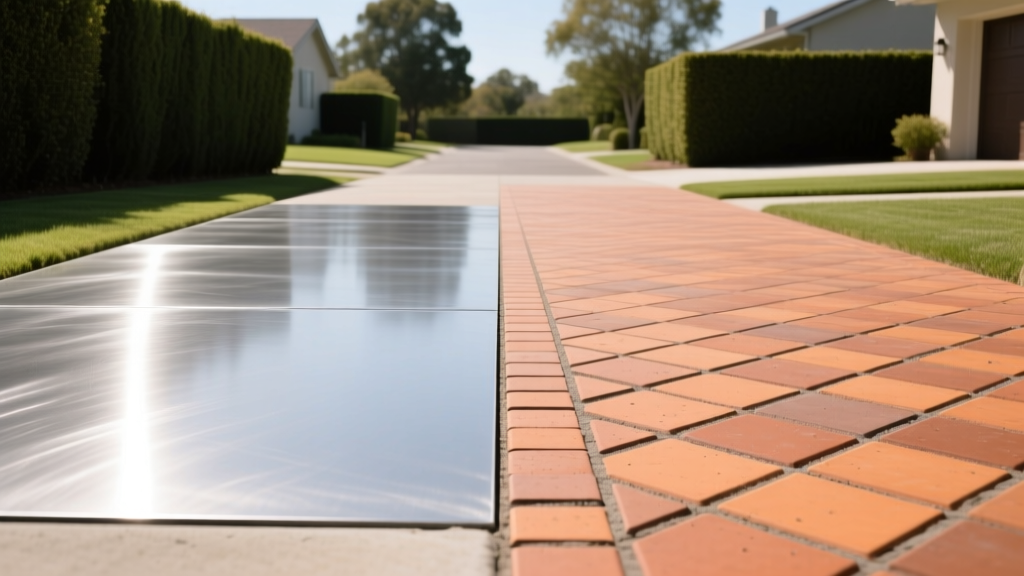
Poured Concrete Driveways: Mix Designs That Dictate Price
The most common mistake homeowners make when budgeting for a concrete driveway is accepting a generic "sidewalk mix." According to the National Ready Mixed Concrete Association (NRMCA), driveways are subjected to severe point loads from vehicle tires, especially during high summer temperatures when asphalt and concrete soften slightly under pressure. To prevent rutting, scaling, and catastrophic cracking, the concrete mix design must be engineered specifically for vehicular traffic.
The 4000 PSI Air-Entrained Standard
A durable driveway requires a minimum compressive strength of 4,000 PSI at 28 days. Achieving this requires a low water-cementitious materials ratio (w/cm) of 0.45 or lower. While this makes the concrete highly dense and strong, it also makes it vulnerable to freeze-thaw damage if not properly modified.
- Air Entrainment: An air-entraining admixture (AEA) per ASTM C260 must be added to create microscopic, disconnected air bubbles. A target air content of 5% to 7% provides the necessary "relief valves" for expanding water during freezing cycles. This adds approximately $5 to $8 per cubic yard to the batch ticket but prevents surface spalling.
- Synthetic Macro-Fibers: Instead of traditional welded wire mesh (which often ends up at the bottom of the slab during the pour, rendering it useless), modern engineered driveways utilize synthetic macro-fibers (e.g., Forta-Ferro or Fibermesh) dosed at 3 to 5 lbs per cubic yard. These fibers provide three-dimensional secondary reinforcement that controls plastic shrinkage cracking and improves impact resistance.
- Aggregate Sizing: A maximum aggregate size of 3/4-inch (ASTM C33) is standard. This ensures a smooth finish while maintaining structural bulk.
Paver Driveways: Material Types and Base Engineering
Unlike rigid concrete slabs, paver driveways rely on flexible pavement engineering. The surface units do not bear the structural load independently; instead, they distribute vehicular loads laterally through joint sand into a compacted aggregate base. The Interlocking Concrete Pavement Institute (ICPI) mandates strict base specifications that heavily influence the final cost of pavers vs concrete driveway projects.
Surface Material Classifications
Not all pavers are created equal. The material chemistry dictates both the aesthetic longevity and the compressive strength of the surface.
- Extruded Concrete Pavers (ASTM C936): Manufactured using zero-slump concrete and high-pressure vibration, these pavers boast a minimum compressive strength of 8,000 PSI—double that of standard poured concrete. They are highly resistant to de-icing salts and offer the best balance of cost and durability.
- Clay Brick Pavers (ASTM C902): Fired in kilns at temperatures exceeding 2,000°F, clay pavers are completely impervious to UV fading and salt scaling. Their natural color runs through the entire unit, meaning surface wear does not reveal a different colored core. However, their manufacturing process makes them 30% to 50% more expensive than concrete pavers.
- Permeable Interlocking Concrete Pavers (PICP): Designed for stormwater management, PICP systems feature wider joints filled with open-graded crushed stone rather than sand. These are heavily regulated by municipal codes in 2026 for new developments to reduce runoff, but they require a deeper, more expensive base excavation.
The Hidden Cost: Base Aggregate Engineering
The true cost differentiator in paver installation is the sub-base. A standard concrete driveway requires a 4-inch compacted gravel subgrade. A paver driveway requires a minimum 4-inch to 8-inch layer of dense-graded aggregate (ASTM D2940) compacted in 2-inch lifts to 95% Proctor density, topped with a 1-inch layer of washed ASTM C33 concrete sand. For permeable systems, the base must utilize open-graded crushed stone (ASTM No. 57 and No. 8) which is more expensive to source and requires specialized compaction techniques to avoid crushing the stone's void structure.
Lifecycle Cost Matrix: Maintenance and Longevity
The initial installed cost is only the first half of the financial equation. Evaluating the long-term cost of pavers vs concrete driveway maintenance reveals distinct operational profiles over a 25-year lifespan.
The 20-Year Cost Reality: While poured concrete has a lower initial installed cost, pavers offer a distinct financial advantage in regions with highly expansive clay soils. A single catastrophic crack in a rigid concrete slab requires a $2,000+ partial teardown and patch, whereas a shifting paver driveway can be unzipped, the base re-graded for $300, and the original stones re-laid.
Maintenance Schedule Comparison
- Poured Concrete: Requires penetration sealing every 3 to 5 years ($0.50 - $0.80 per sq ft). Control joints must be kept clear of debris to prevent spalling. Crack repair via epoxy injection or routing and sealing costs $15 to $25 per linear foot.
- Paver Systems: Requires re-application of polymeric joint sand every 5 to 8 years ($1.00 - $1.50 per sq ft). Weed control in joints is an ongoing seasonal expense. Individual pavers can be replaced for less than $10 per unit if stained by oil or transmission fluid.
Decision Framework: Which Material Fits Your Soil and Climate?
Choosing between pavers and concrete should be dictated by your site's geotechnical and environmental conditions, not just aesthetic preference.
Choose Engineered Poured Concrete If:
- Heavy Point Loads: You frequently park heavy RVs, dump trucks, or use hydraulic floor jacks. A 6-inch thick, 4000 PSI reinforced slab will resist point-load punching better than pavers, which can settle unevenly under extreme static weights.
- Stable, Well-Draining Soils: Your site consists of sandy loam or stable bedrock with minimal frost heave or expansive clay movement.
- Budget Constraints: You need a durable, low-maintenance surface and want to keep the initial capital expenditure under $15 per square foot.
Choose Interlocking Pavers If:
- Expansive Clay or Frost Heave: Your soil undergoes significant seasonal volume changes. The flexible nature of pavers allows them to move with the soil without cracking. If settlement occurs, the system can be re-leveled.
- Utility Access Requirements: You anticipate needing to access underground water lines, sewer mains, or electrical conduits. Pavers can be removed and replaced seamlessly, whereas cutting and patching concrete leaves permanent, unsightly scars.
- Strict Stormwater Regulations: Your local municipality mandates on-site water retention. A Permeable Interlocking Concrete Pavement (PICP) system eliminates the need for expensive underground retention cisterns by managing runoff directly at the surface.
For further technical specifications on flexible pavement bases and jointing sand requirements, consult the engineering guidelines published by the ICPI Technical Specifications. For concrete mix proportioning and air-entrainment tolerances, refer to the American Concrete Institute (ACI) manual of concrete practice.
Written by
James ThorntonJames Thornton is a construction industry veteran with 25 years of hands-on experience in wood framing, lumber grading, and residential building codes. He started as a framing carpenter in rural Oregon, earned his ICC Residential Building Inspector certification, and eventually became a senior plan reviewer for the City of Portland Bureau of Development Services. James holds a B.S. in Wood Science & Technology from Oregon State University and is a certified lumber grader through the West Coast Lumber Inspection Bureau (WCLIB). He has inspected over 3,000 residential construction sites and authored the city's internal guide on advanced framing techniques (2x6 at 24" O.C.). James lives in Bend, OR, where he builds custom timber-frame cabins and competes in lumberjack sports.
More from James Thornton
View all
Insulation
Best Home Insulation Materials: Complete 2026 Guide
Compare top home insulation materials for 2026. Find R-values, installed costs per square foot, and best uses for fiberglass, spray foam, and mineral wool.
Aug 4, 2026

Sustainable Building
Certify Your Green Building Material for LEED and WELL
Step-by-step guide to certifying a green building material for LEED v5 and WELL v2. Master EPDs, HPDs, and VOC limits for 2026 project specifications.
Aug 4, 2026

Stone & Masonry
Veneer Stacked Stone Panels: Interior Design & Style Showcase
Discover how veneer stacked stone panels transform interiors. Explore modern design profiles, material pairings, and technical installation specs.
Aug 4, 2026