Cost of Paver Patio vs Concrete Patio: 2026 Price Breakdown
Compare the 2026 cost of paver patio vs concrete patio installations. Discover material, labor, and maintenance expenses to budget accurately.

The Core Financial Divide: Upfront vs. Lifetime Value
Analyzing the cost of paver patio vs concrete patio installations requires looking beyond the initial contractor quote. While poured concrete generally presents a lower barrier to entry regarding upfront material costs, interlocking pavers offer superior long-term repair economics and higher property value retention. In 2026, supply chain stabilization has normalized concrete pricing, while premium paver manufacturing has seen a 4% inflation adjustment due to kiln energy costs.
• Basic Broom-Finish Concrete: $8.50 – $12.00
• Stamped/Decorative Concrete: $16.00 – $26.00
• Standard Concrete Pavers: $14.00 – $19.00
• Premium Clay Brick Pavers: $22.00 – $32.00
Poured Concrete Patio: 2026 Cost Breakdown
A standard concrete patio relies on a 4-inch thick slab of 3,500 to 4,000 PSI air-entrained concrete, reinforced with either 6x6 W1.4xW1.4 welded wire mesh or #3 rebar set on a 2-foot grid. The cost variance in concrete is driven almost entirely by the finishing technique and the complexity of the forming work.
Material and Labor Variables
Ready-mix concrete delivery currently averages $135 to $165 per cubic yard. For a standard 400-square-foot patio (roughly 5 cubic yards), the raw concrete material costs between $675 and $825. However, labor accounts for 60% to 70% of the total project cost. Forming, pouring, screeding, and finishing require a skilled crew, and decorative finishes demand specialized stamping mats and color hardeners.
| Concrete Finish Type | 2026 Installed Cost (per sq. ft.) | Lifespan Expectancy |
|---|---|---|
| Broom Finish (Standard) | $8.50 – $12.00 | 25 – 30 Years |
| Exposed Aggregate | $12.00 – $16.00 | 25 – 30 Years |
| Stamped (Single Pattern/Color) | $16.00 – $22.00 | 20 – 25 Years* |
| Custom Stamped (Multi-Color) | $22.00 – $28.00+ | 20 – 25 Years* |
*Stamped concrete lifespan is heavily dependent on resealing every 2-3 years; failure to maintain the acrylic sealer leads to color UV degradation and surface spalling.
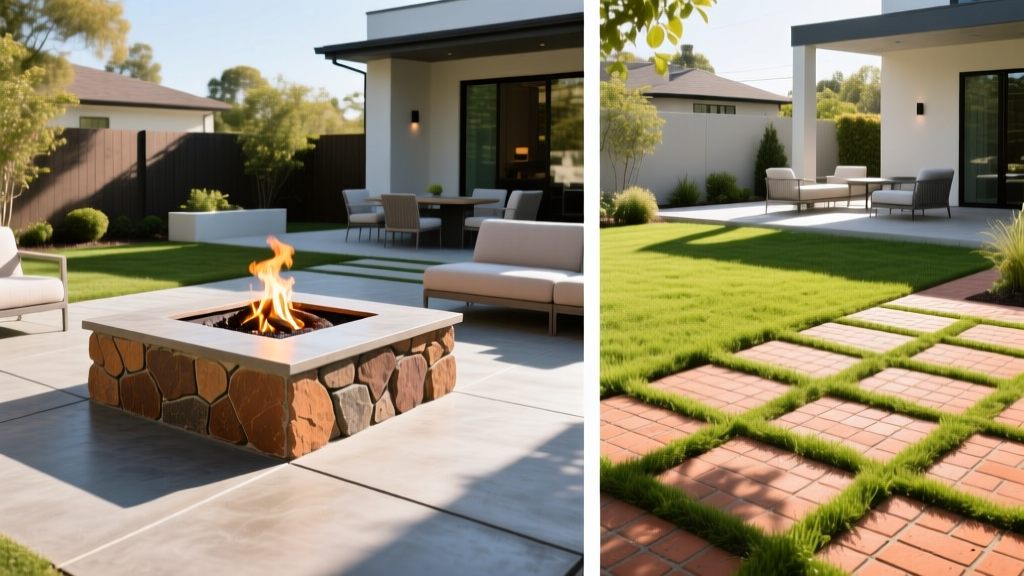
Paver Patio: 2026 Cost Breakdown
The cost of paver patio vs concrete patio flips when analyzing site preparation. Pavers require a meticulously engineered flexible base to prevent settling. According to the Interlocking Concrete Pavement Institute (ICPI), a proper pedestrian paver base requires 4 to 6 inches of compacted Class II road base or crushed stone, topped with a 1-inch layer of coarse, sharp concrete sand (never masonry or play sand).
Material Tiers and Base Engineering
Concrete pavers (such as those manufactured by Belgard or Pavestone) remain the most economical choice, while tumbled clay brick and natural bluestone command premium pricing. The base materials—crushed aggregate, geotextile fabric, and polymeric sand—add roughly $2.50 to $4.00 per square foot to the material cost before a single paver is laid.
- Geotextile Fabric: Mandatory for clay or poorly draining soils to prevent base contamination ($0.30/sq. ft.).
- Edge Restraints: Rigid PVC or aluminum L-channel spikes are required every 12 inches to prevent lateral creeping ($2.50 per linear foot).
- Jointing Sand: High-performance polymeric sands (like Alliance Gator Dust) lock joints and resist ant erosion, costing $35-$50 per 40lb bag, covering roughly 60-80 sq. ft.
Head-to-Head Comparison Matrix
This matrix evaluates the financial and structural realities of both materials across critical project variables.
| Feature | Poured Concrete | Interlocking Pavers |
|---|---|---|
| Initial Installation Cost | Lower (for basic finishes) | Higher (labor-intensive base) |
| Repair Economics | Poor (requires full slab replacement or visible patching) | Excellent (individual unit replacement) |
| Cracking Susceptibility | High (thermal expansion and soil settling) | Virtually None (flexible system) |
| DIY Feasibility | Low (finishing requires high skill) | Moderate (base prep is highly labor-intensive) |
| ROI at Resale | ~65% - 70% | ~75% - 85% |
Hidden Costs That Blow Up Patio Budgets
Contractor estimates frequently assume ideal site conditions. When evaluating the true cost of paver patio vs concrete patio projects, factor in these common site-specific variables:
If your yard slopes more than 1 inch per foot away from the patio footprint, you will need cut-and-fill grading. Exporting excess clay or importing structural fill dirt costs $400 to $800 per dump truck load (including disposal fees). Pavers require a deeper excavation (8-10 inches total) compared to concrete (6-8 inches), slightly increasing hauling costs for paver projects.
- Tree Root Encroachment: Cutting structural roots within 5 feet of a patio compromises the tree; building over them guarantees slab heaving. Root removal or redesigning the footprint adds $500–$1,500.
- Drainage Tie-Ins: The EPA recommends permeable paving systems for stormwater management. If you opt for permeable pavers (requiring a deeper, open-graded crushed stone base) or need to tie a solid concrete slab into a French drain system, add $800 to $2,000 for drainage infrastructure.
- Permits and HOA Fees: Impervious surface limits dictated by municipal zoning can restrict concrete patios. Permeable pavers often bypass these lot-coverage restrictions, saving you from costly variance applications.
Long-Term Maintenance and Repair Economics
The initial installation is only phase one of the financial lifecycle. Concrete is a rigid monolith; pavers are a flexible matrix. This fundamental physics difference dictates their maintenance costs.
Concrete: Slab Jacking and Resurfacing
When soil washes out beneath a concrete slab, it sinks. Mudjacking (slab jacking) costs $3 to $6 per square foot to pump a cementitious slurry beneath the slab and raise it. If the concrete cracks due to freeze-thaw cycles or heavy point loads (like a hot tub), repairs are purely cosmetic. Epoxy crack injection costs $300 to $500 per linear foot, but the scar remains visible. Complete demolition and replacement of a failed 400 sq. ft. slab will cost upwards of $4,000 just for the tear-out and haul-away.
Pavers: Re-Leveling and Joint Maintenance
If a section of a paver patio settles, the repair cost is negligible. You pry up the affected stones with a flat bar, add an inch of bedding sand, tamp it down, and replace the pavers. The primary maintenance cost for pavers is joint stabilization. Every 3 to 5 years, power washing will erode the jointing sand. Re-applying polymeric sand to a 400 sq. ft. patio costs roughly $250 in materials and a weekend of labor. According to the National Association of Realtors (NAR) Remodeling Impact Report, outdoor living spaces featuring high-quality, easily maintainable materials like pavers consistently yield higher homeowner satisfaction and joy scores compared to rigid hardscapes that show age and cracking.
Decision Framework: Which Should You Choose?
Use this logic matrix to finalize your material selection based on your specific site conditions and financial priorities:
Choose Poured Concrete If:
- Your budget is strictly capped below $12 per square foot.
- You are pouring a massive area (1,000+ sq. ft.) where paver base preparation costs would become prohibitive.
- The patio will support extreme static point loads (e.g., a massive masonry outdoor kitchen or an 8,000 lb hot tub) where a rigid, heavily reinforced 6-inch slab is structurally mandatory.
Choose Interlocking Pavers If:
- Your soil is expansive clay or prone to seasonal frost heave (the flexible base absorbs movement without fracturing).
- You have mature trees nearby, and root growth is guaranteed to eventually disrupt the hardscape.
- You anticipate needing to access underground utilities (water lines, gas lines) in the future; pavers can be unzipped and reinstalled perfectly, whereas concrete must be saw-cut and patched.
- Maximizing resale ROI and aesthetic longevity is a higher priority than minimizing day-one installation costs.
Written by
James ThorntonJames Thornton is a construction industry veteran with 25 years of hands-on experience in wood framing, lumber grading, and residential building codes. He started as a framing carpenter in rural Oregon, earned his ICC Residential Building Inspector certification, and eventually became a senior plan reviewer for the City of Portland Bureau of Development Services. James holds a B.S. in Wood Science & Technology from Oregon State University and is a certified lumber grader through the West Coast Lumber Inspection Bureau (WCLIB). He has inspected over 3,000 residential construction sites and authored the city's internal guide on advanced framing techniques (2x6 at 24" O.C.). James lives in Bend, OR, where he builds custom timber-frame cabins and competes in lumberjack sports.
More from James Thornton
View all
Insulation
Best Home Insulation Materials: Complete 2026 Guide
Compare top home insulation materials for 2026. Find R-values, installed costs per square foot, and best uses for fiberglass, spray foam, and mineral wool.
Aug 4, 2026

Sustainable Building
Certify Your Green Building Material for LEED and WELL
Step-by-step guide to certifying a green building material for LEED v5 and WELL v2. Master EPDs, HPDs, and VOC limits for 2026 project specifications.
Aug 4, 2026

Stone & Masonry
Veneer Stacked Stone Panels: Interior Design & Style Showcase
Discover how veneer stacked stone panels transform interiors. Explore modern design profiles, material pairings, and technical installation specs.
Aug 4, 2026