Best Concrete Patching Products & Brand Guide for 2026
Compare top concrete patching brands like Sika, Quikrete, and Euclid. Find exact product specs, cure times, and 2026 pricing for your repair project.
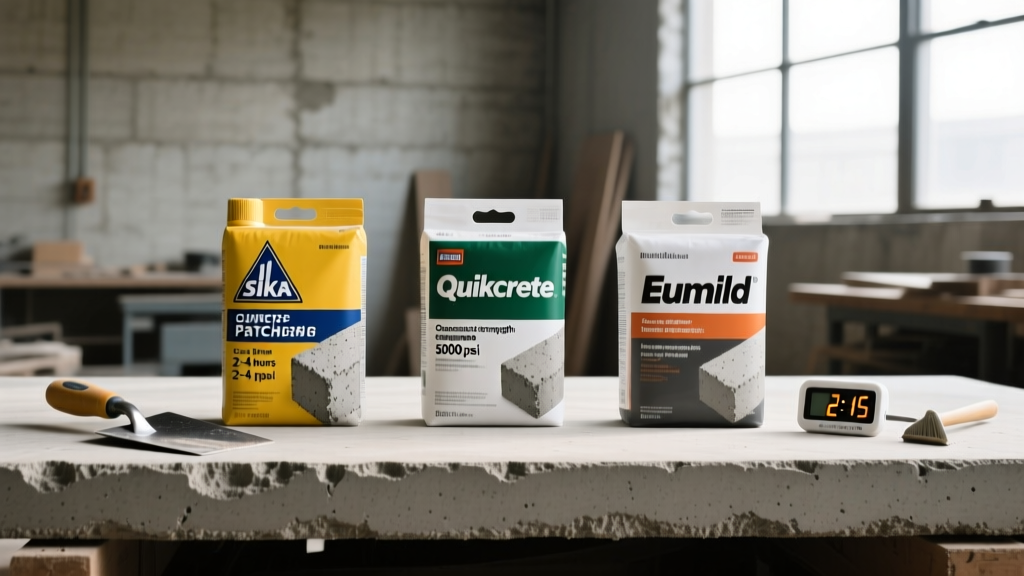
The Evolution of Concrete Patching Chemistry
Concrete degradation is an inevitable consequence of freeze-thaw cycles, chloride intrusion, and structural loading. However, the efficacy of a repair relies entirely on the chemical composition of the patching compound and its compatibility with the existing substrate. In 2026, the market for concrete patching materials has bifurcated into two primary categories: traditional cementitious mixes and advanced polymer-modified systems. Understanding the distinction between these chemistries is the first step in preventing premature repair failure.
Standard cementitious patches rely on Portland cement, aggregates, and water. While they offer high compressive strength, they are inherently brittle and prone to shrinkage cracking. Polymer-modified compounds, conversely, integrate acrylic, vinyl, or latex polymers into the dry mix. These polymers create a co-matrix that drastically reduces the required water-to-cement ratio, enhances flexural strength, and allows for feather-edging—tapering the patch down to a fraction of an inch without the edges snapping off under traffic.
Brand Deep-Dive: Sika’s Polymer-Modified Line
Sika dominates the commercial and high-end residential repair space with its focus on shrinkage-compensated, polymer-modified technologies. Their product line is engineered for scenarios where structural integrity and long-term adhesion are non-negotiable.
SikaTop Patch Pro
Designed for horizontal, vertical, and overhead applications, SikaTop Patch Pro is a one-part, trowelable mortar. Its defining characteristic is its shrinkage-compensation mechanism, which prevents the patch from pulling away from the substrate's edges as it cures. At 28 days, it achieves a compressive strength exceeding 4,000 psi. In 2026, a 25 lb pail retails for approximately $32. It is ideal for spalled driveway edges, exposed rebar encapsulation, and structural column repairs.
Sika Concrete Fix (Polyurethane)
For active, moving cracks where rigid cementitious patches would immediately fail, Sika Concrete Fix utilizes a self-leveling polyurethane formulation. Unlike rigid epoxies, this elastomeric sealant accommodates thermal expansion and substrate movement. It cures to a traffic-bearing state in roughly 4 hours and costs around $14 per 10 oz tube. It is strictly for crack filling, not for rebuilding missing volume.
Brand Deep-Dive: Quikrete’s Consumer & Pro Solutions
Quikrete remains the most accessible brand for DIYers and general contractors, offering a vast catalog of concrete patching products available at nearly every big-box hardware store. Their strength lies in specialized formulations for specific depth and orientation requirements.
Quikrete Vinyl Concrete Patcher (#1241)
This is the gold standard for shallow, horizontal repairs. The vinyl fortification allows the material to be feather-edged down to 1/16 of an inch. Standard cement mixes will crumble at this thickness, but the vinyl binder holds the aggregate together under sheer stress. It is perfect for smoothing out scaled or pitted driveway surfaces. A 10 lb box costs roughly $12. Note that it is strictly for horizontal applications; it lacks the cohesiveness for vertical troweling.
Quikrete Sand Topping Mix (#1103)
When the damage exceeds 1/2 inch in depth, polymer patchers become cost-prohibitive and structurally unnecessary. Quikrete’s Sand Topping Mix is a high-strength Portland cement and graded sand blend designed for repairs up to 2 inches thick. At $8 for a 60 lb bag, it is the most economical choice for deep pothole remediation, provided the edges are squared and a bonding adhesive is applied to the substrate.
Brand Deep-Dive: Euclid Chemical for Heavy-Duty Repair
Euclid Chemical targets the industrial and municipal sectors, providing concrete patching solutions that endure extreme chemical exposure and heavy dynamic loads.
EucoRepair V/O (Vertical/Overhead)
Formulated specifically for high-build vertical and overhead repairs, EucoRepair V/O features a thixotropic consistency. This means the material remains stiff under the trowel but flows slightly under pressure, allowing it to be applied in lifts up to 2 inches thick on vertical surfaces without sagging or slumping. It incorporates silica fume to densify the matrix, providing exceptional resistance to de-icing salts and marine environments. Pricing hovers around $48 for a 50 lb bag, reflecting its premium industrial grade.
Product Comparison Matrix: 2026 Specifications
Selecting the correct concrete patching compound requires matching the product's physical properties to the geometry and environment of the defect. Use the matrix below to guide your procurement.
| Product / Brand | Primary Chemistry | Max Feather-Edge | 28-Day PSI | Set Time | 2026 Est. Price |
|---|---|---|---|---|---|
| SikaTop Patch Pro | Polymer-Modified Cement | 1/4 inch | 4,000+ | 30 mins | $32 / 25 lb |
| Quikrete #1241 Vinyl | Vinyl-Fortified Cement | 1/16 inch | 3,500 | 45 mins | $12 / 10 lb |
| Quikrete #1103 Sand | Standard Cementitious | Not Recommended | 4,000 | 60 mins | $8 / 60 lb |
| EucoRepair V/O | Silica Fume / Polymer | 1/8 inch | 5,500+ | 40 mins | $48 / 50 lb |
| Sika Concrete Fix | Polyurethane Elastomer | N/A (Crack Filler) | N/A | 4 hours | $14 / 10 oz |
Critical Surface Preparation & Failure Modes
The most expensive polymer-modified concrete patching compound will fail catastrophically if applied to an improperly prepared substrate. According to the International Concrete Repair Institute (ICRI), surface preparation is the single highest variable in repair longevity.
Never apply a patch over laitance—the weak, milky layer of cement and fine dust that rises to the surface during the original concrete pour. Laitance has near-zero tensile strength. If you patch over it, the repair will delaminate within months. You must mechanically scarify the surface to achieve an ICRI Concrete Surface Profile (CSP) of 3 to 5, exposing the dense aggregate beneath.
The Delamination and Shrinkage Divide
Failure in concrete patching typically manifests in two distinct modes:
- Delamination (Adhesive Failure): The patch separates cleanly from the existing concrete. This is almost always caused by inadequate surface profiling, failure to saturate the substrate (dry concrete steals water from the patch, halting hydration), or failure to use a bonding agent on deep repairs.
- Shrinkage Cracking (Cohesive Failure): The patch cracks internally or pulls away from the edges. This occurs when the installer adds too much water to the mix to make it 'workable.' Excess water evaporates during curing, leaving voids and causing volumetric shrinkage. Always mix to the manufacturer's exact fluid specifications, utilizing a drill and paddle mixer rather than hand-mixing.
For cementitious and polymer-modified patches, the existing concrete must be Saturated Surface Dry (SSD). Soak the repair area for 2 hours prior to patching, then use a shop-vac or sponge to remove all standing water. The substrate should look dark and damp, but have no puddles. This prevents the old concrete from sucking the hydration water out of the new patch.
FAQ: Concrete Patching Nuances
Can I use a bonding adhesive instead of mechanical preparation?
No. While liquid bonding adhesives (like Quikrete Concrete Bonding Adhesive) are useful for deep, structural pours where mechanical keying is difficult, they do not replace the need for a CSP 3-5 mechanical profile for shallow patches. Adhesives cannot bridge the gap created by a weak laitance layer.
Why did my feather-edge patch crumble at the edges?
If you used a standard sand mix or a non-vinyl cementitious patcher, it lacks the polymer binders required to hold thin cross-sections together. For any taper thinner than 1/4 inch, you must use a vinyl-fortified product like Quikrete #1241 or a specialized acrylic-modified mortar.
How soon can I drive on a driveway patch?
While many products claim 'foot traffic in 2 hours,' vehicular traffic introduces dynamic shear forces. For standard Portland-based patches, a 7-day cure is recommended before driving. For rapid-set polymer-modified products like SikaTop or EucoRepair, 24 to 48 hours is generally sufficient for passenger vehicles, provided ambient temperatures remained above 50°F during the cure cycle. For comprehensive durability standards, refer to the Sika Concrete Repair Systems technical documentation.
Final Procurement Strategy
Successful concrete patching is not about finding a single 'miracle' product, but about matching the material's rheology to the defect's geometry. Keep Quikrete Vinyl Patcher on hand for surface scaling, SikaTop for structural spalls, and polyurethane sealants for active control joints. By respecting the chemistry and adhering to strict ICRI surface preparation protocols, your repairs will outlast the original substrate.