Best Waterproofing Material for Concrete Mix Designs in 2026
Discover the best waterproofing material for concrete mix designs. Compare crystalline admixtures, SCMs, and w/c ratios for impermeable slabs in 2026.
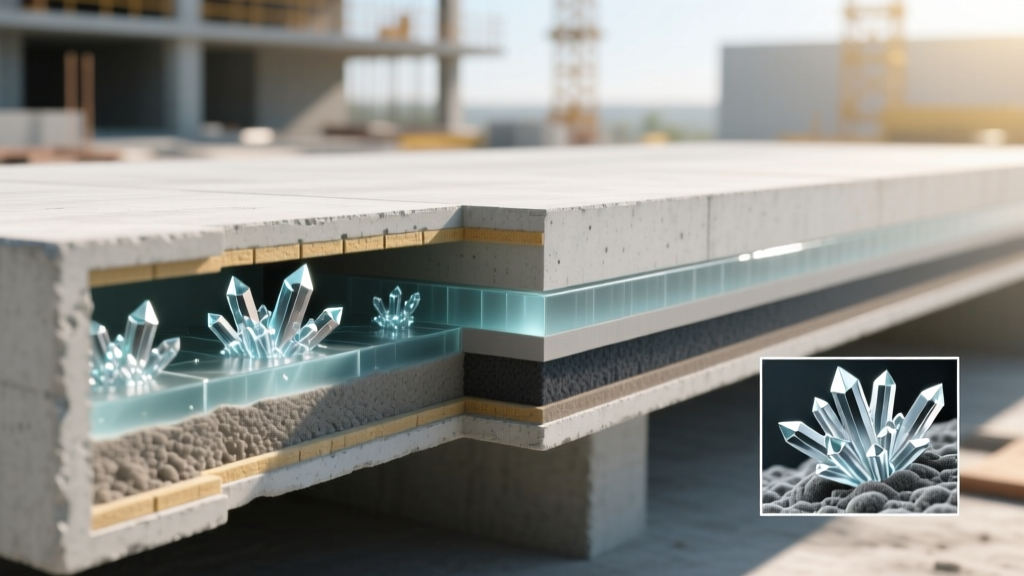
The Fundamental Flaw in Traditional Concrete Waterproofing
For decades, the construction industry relied on a flawed paradigm: pour standard concrete, then apply a surface membrane to keep water out. Whether utilizing bentonite clay panels, rubberized asphalt sheet membranes, or liquid-applied polyurethanes, these exterior barriers share a critical vulnerability. They are prone to puncture during backfilling, delamination due to hydrostatic pressure, and degradation at cold joints. When designing below-grade foundations, water-retaining tanks, or marine structures in 2026, structural engineers and concrete technologists recognize that the best waterproofing material for concrete is not a coating applied after the fact, but an integral component engineered directly into the mix design.
Concrete is inherently porous. As the cement hydrates, excess water evaporates, leaving behind a network of microscopic capillary pores. If the water-to-cementitious (w/cm) ratio is too high, these pores interconnect, creating pathways for water, chlorides, and sulfates. True waterproofing requires eliminating these pathways at the chemical level.
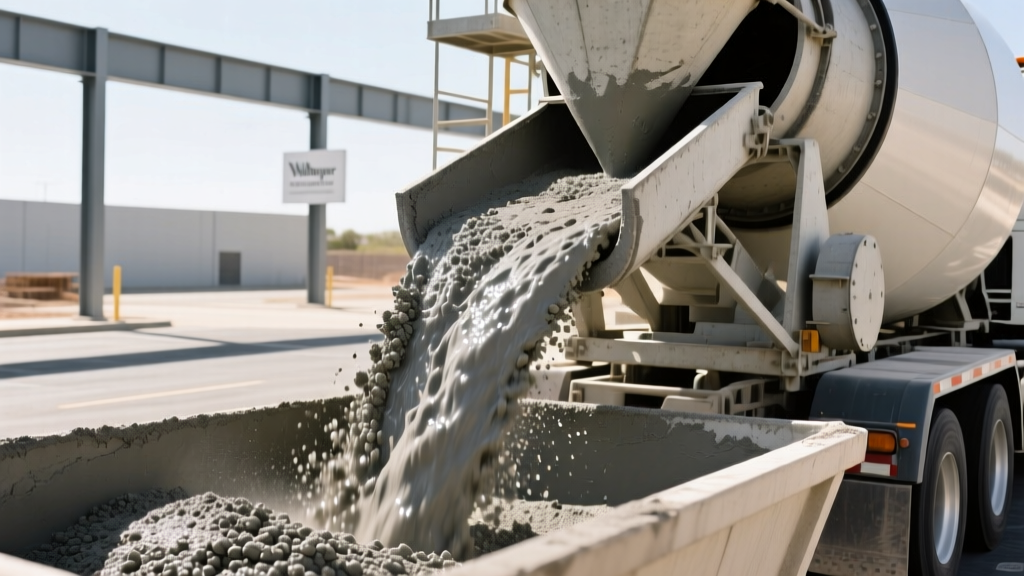
Categorizing Permeability-Reducing Admixtures (PRAs)
According to the American Concrete Institute (ACI) Committee 212, Permeability-Reducing Admixtures (PRAs) are divided into three distinct categories. Understanding these distinctions is vital for specifying the correct chemistry for your application.
- Hydrophobic (Water-Repellent) Admixtures: These include stearates, oleates, and certain oils. They coat the capillary pores to repel water. Verdict: Effective only for damp-proofing against non-hydrostatic moisture. They fail under active hydrostatic pressure and are not considered true waterproofing.
- Pore-Blocking Admixtures: These utilize finely divided solid particles like talc, bentonite clay, or silica fume to physically clog the capillary network. Verdict: Excellent for reducing general permeability and absorption, but they cannot bridge or self-seal micro-cracks that form during curing.
- Crystalline Admixtures: These contain proprietary blends of Portland cement, finely graded silica sand, and reactive chemicals. When introduced to moisture, they catalyze a reaction with the free lime (calcium hydroxide) in the concrete to form insoluble, needle-like crystalline structures that permanently block capillaries and micro-cracks. Verdict: This is the undisputed best waterproofing material for concrete subjected to hydrostatic pressure.
Engineering the Ultimate Waterproof Mix: Step-by-Step Parameters
Selecting a crystalline admixture is only half the battle. The base mix design must be optimized to support the admixture's chemical reaction and minimize initial porosity. Follow these strict parameters for structural waterproofing.
1. Restrict the Water-to-Cementitious Ratio (w/cm)
The single most critical factor in concrete permeability is the w/cm ratio. According to data published by the National Ready Mixed Concrete Association (NRMCA), permeability increases exponentially when the w/cm ratio exceeds 0.50. For waterproof structures, specify a maximum w/cm ratio of 0.40 to 0.42. To maintain workability at this low ratio, you must incorporate a high-range water reducer (HRWR), commonly known as a superplasticizer, to achieve a 6-to-8 inch slump without adding excess water.
2. Integrate Supplementary Cementitious Materials (SCMs)
SCMs act as micro-fillers and pozzolans, consuming the free calcium hydroxide that crystalline admixtures also target, resulting in a denser calcium-silicate-hydrate (C-S-H) matrix.
- Silica Fume: Replace 5% to 8% of the cement by weight. Silica fume particles are 100 times smaller than cement grains, physically blocking capillary pores and drastically reducing chloride ion penetrability.
- Fly Ash (Class F): Replace 15% to 25% by weight. Class F fly ash improves long-term impermeability and reduces the heat of hydration, minimizing thermal cracking in mass pours.
- Slag Cement (Type 120): Replace 30% to 50% by weight. Highly effective for marine environments and sulfate-rich soils, though it slows early strength gain.
3. Dose the Crystalline Admixture Accurately
Crystalline admixtures are typically dosed based on the total weight of the cementitious material, not the total volume of the concrete. Under-dosing results in incomplete crystallization, while over-dosing can lead to rapid slump loss and flash setting. Always utilize automated dispensing at the batch plant rather than tossing dry bags into the transit mixer on-site.
Real-World Product Specifications & Dosing Rates
When specifying the best waterproofing material for concrete, contractors and engineers rely on proven crystalline systems. Below is a comparison of the leading integral crystalline admixtures available for commercial batching in 2026.
| Product / Manufacturer | Active Technology | Standard Dosing Rate | Self-Sealing Crack Width | Best Application Scenario |
|---|---|---|---|---|
| Xypex Admix C-1000 NF | Proprietary catalytic silica | 2.0% - 3.0% by wt. of cement | Up to 0.4 mm (1/64 in) | Deep foundations, sewage treatment tanks, elevator pits |
| Kryton Krystol Internal Membrane (KIM) | Krystol crystalline technology | 10 kg per m³ (approx. 1.5% by wt) | Up to 0.5 mm | Below-grade parking structures, water reservoirs, dams |
| Sika WT-200 | Hydrophilic polymer / crystalline hybrid | 1.0% - 2.0% by wt. of cement | Up to 0.3 mm | Swimming pools, retaining walls, secondary containment |
Cost vs. Lifecycle ROI: Integral vs. Exterior Membranes
Adding a premium crystalline admixture like Xypex or Kryton typically adds $18.00 to $28.00 per cubic yard to the concrete batch ticket. For a standard 10,000 sq. ft. basement foundation requiring 150 cubic yards, the material premium is roughly $3,450.
Conversely, installing a high-quality exterior sheet membrane (like HDPE or self-adhered rubberized asphalt) costs between $2.50 and $4.50 per square foot installed, totaling $25,000 to $45,000 for the same footprint. Furthermore, integral crystalline waterproofing eliminates the need for protective board during backfilling, saves days of critical-path scheduling, and becomes a permanent, self-healing part of the structure. The ROI heavily favors integral mix design.
Testing and Validation: Proving the Mix Works
You cannot manage what you do not measure. Before pouring a structural waterproof element, the proposed mix design must be validated through rigorous laboratory testing. Relying solely on the admixture manufacturer's claims is a liability risk.
The industry standard for measuring the permeability of concrete is ASTM C1202, the Standard Test Method for Electrical Indication of Concrete's Ability to Resist Chloride Ion Penetration. This test measures the total charge passed (in Coulombs) over a 6-hour period. For a mix design to be classified as having 'Very Low' permeability—essential for waterproof structures—the test results must yield less than 1,000 Coulombs. A well-designed mix utilizing a w/cm of 0.40, 8% silica fume, and a crystalline admixture will frequently score below 500 Coulombs at 56 days.
Additionally, specify ASTM C1585 to measure the rate of water absorption (sorptivity). This test is particularly useful for evaluating the effectiveness of hydrophobic and pore-blocking PRAs, ensuring the concrete matrix resists capillary suction.
Edge Cases and Field Failure Modes
Even the best waterproofing material for concrete will fail if field execution is poor. Crystalline admixtures are not magic; they require specific conditions to function and have distinct limitations.
- Honeycombing and Poor Consolidation: Crystalline chemicals can seal micro-cracks and capillary pores, but they cannot bridge macro-voids or honeycombs caused by inadequate vibration. If the concrete is not properly consolidated, water will flow freely through the voids, bypassing the crystalline matrix entirely.
- Structural Cracking: While crystalline admixtures can self-seal shrinkage cracks up to 0.4mm or 0.5mm, they cannot seal structural cracks caused by differential settlement, overloading, or inadequate rebar detailing. For anticipated structural movement joints or cold joints, you must still integrate physical PVC or bentonite waterstops into the formwork.
- Curing Requirements: The crystallization process requires continuous moisture. If the concrete surface is allowed to dry out prematurely in the first 72 hours, the reaction halts. Specify wet curing (using saturated burlap or continuous misting) or apply a high-quality, dissipating curing compound immediately after finishing. Never use plastic sheeting alone, as it can cause localized sweating and uneven hydration.
- Admixture Incompatibility: Crystalline admixtures can sometimes interact unpredictably with certain polycarboxylate-based superplasticizers or accelerators. Always mandate a trial batch at the local ready-mix plant 30 days prior to the pour to verify slump retention, air content stability, and setting times.
By shifting the focus from exterior barriers to internal mix design chemistry, engineers and contractors can deliver below-grade and water-retaining structures that are fundamentally impermeable. Specifying a low w/cm ratio, optimizing SCMs, and integrating a proven crystalline admixture ensures the concrete itself becomes the primary, permanent waterproofing barrier.
Written by
David NakamuraDavid Nakamura is a licensed architect (AIA) and construction technology writer focused on sustainable building methods, mass timber engineering, and high-performance building envelopes. He holds a Master of Architecture from the University of Washington and is a certified Passive House Consultant (CPHC). David spent eight years at the Seattle firm Mithun, where he led the design of three LEED Platinum projects, before founding his own practice specializing in net-zero residential design. He serves on the editorial advisory board of GreenBuilder Magazine and has authored peer-reviewed papers on cross-laminated timber (CLT) connections for the Journal of Structural Engineering. In his spare time, David teaches woodworking at Pratt Fine Arts Center and kayaks the Puget Sound.
More from David Nakamura
View all
Construction Cost
Labor Cost to Build a Deck Per Sq Ft: 2026 Installation Guide
Discover the exact labor cost to build a deck per sq ft in 2026. This installation guide breaks down contractor rates, complexity factors, and hidden fees.
Aug 4, 2026

Construction Cost
How Much Does It Cost to Build a 3 Bedroom House? Financing Guide
Learn exactly how much it costs to build a 3 bedroom house and explore 2026 financing options, construction loan types, and budget frameworks for your build.
Aug 4, 2026

Construction Cost
Cost to Build a Tennis Court: 2026 Guide
How much does it cost to build a tennis court in 2026? Breakdowns for asphalt, concrete, and synthetic surfaces plus fencing and lighting.
Jul 30, 2026