Cost of Paver Patio vs Stamped Concrete: 2026 Breakdown
Compare the 2026 cost of paver patio vs stamped concrete. Deep dive into material pricing, labor, base prep, and 10-year maintenance ROI.

The Bottom Line Up Front
In 2026, the cost of paver patio vs stamped concrete hinges on your timeline and tolerance for maintenance. Stamped concrete averages $14 to $24 per square foot installed, offering a lower upfront cost but requiring mandatory control joints and periodic resealing. Paver patios range from $18 to $35+ per square foot, driven by extensive base preparation and higher material costs, but they offer superior freeze-thaw durability and localized repairability without visible patching.
Stamped Concrete Cost Breakdown (Per Square Foot)
Stamped concrete mimics high-end materials like slate, flagstone, or brick using textured polyurethane mats applied to freshly poured concrete. The pricing structure is heavily weighted toward skilled labor and specialized finishing materials.
Material & Labor Allocation
- Concrete Delivery & Pumping: $165 to $195 per cubic yard (3,500 to 4,000 PSI mix with fiber mesh reinforcement). A standard 4-inch thick patio requires roughly 1.25 cubic yards per 100 square feet.
- Coloring Agents: Integral color (mixed in the truck) adds $0.50 to $1.00 per sq ft. Broadcast color hardeners (applied on-site for more vibrant, durable hues) add $1.50 to $2.50 per sq ft.
- Antiquing Release Agent: $0.30 to $0.60 per sq ft. This prevents the stamping mats from sticking and provides secondary color accents.
- Forming, Pouring & Stamping Labor: $8.00 to $14.00 per sq ft. Stamping is highly time-sensitive; contractors must pay premium rates for a larger crew to finish the slab before the concrete sets.
- Curing & Sealing: $1.50 to $3.00 per sq ft for a high-quality solvent-based acrylic or polyaspartic sealer applied after the 28-day curing period.
Expert Insight on Cracking: According to guidelines from the American Concrete Institute (ACI), all concrete will eventually crack. Stamped concrete requires saw-cut control joints every 8 to 10 feet. While contractors try to hide these joints within the pattern's grout lines, they are often visible and interrupt the aesthetic continuity of the design.
Paver Patio Cost Breakdown (Per Square Foot)
Interlocking concrete pavers are individual units laid over a flexible aggregate base. The higher upfront cost of pavers is directly tied to the volume of excavation, base materials, and meticulous compaction required to prevent settling.
Material & Labor Allocation
- Excavation & Haul-Away: $2.50 to $4.50 per sq ft. Paver bases require digging 7 to 9 inches deep, generating significantly more spoil material to haul away than a standard concrete slab.
- Base Aggregate & Geotextile Fabric: $3.00 to $5.50 per sq ft. This includes non-woven geotextile fabric and 4 to 6 inches of 3/4-inch crushed angular gravel, compacted in 2-inch lifts.
- Bedding Sand & Edge Restraints: $1.50 to $2.50 per sq ft. Includes 1 inch of coarse, sharp concrete sand and heavy-duty aluminum or structural polymer edge restraints secured with 10-inch spikes.
- The Pavers: $4.00 to $15.00+ per sq ft. Standard concrete pavers (e.g., Belgard, Unilock) sit on the lower end, while tumbled, multi-piece, or natural clay pavers push costs higher.
- Laying & Compaction Labor: $6.00 to $10.00 per sq ft. Hand-laying complex patterns (like herringbone) increases labor time by 20% to 30% compared to simple running bond patterns.
- Polymeric Sand & Final Sweep: $1.00 to $2.00 per sq ft. Polymeric sand binds the joints when activated with water, deterring weeds and insect infiltration.
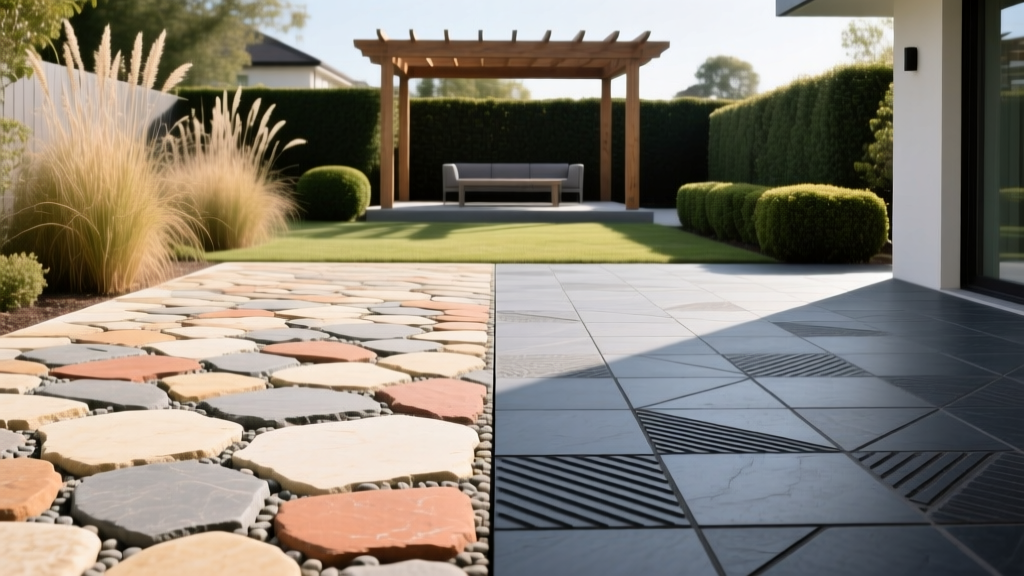
The Base Preparation Factor: Where Budgets Blow Up
The most common cause of hardscape failure—and subsequent unbudgeted repair costs—is improper base preparation. The Interlocking Concrete Pavement Institute (ICPI) mandates strict base compaction protocols that inexperienced contractors often skip to lower their bids.
If a contractor bids a paver patio significantly below the $18/sq ft threshold, they are likely proposing a 'sand-set' base (laying pavers directly over native soil or a thin layer of sand without crushed stone). In freeze-thaw climates, this guarantees severe frost heave, pooling water, and total structural failure within two to three winters.
10-Year Lifecycle & Maintenance Matrix
Evaluating the cost of paver patio vs stamped concrete requires looking beyond installation day. Below is a projected 10-year maintenance cost comparison for a standard 400-square-foot patio.
| Maintenance Task | Stamped Concrete (10-Year Cost) | Paver Patio (10-Year Cost) |
|---|---|---|
| Resealing / Joint Stabilization | $1,200 - $1,800 (Required every 2-3 years) | $400 - $600 (Polymeric sand top-ups every 4-5 years) |
| Crack / Settling Repair | $500 - $1,500 (Epoxy injection/slab jacking; highly visible) | $150 - $300 (Lift, re-level base, replace pavers; invisible) |
| Stain / Efflorescence Removal | $200 - $400 (Acid washing risks sealer damage) | $100 - $250 (Specialized efflorescence cleaners) |
| Estimated 10-Year Total | $1,900 - $3,700 | $650 - $1,150 |
Site-Specific Variables That Skew Pricing
Base estimates assume a flat, easily accessible backyard. Introduce any of the following variables, and expect your per-square-foot costs to shift dramatically:
- Slopes & Retaining Walls: A yard with a 5% or greater slope requires terracing. Adding a segmental retaining wall (SRW) to create a flat pad adds $35 to $65 per linear foot to the project.
- Equipment Access: If a concrete pump truck cannot reach the backyard (e.g., narrow side yards, overhead wires), concrete must be wheeled in via wheelbarrow or buggy, adding $2.00 to $4.00 per sq ft in manual labor surcharges.
- Drainage Integration: Both systems require a minimum 1% slope away from the home. If your site traps water, integrating French drains or permeable paver systems (which require deeper, specialized open-graded bases) will increase base prep costs by 20% to 35%.
Decision Framework: Which Should You Choose?
Use this practical framework to align your hardscape choice with your property's specific constraints and your long-term ownership plans.
Choose Stamped Concrete If:
- Budget is the primary constraint: You need a large, continuous surface area covered and want to keep initial capital expenditure closer to $15/sq ft.
- You prefer a seamless look: You dislike the grid-like joints of pavers and want a broad, uninterrupted canvas for outdoor furniture.
- Heavy static loads are expected: You are building a pad for a hot tub, heavy outdoor kitchen, or vehicle parking where a rigid, monolithic 4,000 PSI slab provides superior load distribution compared to flexible pavers.
Choose a Paver Patio If:
- You live in a severe freeze-thaw climate: The flexible nature of pavers allows them to shift slightly during frost heave and settle back into place, whereas rigid concrete will snap.
- Utility access is required: If you have underground sewer lines, gas lines, or irrigation that may need future servicing, pavers can be unzipped and perfectly reinstalled. Cutting and patching stamped concrete leaves a permanent, unsightly scar.
- Long-term ROI is the goal: You plan to sell the home in 5 to 10 years and want a hardscape that can be easily refreshed to look brand new for the listing photos without the expense of concrete resurfacing.
For further industry standards on hardscape installation and contractor certification, consult the National Association of Landscape Professionals (NALP) to verify that your installer adheres to current structural and aesthetic guidelines.
Written by
Sarah WhitfieldSarah Whitfield is a chartered quantity surveyor (MRICS) and construction cost analyst with 15 years of experience in material pricing, procurement strategy, and project budgeting. She earned her degree in Construction Management from the University of Reading (UK) and has worked on projects ranging from $2M custom homes to $180M mixed-use developments across North America and Europe. Sarah currently leads cost estimating for BuildMat Insight, maintaining a proprietary database of 4,000+ material price points updated quarterly. She is a frequent contributor to RSMeans cost data panels and has presented at the International Cost Engineering Council (ICEC) congress. Based in Denver, CO, Sarah is an avid trail runner and volunteer mentor for Women in Construction.
More from Sarah Whitfield
View all
Wood & Lumber
What Are the Different Types of Wood? A Builder's Guide
Compare structural softwoods, finish hardwoods, and engineered lumber. Analyze Janka ratings, MOE values, and 2026 pricing for construction.
Aug 4, 2026

Walls & Panels
Steel Framing vs Wood Framing: Corrosion and Moisture Defense
Compare steel framing vs wood framing for moisture resistance. Learn about galvanized coatings, condensation risks, and corrosion protection strategies.
Jul 21, 2026

Stone & Masonry
How to Cut Stone Veneer: Wet Saw vs Grinder Comparison
Compare the best tools for cutting stone veneer. We review wet saws, angle grinders, and chop saws to help you achieve clean, chip-free cuts.
Jul 21, 2026