Stained Concrete vs Epoxy: How Slab Mix Design Dictates Your Finish
Compare stained concrete vs epoxy through the lens of slab mix design. Learn how moisture, fly ash, and CSP profiles determine coating success.

The Chemistry of the Slab: Why Mix Design Matters
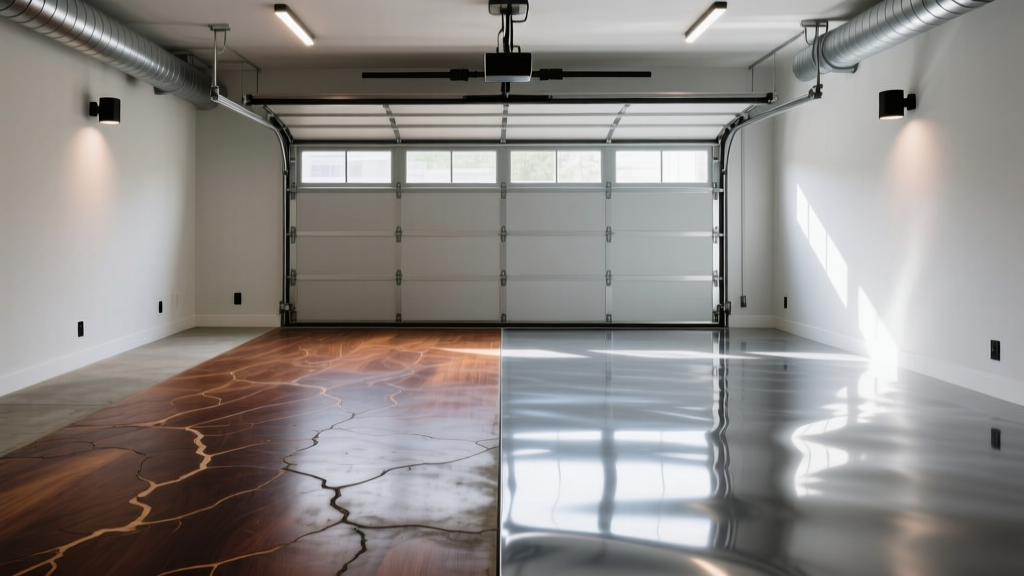
When evaluating stained concrete vs epoxy for commercial or high-end residential floors, most specifiers focus exclusively on aesthetics and surface durability. This is a critical error. The long-term success of either finish is fundamentally dictated by the underlying concrete mix design. A slab is not a blank canvas; it is a complex, porous matrix of cementitious materials, aggregates, and chemical admixtures. The interaction between these internal components and your chosen surface treatment will determine whether you achieve a permanent, vibrant finish or suffer catastrophic delamination and blotching within the first year.
Acid Stains and the Supplementary Cementitious Material (SCM) Dilemma
Traditional acid stains do not coat the concrete; they penetrate the surface and react chemically with the hydrated lime (calcium hydroxide) present in the cement paste. The metallic salts in the stain react with the calcium hydroxide to form permanent, insoluble colored compounds within the pores of the slab.
This chemical dependency creates a massive vulnerability when dealing with modern, sustainable concrete mixes. To reduce the carbon footprint of concrete, batch plants routinely replace Portland cement with Supplementary Cementitious Materials (SCMs) like Class F fly ash or Ground Granulated Blast-Furnace Slag (GGBFS). While excellent for structural integrity and reducing heat of hydration, SCMs consume calcium hydroxide during the secondary pozzolanic reaction.
If your slab mix design contains more than 15% Class F fly ash or 30% GGBFS by weight of cementitious material, the available calcium hydroxide at the surface will be severely depleted. Acid stains applied to these mixes will yield weak, washed-out, or entirely non-existent color reactions. For high-SCM mixes, you must pivot to water-based acrylic or reactive polymer stains, which rely on physical penetration and pigment suspension rather than chemical reactions.
Epoxy Systems and Moisture Vapor Transmission (MVT)
Unlike stains, epoxy coatings form an impermeable, non-breathable film on the surface. The primary enemy of epoxy is not the chemical composition of the cement, but the physical porosity and moisture content dictated by the water-cement (w/c) ratio and the presence (or absence) of a sub-slab vapor retarder.
A high w/c ratio (above 0.50) leaves behind a network of capillary pores as the excess water evaporates. If the slab was poured without a high-performance vapor barrier (minimum 10-mil polyethylene per ASTM E1745), ground moisture will continuously migrate upward through these pores. When this moisture vapor hits the impermeable epoxy layer, it creates hydrostatic pressure. Once the vapor pressure exceeds the tensile bond strength of the epoxy (typically 300-500 psi), the coating will blister, delaminate, and fail.
Mitigating MVT in High-Slump Mixes
Before specifying a 100% solids epoxy system, you must conduct quantitative moisture testing. The industry standard is the in-situ relative humidity (RH) probe test per ASTM F2170. Drilling holes to 40% of the slab depth provides an accurate reading of internal moisture.
- Acceptable for standard epoxy: RH levels below 75%.
- Borderline (75% - 85% RH): Requires a moisture-mitigating epoxy primer (e.g., Laticrete NXT or Sherwin-Williams Sher-Crete MVB) before applying the build coat.
- Critical Failure Zone (Above 85% RH): Standard epoxies will fail. You must switch to a breathable system, such as a moisture-vapor-permeable polyurethane, or revert to a penetrating stain and sealer combination.
Stained Concrete vs Epoxy: Technical Decision Matrix
Use this matrix to align your finish choice with the specific parameters of your concrete slab.
| Specification Criteria | Acid / Reactive Stain | 100% Solids Epoxy System |
|---|---|---|
| SCM Tolerance | Low (Requires <15% Fly Ash) | High (Unaffected by SCMs) |
| MVT Sensitivity | Low (Breathable with acrylic sealer) | Extreme (Requires MVB if RH >75%) |
| Surface Profile (CSP) | CSP 1 to 2 (Light etching) | CSP 2 to 3 (Shot blasting required) |
| Abrasion Resistance | Moderate (Relies on topical sealer) | Exceptional (Mil-thickness build) |
| UV Stability | High (Inorganic pigments) | Low (Requires UV-stable urethane topcoat) |
Surface Profile (CSP) Requirements and Preparation
The mechanical preparation of the slab is where mix design intersects with application methodology. The International Concrete Repair Institute (ICRI) Concrete Surface Profile (CSP) system defines the necessary roughness for coating adhesion.
For Stained Concrete: The goal is to open the pores without removing the cement paste (which contains the calcium hydroxide needed for the reaction). A CSP 1 or CSP 2 profile is ideal. This is typically achieved using a mild chemical etch or a light pass with a planetary grinder equipped with 40-grit to 80-grit diamond abrasive segments. Over-grinding to a CSP 3 will expose the aggregate, which contains no calcium hydroxide and will not accept acid stain, resulting in a speckled, uncolored floor.
For Epoxy Systems: Epoxy requires a mechanical 'tooth' to achieve its structural bond. A CSP 2 or CSP 3 profile is mandatory. Acid etching is largely considered obsolete and unreliable for modern high-solids epoxies. Shot blasting is the required preparation method. The kinetic energy of the steel shot fractures the surface laitance and exposes the hard aggregate matrix, creating microscopic undercut profiles that the low-viscosity epoxy primer will flow into and lock onto.
2026 Cost and Longevity Breakdown
Material and labor costs have stabilized in 2026, but the prep-work requirements heavily skew the final price per square foot.
Stained Concrete Pricing
- Materials: $0.75 - $1.20 per sq. ft. (Acid stain and solvent-based acrylic sealer).
- Labor & Prep: $2.00 - $3.50 per sq. ft.
- Total Installed Cost: $2.75 - $4.70 per sq. ft.
- Lifespan: The stain itself is permanent, but the acrylic sealer must be recoated every 2 to 4 years in high-traffic commercial environments.
100% Solids Epoxy Pricing
- Materials: $2.50 - $4.00 per sq. ft. (Primer, build coat, and polyurethane topcoat).
- Labor & Prep: $3.50 - $6.00 per sq. ft. (Shot blasting is labor and equipment intensive).
- Total Installed Cost: $6.00 - $10.00 per sq. ft.
- Lifespan: 10 to 15 years before requiring a recoat of the sacrificial urethane topcoat.
Real-World Failure Modes to Avoid
If the concrete contractor applied a film-forming curing compound (like a wax or acrylic resin) to prevent plastic shrinkage cracking during the initial pour, both stains and epoxies will fail. Curing compounds block stain penetration and act as a bond-breaker for epoxy. You must specify that the slab is finished with a dissipating curing compound, or budget for aggressive scarification to physically remove the membrane before applying either finish.
Sourcing and Specification Guidelines
When writing the project specifications, do not leave the finish decision to the general contractor. Explicitly tie the finish to the batch plant mix design. If the structural engineer mandates a high-slag mix for thermal cracking control, automatically strike acid stains from the architectural finishes and specify a water-based dye or an epoxy system. By aligning the chemical realities of the concrete mix with the physical requirements of the coating, you eliminate the most common causes of decorative concrete failure.
Written by
Marcus ChenMarcus Chen is a licensed structural engineer (PE) and building materials analyst with over 12 years of experience across residential, commercial, and industrial construction. He holds a Master of Science in Civil Engineering from UC Berkeley and spent six years at Thornton Tomasetti before transitioning to independent consulting and technical writing. Marcus specializes in material selection for seismic-prone regions, concrete reinforcement strategies, and lifecycle cost analysis. His work has been cited by the American Concrete Institute (ACI) and the Structural Engineers Association of California (SEAOC). When he is not on a job site or at his desk, you will find him hiking the Sierra Nevada or restoring a 1920s craftsman bungalow in Oakland, CA.
More from Marcus Chen
View all
Construction Cost
How Much Did the Eiffel Tower Cost to Build?
How much did the Eiffel Tower cost to build in 1889? We adjust for inflation and compare its budget to modern skyscraper construction.
Aug 4, 2026

Fire Resistance
What Is a Fire Resistant Material? Testing & Certification Guide
Discover what is a fire resistant material through ASTM and UL testing. Learn how fire ratings, certifications, and assemblies work in construction.
Aug 4, 2026

Construction Cost
How Much Did the Burj Khalifa Cost to Build?
How much did the Burj Khalifa cost to build? We break down the $1.5B project and extract 5 money-saving strategies for your next build.
Jul 30, 2026