Cement Boards Performance Ratings & ASTM Specifications Guide
Compare top cement boards by ASTM performance ratings, flexural strength, water absorption, and fire specifications for tile and cladding.
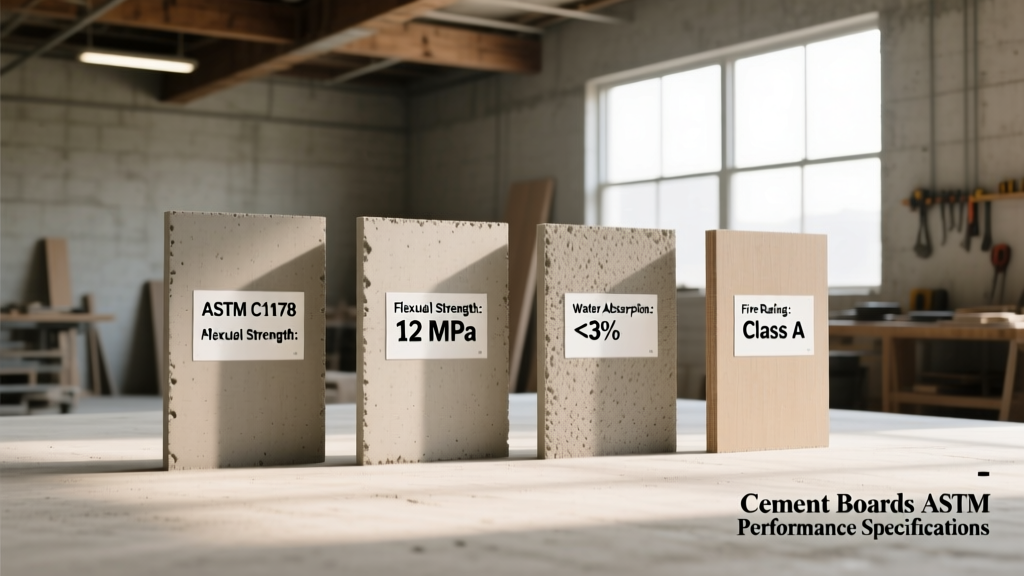
Decoding Cement Board Classifications and Core ASTM Standards
Cementitious backer units (CBUs), commonly referred to as cement boards, serve as the critical structural interface between dimensional lumber or steel framing and rigid surface finishes like ceramic tile, stone veneer, and exterior cladding. Unlike gypsum-based alternatives, true cement boards are engineered to withstand continuous moisture exposure, high alkalinity, and significant impact loads without degrading. Evaluating these materials requires a strict adherence to standardized performance ratings rather than relying on manufacturer marketing claims.
The benchmark for evaluating these panels in North America is ASTM C1325, the Standard Specification for Non-Asbestos Fiber-Mat Reinforced Cementitious Substrate Sheets. This standard dictates the minimum thresholds for flexural strength, water absorption, dimensional stability, and impact resistance. For flat non-asbestos fiber-cement sheets used in exterior cladding or soffits, ASTM C1186 applies, which introduces additional freeze-thaw and weathering durability metrics.
Quick Reference: The Big Three Testing Standards
- ASTM C1325: Governs interior and exterior tile backer boards (flexural strength, nail pull resistance).
- ASTM C473: Standard test method for physical testing of gypsum panel products, adapted for measuring the water absorption limits of cementitious cores.
- ASTM E84 / ASTM E136: Dictates surface burning characteristics (flame spread/smoke developed) and baseline non-combustibility for fire-rated assemblies.
Head-to-Head Performance Matrix: Top Cementitious Backer Units
While all major manufacturers must meet baseline ASTM C1325 requirements, variations in aggregate sizing, fiber-mat reinforcement density, and edge profiling create distinct performance profiles. Below is a technical comparison of the three dominant 1/2-inch cement boards on the market.
| Product Model | Core Density (pcf) | Weight (lbs/sqft) | Water Absorption | Edge Profile |
|---|---|---|---|---|
| James Hardie HardieBacker 500 | ~72 pcf | 2.6 | < 8% | Square Edge |
| USG Durock Brand Cement Board | ~85 pcf | 3.0 | < 8% | Square Edge |
| National Gypsum PermaBase | ~78 pcf | 2.8 | < 8% | EdgeTapered |
Critical Physical Specifications and Failure Thresholds
Flexural Strength and Load Deflection
Flexural strength determines a panel's ability to resist bending under load, which is critical when installed over floor joists with standard 16-inch on-center (OC) spacing. ASTM C1325 requires a minimum flexural strength of 1,200 psi parallel to the face fibers and 800 psi perpendicular. High-density boards like USG Durock often exceed 1,800 psi, making them the preferred specification for commercial stone installations where point-loads from heavy natural stone (e.g., 3cm granite or slate) can cause mid-panel deflection and subsequent grout cracking.
Water Absorption and Freeze-Thaw Durability
Unlike cement backer boards, water-resistant gypsum boards (like DensShield) rely on facing materials to block moisture. True cement boards are homogeneous; their water resistance is a function of core density and Portland cement chemistry. Under ASTM C473 testing, a 2-hour immersion test dictates that water absorption must not exceed 8% by weight. Boards that exceed this threshold are highly susceptible to spalling and delamination in exterior freeze-thaw cycles. For exterior cladding applications in climate zones 5 and above, specifying a board with a documented absorption rate below 6% is a critical risk-mitigation strategy.
Fastener Alkalinity and Corrosion Specifications
The most frequent catastrophic failure in cement board installations is not the panel itself, but the fastener degradation caused by the panel's chemical composition. Portland cement is highly alkaline, maintaining a pH level between 11.5 and 13.0 when moist. This alkalinity aggressively attacks standard zinc coatings found on conventional drywall or deck screws.
- Prohibited: Electro-galvanized screws, standard phosphate-coated drywall screws, and uncoated steel nails.
- Required for Interior/Dry: Ceramic-coated backer screws (e.g., Backer-On) or hot-dipped galvanized (HDG) fasteners.
- Required for Exterior/Wet: Stainless steel (Type 304 minimum; Type 316 for coastal/salt-air environments) or heavily HDG fasteners meeting ASTM A153.
Expert Specification Note: When securing cement boards to steel framing, the fastener must self-drill through the steel without stripping the anti-corrosion coating on the screw threads. Specify self-drilling points with a minimum #2 drill point rating for 20-gauge to 16-gauge steel studs, and ensure the bugle head sits flush without breaking the paper face of the adjacent gypsum panels if transitioning materials.
Joint Treatment and Thinset Compatibility Tolerances
Proper joint treatment prevents telegraphing cracks through the finished tile or veneer layer. Cement boards expand and contract at different rates than wood framing, necessitating specific movement accommodations.
Gap Tolerances and Mesh Requirements
Installers must maintain a strict 1/8-inch gap between all panel edges and at corners. This gap must be filled with a polymer-modified thinset mortar meeting ANSI A118.11 or ANSI A118.4 specifications. Standard unmodified thinset (ANSI A118.1) lacks the tensile adhesion required to bridge the dynamic joint. Furthermore, joints must be reinforced with 2-inch alkali-resistant (AR) fiberglass mesh tape. Standard drywall paper tape or standard fiberglass mesh will dissolve and lose structural integrity when exposed to the high pH of the cementitious thinset.
Silica Dust Mitigation During Cutting
Cutting cement boards generates respirable crystalline silica. The Occupational Safety and Health Administration (OSHA) enforces a Permissible Exposure Limit (PEL) of 50 micrograms per cubic meter of air (8-hour TWA). Scoring and snapping with a carbide-tipped knife is the preferred method for straight cuts on fiber-mat reinforced boards like HardieBacker, generating near-zero airborne dust. For dense aggregate boards like Durock or PermaBase, or for curved cuts, contractors must use a continuous-rim diamond blade paired with a HEPA-filtered dust extraction vacuum or a wet-cutting saw to remain compliant with OSHA standard 29 CFR 1926.1153.
Fire Ratings and Surface Burning Characteristics
Cement boards are inherently non-combustible. When tested per ASTM E136, they exhibit zero flame spread and zero smoke development. Under ASTM E84 (Steiner Tunnel Test), they easily achieve a Class A Fire Rating (Flame Spread Index 0-25, Smoke Developed Index 0-450). This specification allows cement boards to be utilized as a primary component in Underwriters Laboratories (UL) fire-rated assemblies, such as UL Design U419, providing 1-hour or 2-hour fire resistance ratings for commercial shaft walls and area separation walls when paired with specific steel stud gauges and mineral wool insulation.