Concrete vs Pavement Driveway: Complete Cost Breakdown Analysis
Compare concrete vs pavement driveway costs with our detailed breakdown. Analyze initial installation, 30-year lifecycle pricing, and hidden base expenses.

Defining the Materials: Concrete vs Asphalt Pavement
When homeowners and contractors evaluate a concrete vs pavement driveway installation, the term "pavement" almost universally refers to Hot Mix Asphalt (HMA). While both materials serve the same fundamental purpose—providing a durable, load-bearing surface for vehicular traffic—their chemical compositions, structural behaviors, and long-term financial footprints are vastly different. Concrete is a rigid pavement relying on the structural strength of the slab itself, while asphalt is a flexible pavement that distributes loads through a layered aggregate base.
This cost breakdown analysis moves beyond superficial per-square-foot estimates. We will dissect the hidden variables of site preparation, material specifications, and 30-year lifecycle maintenance to determine which driveway material offers the superior return on investment for your specific climate and load requirements.
Initial Installation Costs: Line-Item Breakdown
The upfront cost of a driveway is dictated by more than just the surface material. Excavation, grading, and base preparation often account for 30% to 40% of the total project budget. Below is a comparative line-item cost analysis for a standard 600-square-foot residential driveway (approximately 12x50 feet) in 2026.
| Cost Category | Concrete (Rigid) | Asphalt Pavement (Flexible) |
|---|---|---|
| Excavation & Grading | $1.50 - $2.50 / sq ft | $1.50 - $2.50 / sq ft |
| Aggregate Base (Class II) | $1.20 - $1.80 / sq ft (4-inch) | $1.80 - $2.50 / sq ft (6 to 8-inch) |
| Material Cost | $3.50 - $5.00 / sq ft (4,000 PSI) | $2.00 - $3.50 / sq ft (PG 64-22 HMA) |
| Labor & Finishing | $3.00 - $5.50 / sq ft | $1.50 - $2.50 / sq ft |
| Total Estimated Cost | $9.20 - $14.80 / sq ft | $6.80 - $11.00 / sq ft |
Data Highlight: The Base Thickness Discrepancy
Notice the aggregate base cost difference. Asphalt is a flexible pavement; it relies heavily on a thick, heavily compacted crushed stone base (typically 6 to 8 inches) to prevent rutting and structural failure. Concrete is a rigid pavement; the slab itself possesses high flexural strength, allowing it to perform adequately over a thinner 4-inch compacted base, provided the subgrade is stable.
Material Specifications and Structural Requirements
To accurately compare costs, you must ensure you are quoting equivalent structural capacities. A lowball concrete quote often sacrifices mix design, while a lowball asphalt quote sacrifices compaction lifts.
Concrete Driveway Specifications
- Mix Design: Minimum 4,000 PSI compressive strength with a low water-cement ratio (0.45) and 5% to 7% air entrainment for freeze-thaw resistance.
- Thickness: 4 inches for standard passenger vehicles; 5 to 6 inches if parking heavy trucks, RVs, or boat trailers.
- Reinforcement: 6x6 W1.4xW1.4 welded wire mesh (WWM) or #4 rebar spaced at 16 inches on center. Fiber mesh is acceptable for secondary micro-crack control but does not replace structural steel.
- Jointing: Control joints cut or tooled at 10-foot intervals to a depth of 25% of the slab thickness to control shrinkage cracking.
Asphalt Pavement Specifications
- Binder Grade: PG 64-22 (Performance Graded) asphalt binder is standard for most US climates, engineered to resist rutting at 64°C and thermal cracking at -22°C.
- Thickness: A 2-inch binder course overlaid with a 1.5-inch surface course (total 3.5 inches of compacted HMA).
- Tack Coat: An SS-1h emulsion tack coat must be applied between the aggregate base and the asphalt lift to prevent delamination.
- Compaction: Must achieve 92% to 94% of theoretical maximum specific gravity (TMD) via vibratory steel-drum and pneumatic-tired rollers.
The Hidden Variables: Site Prep and Edge Cases
According to the Federal Highway Administration's guidelines on Life-Cycle Cost Analysis, subgrade preparation is the single highest predictor of pavement longevity. If your site features expansive clay soils, both materials will require mitigation, but the costs differ.
Warning: Expansive Soils and Frost Heave
In regions with heavy clay, moisture fluctuations cause the soil to swell and shrink. Asphalt will telegraph these movements, resulting in severe alligator cracking. Concrete will experience differential settling, leading to faulting at the joints. For expansive soils, budget an additional $2.00 to $4.00 per square foot to remove 12 inches of native clay and replace it with a non-expansive engineered fill before installing either driveway.
Long-Term Maintenance and 30-Year Lifecycle Costs
The initial installation is only the first phase of your financial commitment. The National Asphalt Pavement Association (NAPA) emphasizes that proactive maintenance drastically extends HMA lifespan, while the American Concrete Institute (ACI) notes that concrete requires less frequent, but sometimes more expensive, interventions.
| Maintenance Task | Concrete Frequency & Cost | Asphalt Frequency & Cost |
|---|---|---|
| Surface Sealing | Every 3-5 years ($0.20 - $0.35 / sq ft) | Every 3-5 years ($0.15 - $0.25 / sq ft) |
| Crack Repair | Rare; epoxy/polyurethane injection ($15-$25 per linear ft) | Common; hot-pour crack sealing ($0.10 - $0.20 / linear ft) |
| Major Resurfacing | Mudjacking/Slabjacking ($5 - $8 / sq ft) at Year 20+ | Mill and Overlay ($3.50 - $5.50 / sq ft) at Year 15-20 |
| Snow/Ice Removal | High risk of spalling from magnesium chloride de-icers | Highly resistant to chemical de-icers; dark color melts ice faster |
The 30-Year Cumulative Cost Projection (Per 600 Sq Ft Driveway)
Assuming standard maintenance schedules and a 5% inflation adjustment on future maintenance labor and materials:
- Asphalt Pavement: $6,000 (Install) + $1,200 (Sealcoating x5) + $2,500 (Overlay at Year 15) + $1,500 (Sealcoating x3) = $11,200 Total
- Concrete: $9,000 (Install) + $1,500 (Sealing x5) + $1,800 (Mudjacking/Joint repair at Year 20) = $12,300 Total
While concrete maintains a higher residual value and boosts property appraisal more effectively than asphalt, the raw 30-year out-of-pocket lifecycle cost is remarkably similar when proper maintenance is applied to both.
Failure Modes: What Actually Destroys Driveways?
Understanding how each material fails will help you decide which risks you are willing to accept.
Asphalt Failure Modes
- Thermal Rutting: In sustained temperatures above 95°F, HMA softens. Parking a heavy RV or boat trailer with dual-axle point loads for weeks at a time will cause permanent depressions.
- Oxidation and Raveling: UV exposure degrades the asphalt binder, turning the surface gray and causing the aggregate to loosen and pop out (raveling). This is entirely preventable with timely sealcoating.
- Petroleum Spills: Gasoline, oil, and transmission fluid act as solvents to asphalt, rapidly dissolving the binder and leaving deep potholes.
Concrete Failure Modes
- De-Icer Spalling: Applying calcium chloride or magnesium chloride rock salt during the first winter of a new pour will cause catastrophic surface scaling. Only sodium chloride or sand should be used in year one.
- Joint Faulting: If water infiltrates control joints and erodes the subgrade, heavy vehicle tires will pump the mud out, leaving the slab unsupported and causing the edges to snap off.
- Tree Root Uplift: Concrete is highly susceptible to root pressure. Planting aggressive species like Willows or Maples within 15 feet of the driveway edge will almost guarantee structural heaving.
Decision Framework: Which Should You Choose?
Use this practical framework to make your final material selection based on your specific property constraints.
Choose Asphalt Pavement If:
- Budget is the primary constraint: You need a functional, paved surface immediately but want to keep initial capital expenditures under $7,500 for a standard driveway.
- You live in a severe freeze-thaw climate: Asphalt's flexibility allows it to absorb minor frost heave without catastrophic cracking, and its dark color aids in passive snowmelt.
- You have a steep gradient: Asphalt provides superior surface friction and skid resistance on inclines greater than 12%, especially when wet or icy.
Choose Concrete If:
- You park heavy, static loads: RVs, car lifts, or heavy commercial trucks will not cause rutting or depressions in a properly cured 4,000 PSI concrete slab, even in peak summer heat.
- Property resale value is a priority: Real estate appraisals consistently favor concrete driveways, often recouping 70% to 80% of the installation cost in added home value.
- You want design versatility: Concrete can be stamped, stained, scored, or exposed-aggregate finished to match architectural styles, whereas asphalt is strictly limited to black or muted gray coatings.
Final Verdict on Driveway Paving Costs
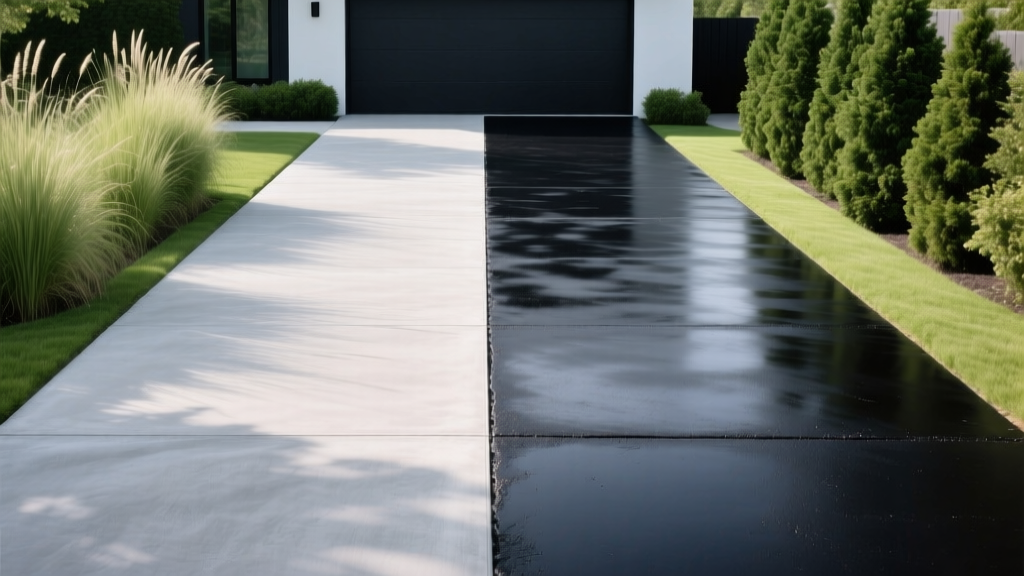
The debate between a concrete vs pavement driveway ultimately hinges on how you define "cost." If you are strictly minimizing upfront capital outlay, Hot Mix Asphalt is the undisputed winner, saving roughly 30% to 40% on day one. However, if you view the driveway as a 30-year infrastructure asset, concrete's superior load-bearing capacity, resistance to petroleum spills, and higher contribution to property equity make it the more financially sound investment for homeowners planning to stay in their homes long-term. Always mandate a 4-inch compacted aggregate base minimum for concrete and a 6-inch base for asphalt, regardless of what the lowest-bidding contractor suggests.
Written by
Priya KapoorPriya Kapoor is a real estate market analyst and construction economics researcher with expertise in housing affordability, development feasibility, and infrastructure investment. She holds a Master of Regional Planning from Cornell University and previously worked as a senior analyst at CBRE's Investment Properties group, where she modeled returns for $4B in mixed-use development pipelines. Priya now runs an independent research practice advising developers, municipalities, and REITs on construction cost forecasting and market timing. She publishes the quarterly "BuildMat Market Pulse" report tracking material price indices across 12 commodity categories. Based in Austin, TX, Priya serves on the board of Habitat for Humanity Austin and is a marathon runner.
More from Priya Kapoor
View all
Construction Cost
Cost to Build a 1600 Sq Ft Home in 2026: Full Breakdown
Accurate 2026 cost to build a 1600 sq ft home—material, labor, and regional pricing breakdowns included. Plan your budget with real-time estimates.
Aug 11, 2026

Wood & Lumber
Name the Types of Wood for Pressure Treatment and Preservation
Learn how to name the types of wood best suited for pressure treatment. Compare species treatability, chemical retention levels, and 2026 preservation costs.
Aug 4, 2026

Stone & Masonry
Stone Veneer Suppliers Lindenhurst: 2026 Cost Analysis
Analyze 2026 stone veneer costs in Lindenhurst, NY. Compare local supplier pricing, delivery fees, and Suffolk County installation labor rates.
Aug 4, 2026