Polyurethane Concrete Raising vs Mudjacking: Best Applications
Compare polyurethane concrete raising vs mudjacking for your projects. Discover costs, cure times, and the best applications for each slab repair method.

The Physics of Slab Settlement and Void Filling
Concrete slabs rarely fail due to the compressive weakness of the concrete itself; they fail because the subgrade support erodes, compacts, or washes away. When a void forms beneath a 4-inch thick residential driveway slab or an 8-inch municipal thoroughfare, the tensile stress exceeds the concrete's modulus of rupture, leading to differential settlement and cracking. Remediation requires not just lifting the slab, but permanently densifying the subgrade. The two dominant techniques for this are traditional cementitious mudjacking (slabjacking) and modern polyurethane concrete raising (polyjacking). Choosing between them requires moving beyond generic cost comparisons and evaluating the specific hydrological, structural, and logistical demands of the application.
Mudjacking: Heavy-Duty Applications and Material Realities
Mudjacking relies on a hydraulic pump to inject a dense slurry beneath the settled concrete. The standard 2026 mix design consists of topsoil or washed masonry sand, Portland cement, and water, occasionally augmented with fly ash to improve flowability. This slurry typically weighs between 100 and 120 pounds per cubic foot (pcf) and requires injection holes ranging from 1.25 to 2 inches in diameter.
Where Mudjacking Dominates
- Municipal Sidewalks and ADA Ramps: For city-scale projects involving thousands of square feet of public right-of-way, the low material cost of mudjacking slurry makes it the default choice. The aesthetic impact of 1.5-inch patched holes is acceptable in public infrastructure.
- Highway Shoulders and Bridge Approaches: The heavy weight of the cementitious slurry is advantageous when stabilizing massive, thick concrete sections (8 to 12 inches thick) that require significant dead weight to resist hydrostatic uplift from high water tables.
- Rural Agricultural Aprons: For heavy equipment pads and silo bases where cosmetic perfection is secondary to structural load-bearing capacity, mudjacking provides a rigid, high-compressive-strength base.
Polyurethane Concrete Raising: Precision, Speed, and Chemistry
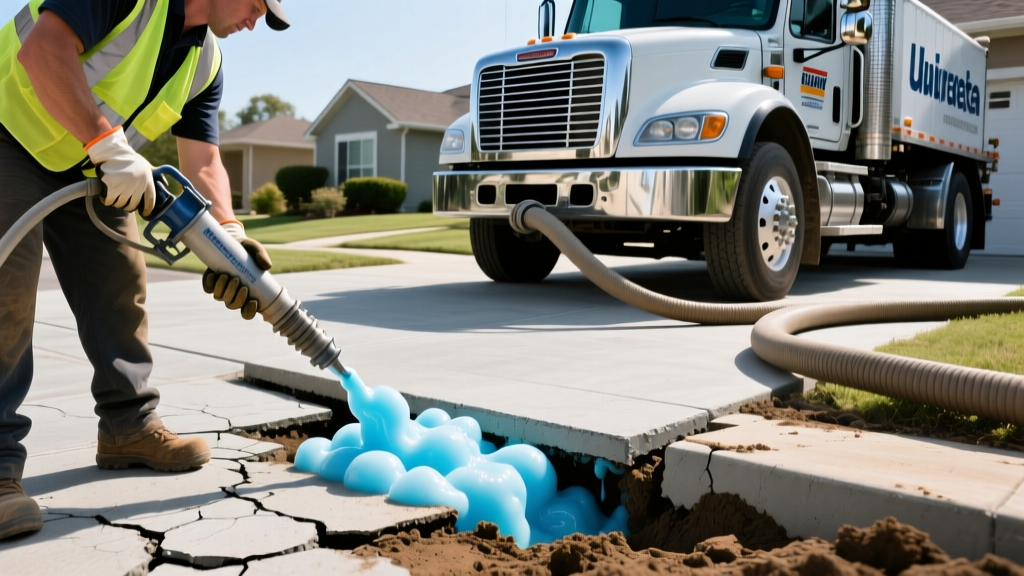
Polyjacking utilizes a two-part, closed-cell structural polyurethane foam. When the isocyanate and polyol resin components meet at the injection wand, an exothermic chemical reaction occurs, expanding the foam up to 20 times its liquid volume. The cured foam is remarkably lightweight (2.5 to 4.0 pcf) and requires injection holes of only 5/8 of an inch in diameter.
Where Polyurethane Raising Dominates
- Residential Pool Decks and Patios: The 5/8-inch injection holes are easily disguised with standard caulking, preserving the aesthetic of stamped or exposed-aggregate concrete. Furthermore, closed-cell polyurethane is completely impervious to water, making it ideal for the high-splash zones around pools.
- Interior Warehouse and Manufacturing Floors: Structural polyurethane achieves 90% of its full compressive strength within 15 minutes. A forklift can drive over a repaired warehouse aisle in under an hour, eliminating the 24-to-48-hour shutdown required by mudjacking.
- Tight-Access Driveways and Walkways: Polyjacking equipment is highly portable. The chemical drums and pumping rig can be mounted on a small trailer or even wheeled manually through narrow side-yards where a heavy mudjacking pump truck cannot reach.
Application Matrix: Choosing the Right Method by Scenario
The decision framework for contractors and property managers should be based on the specific environmental and operational parameters of the site. According to guidelines referenced by the International Concrete Repair Institute (ICRI), matching the repair material to the service environment is critical for long-term durability.
| Application Scenario | Recommended Method | Primary Justification | Secondary Consideration |
|---|---|---|---|
| Stamped / Decorative Driveways | Polyurethane | 5/8-inch holes prevent visual scarring; precise millimeter-level lifting control. | Higher upfront material cost. |
| Municipal Sidewalk Networks | Mudjacking | Lowest cost per square foot for high-volume, non-decorative public works. | Requires heavy truck access; larger patch holes. |
| Active Warehouse Aisles | Polyurethane | 15-minute cure time allows immediate return to heavy forklift service. | Requires certified chemical applicators. |
| Bridge Approach Slabs (Deep Voids) | Polyurethane | Lightweight foam (3 pcf) does not add destabilizing dead load to retaining walls. | Deep-fill requires specialized high-yield foam formulations. |
| Heavy Equipment / Silo Pads | Mudjacking | High-density cementitious slurry provides massive compressive resistance. | Longer cure time before heavy loading. |
2026 Cost Analysis and ROI Timelines
Pricing for slab lifting is highly dependent on the volume of void space beneath the concrete, not just the surface square footage. However, baseline market rates for 2026 reflect the following averages:
Mudjacking Economics
- Average Cost: $5.00 to $9.00 per square foot.
- Minimum Call-Out Fee: $400 - $600.
- Material Cost: Extremely low (sand, cement, water), but labor and heavy equipment transport drive the price.
- Lifespan: 5 to 10 years, heavily dependent on site drainage.
Polyurethane Economics
- Average Cost: $9.00 to $18.00 per square foot.
- Minimum Call-Out Fee: $800 - $1,200.
- Material Cost: High (specialty chemical resins), offset by lower labor time and smaller equipment footprint.
- Lifespan: 20+ years. The American Concrete Institute (ACI) notes that closed-cell polymers do not degrade in alkaline soil environments, effectively making the repair permanent if surface water is managed.
Edge Cases: When Both Methods Fail
Neither mudjacking nor polyurethane raising is a cure-all. Both techniques rely on the structural integrity of the concrete slab acting as a unified beam. If the slab is severely fractured (more than 3 intersecting major cracks within a 10-foot span), lifting will result in a 'hinge' effect, breaking the slab into uneven pie slices. In these cases, full-depth replacement is the only viable option.
Final Verification for Project Managers
When specifying a repair method for commercial or municipal projects, refer to the Federal Highway Administration (FHWA) pavement preservation guidelines for infrastructure applications. For residential and commercial architectural slabs, mandate the use of hydrophobic, high-density structural polyurethane (minimum 40 psi compressive strength) to ensure the repair survives seasonal freeze-thaw cycles and hydrostatic pressure. Always require the contractor to perform a pre-injection ground-penetrating radar (GPR) or dynamic cone penetrometer (DCP) test to map the exact depth and volume of the subgrade voids, ensuring accurate material estimation and preventing over-injection blowouts.
Written by
Sarah WhitfieldSarah Whitfield is a chartered quantity surveyor (MRICS) and construction cost analyst with 15 years of experience in material pricing, procurement strategy, and project budgeting. She earned her degree in Construction Management from the University of Reading (UK) and has worked on projects ranging from $2M custom homes to $180M mixed-use developments across North America and Europe. Sarah currently leads cost estimating for BuildMat Insight, maintaining a proprietary database of 4,000+ material price points updated quarterly. She is a frequent contributor to RSMeans cost data panels and has presented at the International Cost Engineering Council (ICEC) congress. Based in Denver, CO, Sarah is an avid trail runner and volunteer mentor for Women in Construction.
More from Sarah Whitfield
View all
Wood & Lumber
What Are the Different Types of Wood? A Builder's Guide
Compare structural softwoods, finish hardwoods, and engineered lumber. Analyze Janka ratings, MOE values, and 2026 pricing for construction.
Aug 4, 2026

Walls & Panels
Steel Framing vs Wood Framing: Corrosion and Moisture Defense
Compare steel framing vs wood framing for moisture resistance. Learn about galvanized coatings, condensation risks, and corrosion protection strategies.
Jul 21, 2026

Stone & Masonry
How to Cut Stone Veneer: Wet Saw vs Grinder Comparison
Compare the best tools for cutting stone veneer. We review wet saws, angle grinders, and chop saws to help you achieve clean, chip-free cuts.
Jul 21, 2026