Clay vs Concrete Pavers: Driveway & Patio Application Showcase
Compare clay vs concrete pavers for driveways and patios. Explore 2026 costs, ASTM durability standards, failure modes, and real-world application showcases.

The Material Science: Kiln-Fired Shale vs. Vibratory-Pressed Cement
When selecting hardcaping for exterior applications, the debate between clay and concrete pavers centers on two fundamentally different manufacturing processes. Clay pavers are formed from natural shale and clay, then fired in kilns at temperatures exceeding 2,000°F. This vitrification process creates a dense, non-fading ceramic unit governed by ASTM C902 standards. Conversely, concrete pavers are manufactured using a zero-slump mixture of Portland cement, fine aggregates, and mineral oxides, compacted under extreme vibratory pressure and cured. These units adhere to ASTM C936 specifications.
While both materials offer superior load-bearing capabilities compared to poured concrete or asphalt, their distinct material properties dictate entirely different best-use applications. According to the Brick Industry Association, clay pavers maintain their structural integrity and color indefinitely, while the National Concrete Masonry Association highlights concrete pavers for their versatile geometries and interlocking load distribution.
Application Showcase 1: High-Load Residential Driveways
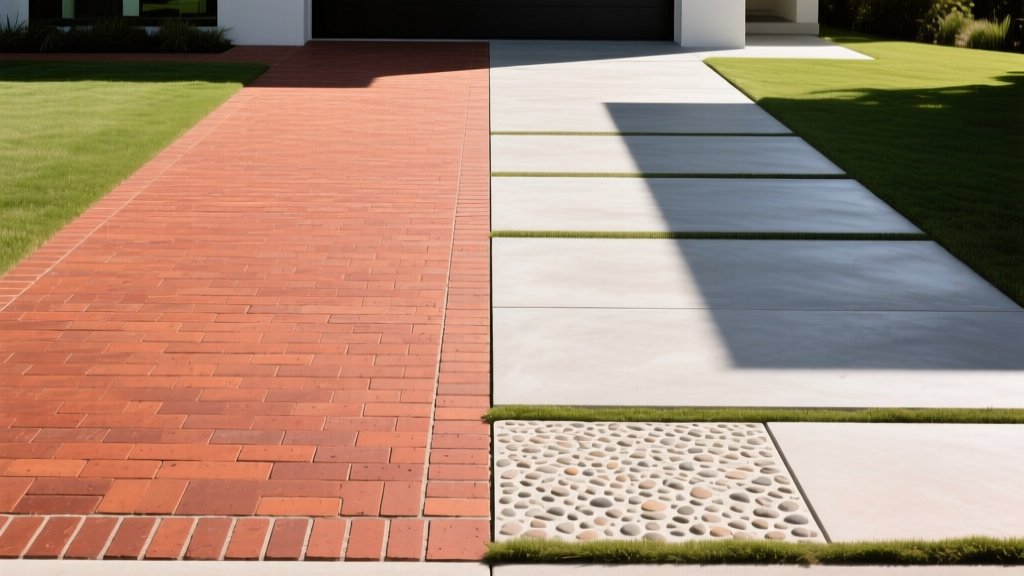
For driveways subjected to daily vehicular traffic, turning tires, and heavy point-loads (such as RVs or boat trailers), concrete pavers are the superior application choice. Modern concrete pavers, like the Belgard Mega-Arbel or Unilock Lineo Dimensional Stone, are engineered with precise dimensional tolerances that allow for tight, interlocking jointing. This interlock is critical; it distributes dynamic vehicular loads laterally across the base aggregate rather than transferring them directly downward.
Driveway Specification Requirements (2026)
- Compressive Strength: Minimum 8,000 PSI (ASTM C936 standard).
- Thickness: Minimum 60mm (2 3/8 inches) for passenger vehicles; 80mm (3 1/8 inches) if heavy trucks or RVs will park on the apron.
- Base Aggregate: 6 to 8 inches of compacted, crushed angular stone (ASTM D2940) to prevent lateral shifting under tire torque.
Concrete pavers also offer a distinct advantage in snow-removal scenarios. Their smooth, chamfered edges prevent snowplow blades from catching and dislodging individual units, a common failure point with rougher, extruded clay bricks. Furthermore, concrete pavers are available in large-format slabs that mimic natural flagstone, reducing the total number of joints and creating a sleeker, modern aesthetic for contemporary home facades.
Application Showcase 2: Heritage Patios, Walkways, and Pool Decks
When the application shifts from heavy load-bearing to aesthetic permanence and pedestrian comfort, clay pavers dominate the landscape. Because the color of a clay paver is derived from the natural minerals in the shale and the firing process—rather than surface-applied synthetic pigments—clay is entirely immune to UV fading. A red or terracotta clay paver from manufacturers like Pine Hall Brick or Whitacre Greer will look virtually identical in year 30 as it did on day one.
Clay pavers are the premier choice for pool decks and high-sun patios for another critical reason: thermal mass and reflectivity. Lighter-colored clay bricks naturally reflect more sunlight than dyed concrete, keeping the surface cooler under bare feet. Additionally, the slight dimensional variations inherent in kiln-fired clay create a charming, Old World texture that perfectly complements traditional, Tudor, or Mediterranean architectural styles.
"In high-sun exposure areas, concrete pavers with dark integral pigments can lose up to 30% of their color vibrancy over a decade due to UV degradation of the iron oxide pigments. Clay pavers experience zero UV pigment loss, as their color is a result of chemical vitrification."
— Landscape Architecture Material Review, 2025
Technical Comparison Matrix
| Feature | Clay Pavers (ASTM C902) | Concrete Pavers (ASTM C936) |
|---|---|---|
| Compressive Strength | 10,000+ PSI (Class SX) | 8,000+ PSI |
| Water Absorption | Max 7.0% (Severe Weathering) | Max 5.0% |
| Color Longevity | Permanent (Vitrified) | Subject to UV fading over 10-15 years |
| Dimensional Tolerance | Slight variations (requires wider joints) | Highly precise (allows tight, interlocking joints) |
| Efflorescence Risk | Very Low | High (Free lime migration) |
| 2026 Installed Cost | $18 - $28 per sq. ft. | $14 - $22 per sq. ft. |
Real-World Failure Modes and Edge Cases
Understanding how these materials fail in the field is critical for long-term application success. The American Concrete Institute and masonry experts consistently document specific degradation pathways for both materials.
Concrete Paver Failure: Efflorescence and Spalling
The most common aesthetic complaint with concrete pavers is efflorescence—a white, powdery residue caused by water-soluble calcium hydroxide migrating to the surface and reacting with atmospheric carbon dioxide. While efflorescence is temporary and usually washes away after a year of weathering, it can severely mar the appearance of a newly installed patio. To mitigate this, modern installers use efflorescence-inhibiting polymeric sands and penetrating silane/siloxane sealers.
Structurally, concrete pavers can suffer from surface spalling in freeze-thaw climates if the water absorption exceeds the 5% ASTM threshold, or if de-icing salts (specifically calcium chloride) are applied during the first winter before the pavers have fully cured and sealed.
Clay Paver Failure: Chipping and Freeze-Thaw Fractures
Clay pavers are highly brittle compared to concrete. When dropped during installation or subjected to sharp, heavy impacts (like a steel shovel edge or a dropped cast-iron planter), the edges and corners will chip or shear off. Furthermore, if a clay paver is installed in a severe freeze-thaw zone but fails to meet the ASTM C902 Class SX (Severe Weathering) rating—meaning its water absorption is higher than 7%—the trapped water will expand upon freezing, causing the face of the brick to delaminate or shatter.
Installation Divergences and Jointing Strategies
While the sub-base preparation (compacted aggregate over geotextile fabric) is identical for both materials, the bedding and jointing strategies diverge significantly based on material tolerances.
- Bedding Sand: Both require a 1-inch layer of coarse, washed concrete sand (ASTM C33). However, concrete pavers require a perfectly screeded, undisturbed sand bed to maintain their tight interlock. Clay pavers, due to their slight size variations, require a slightly thicker, more forgiving bedding layer to allow the installer to tap individual bricks into a level plane.
- Jointing Sand: Concrete pavers feature chamfered edges and tight joints (1/16 to 1/8 inch), making them ideal for fine-grade polymeric sand that locks the matrix together and prevents weed growth. Clay pavers often feature square edges and wider joints (3/16 to 1/4 inch) to accommodate size variations. Standard joint sand is often preferred here, as polymeric sand can stain the porous, unsealed surface of clay bricks if not cleaned meticulously during activation.
- Edge Restraints: Both systems absolutely require rigid edge restraints (extruded PVC or poured concrete curbing) secured with 10-inch galvanized spikes. Without restraints, the lateral forces of traffic and thermal expansion will cause the perimeter pavers to migrate outward, unzipping the entire installation.
The Final Verdict: Decision Framework
Choosing between clay and concrete pavers is not about identifying a universally superior material, but rather matching the material science to the specific demands of the application site.
Choose Concrete Pavers If:
- The project is a high-traffic driveway requiring interlocking load distribution.
- You require large-format, modern slab aesthetics with minimal joint lines.
- The budget is constrained to the $14–$22 per square foot installed range.
- Snowplowing is a regular winter necessity.
Choose Clay Pavers If:
- The project is a high-sun patio or pool deck where UV color fading is unacceptable.
- The architectural style demands traditional, Old World, or heritage aesthetics.
- You want a zero-maintenance surface that will not require resealing to maintain color.
- The budget allows for the $18–$28 per square foot premium.
By aligning the ASTM performance characteristics of the paver with the environmental and structural demands of the site, contractors and homeowners can ensure a hardscape installation that remains structurally sound and aesthetically flawless for decades.
Written by
James ThorntonJames Thornton is a construction industry veteran with 25 years of hands-on experience in wood framing, lumber grading, and residential building codes. He started as a framing carpenter in rural Oregon, earned his ICC Residential Building Inspector certification, and eventually became a senior plan reviewer for the City of Portland Bureau of Development Services. James holds a B.S. in Wood Science & Technology from Oregon State University and is a certified lumber grader through the West Coast Lumber Inspection Bureau (WCLIB). He has inspected over 3,000 residential construction sites and authored the city's internal guide on advanced framing techniques (2x6 at 24" O.C.). James lives in Bend, OR, where he builds custom timber-frame cabins and competes in lumberjack sports.
More from James Thornton
View all
Insulation
Best Home Insulation Materials: Complete 2026 Guide
Compare top home insulation materials for 2026. Find R-values, installed costs per square foot, and best uses for fiberglass, spray foam, and mineral wool.
Aug 4, 2026

Sustainable Building
Certify Your Green Building Material for LEED and WELL
Step-by-step guide to certifying a green building material for LEED v5 and WELL v2. Master EPDs, HPDs, and VOC limits for 2026 project specifications.
Aug 4, 2026

Stone & Masonry
Veneer Stacked Stone Panels: Interior Design & Style Showcase
Discover how veneer stacked stone panels transform interiors. Explore modern design profiles, material pairings, and technical installation specs.
Aug 4, 2026