Understanding the Cement vs Concrete Difference: An Application Showcase
Discover the cement vs concrete difference through real-world construction applications, material strengths, and 2026 job-site specification guidelines.

The Fundamental Divide: Binder vs. Composite
The phrase "cement driveway" is a misnomer that makes structural engineers cringe. Understanding the cement vs concrete difference is not merely semantic pedantry; it dictates structural integrity, material procurement, and application success on any job site. At the most basic chemical level, cement is an ingredient, while concrete is the final composite material.
- Portland Cement: A hydraulic binder manufactured by heating limestone and clay to form clinker, which is then ground with gypsum (ASTM C150). It reacts with water to form a hardening paste.
- Concrete: A composite material consisting of 10-15% cement paste, 25-30% fine aggregate (sand), and 60-75% coarse aggregate (crushed stone or gravel), governed by ACI 318 standards.
According to the Portland Cement Association, the aggregates in concrete provide bulk dimensional stability and compressive strength, while the cement paste acts as the glue that coats the aggregate particles and fills the voids. Specifying pure cement for a high-volume structural application will result in catastrophic shrinkage and financial ruin, just as using concrete for a thin masonry joint will result in poor adhesion and structural failure.
Application Showcase: When to Specify Cement-Based Products
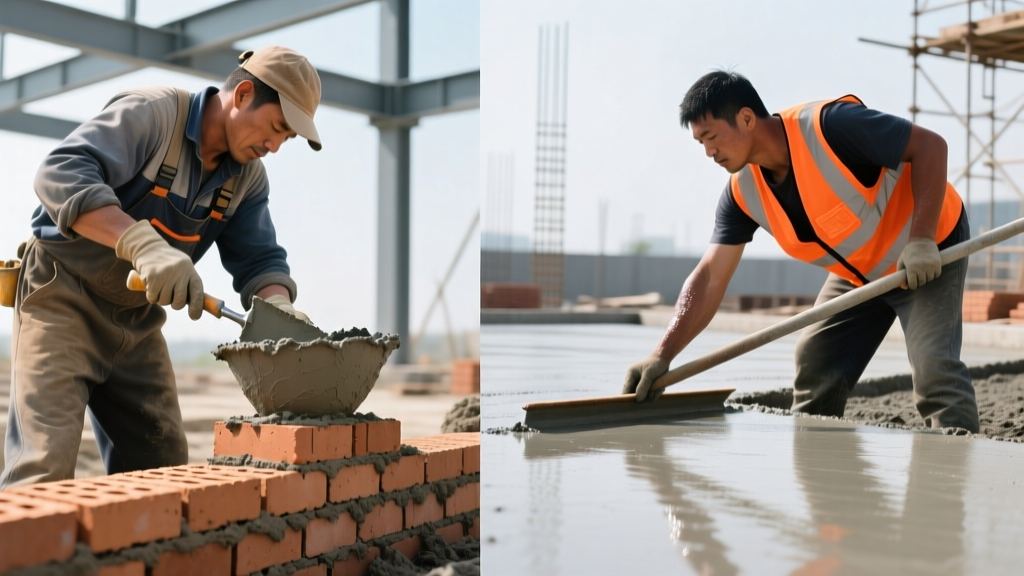
When we discuss "cement applications" in construction, we are almost exclusively referring to cement-based mixtures that omit coarse aggregates. These include masonry mortar, grout, stucco, and tile thin-set. The absence of large gravel allows these mixtures to flow into tight spaces, bond to vertical surfaces, and create seamless aesthetic finishes.
Masonry Mortar (ASTM C270)
Mortar is designed for bonding masonry units (brick, block, stone). It requires high workability, water retention, and tensile bond strength rather than extreme compressive strength. A standard mortar mix combines Portland cement, hydrated lime (or masonry cement), and fine masonry sand. The lime acts as a plasticizer, allowing the mortar to squeeze into the microscopic pores of the brick, creating a mechanical and chemical lock.
| Mortar Type | Proportions (Cement : Lime : Sand) | Min. Compressive Strength (28 Days) | Primary Application Showcase |
|---|---|---|---|
| Type N | 1 : 1 : 6 | 750 psi | General-purpose above-grade exterior and interior load-bearing walls. |
| Type S | 1 : 0.5 : 4.5 | 1,800 psi | Below-grade foundations, retaining walls, and pavements requiring high lateral strength. |
| Type M | 1 : 0.25 : 3.5 | 2,500 psi | Heavy-load masonry, below-grade applications subjected to severe lateral earth pressure. |
Stucco and Architectural Rendering
Traditional three-coat stucco relies on a Portland cement base mixed with fine sand and lime. The scratch and brown coats utilize a 1:3 cement-to-sand ratio, while the finish coat uses an even finer aggregate. The cement provides the weather-resistant shell, while the fine aggregate ensures a trowelable consistency that pure concrete could never achieve.
Application Showcase: When to Specify Concrete
Concrete is the backbone of modern load-bearing infrastructure. The inclusion of coarse aggregate (typically 3/4-inch or 1-inch crushed rock) creates an interlocking skeletal structure that resists massive compressive loads. The National Ready Mixed Concrete Association emphasizes that the precise engineering of the water-cement (w/c) ratio and aggregate gradation is what allows concrete to achieve strengths exceeding 10,000 psi in high-rise construction.
Structural Foundations and Flatwork
For residential and commercial flatwork (slabs-on-grade, driveways, footings), concrete is mandatory. A standard 3,000 psi concrete mix contains roughly 470 lbs of cement per cubic yard, balanced with 1,300 lbs of coarse aggregate and 1,000 lbs of sand. The coarse aggregate restricts the volume of cement paste, which is critical because cement paste is the component most susceptible to shrinkage and thermal cracking during the hydration process.
High-Performance and Precast Elements
In precast concrete manufacturing and post-tensioned structural elements, engineers specify high-early-strength (Type III) cement within a low w/c ratio concrete matrix (0.40 or lower). This specific concrete formulation allows precast panels to reach 4,000 psi in under 24 hours, facilitating rapid stripping from forms and immediate transport to the job site.
The Job-Site Decision Matrix: Cement vs. Concrete
Selecting the wrong material for a specific application is a leading cause of callback repairs. Use this decision framework to specify the correct material class for your project phase.
| Project Requirement | Specify Cement-Based (Mortar/Grout) | Specify Concrete |
|---|---|---|
| Primary Load Type | Tensile bond, shear, and light compression. | Heavy vertical compression and structural bending. |
| Aggregate Size Limit | Max 1/16" to 1/8" (Fine sand only). | Up to 1" or 1.5" (Coarse crushed stone). |
| Application Thickness | 3/8" to 1" (Thin joints and veneers). | 4" to 48"+ (Slabs, footings, columns). |
| Workability Need | High plasticity, trowelable, sticky. | Slump-dependent, pourable, vibratable. |
Critical Job-Site Mistakes to Avoid
Misunderstanding the cement vs concrete difference leads to severe field errors. Superintendents and masons must actively police the following practices:
A common field error is adding pure Portland cement to bagged concrete mix in an attempt to "make it stronger." This is structurally detrimental. Adding pure cement increases the paste volume without adding corresponding coarse aggregate. This drastically increases the water demand, ruins the engineered w/c ratio, and guarantees severe plastic shrinkage cracking and thermal warping as the excess cement hydrates.
Attempting to lay brick using bagged concrete mix (which contains gravel) will result in failed bonds. The coarse aggregate prevents the trowel from achieving a smooth bed joint, keeps the masonry units from seating properly, and creates voids that allow water infiltration and subsequent freeze-thaw spalling.
While both are cement-based and lack coarse gravel, they serve opposite functions. Mortar is designed to support the weight of masonry units (low slump, high yield). Grout is designed to flow into and fill the hollow cells of CMU (concrete masonry units) to embed rebar (high slump, self-consolidating). Swapping them compromises both the structural reinforcement and the masonry bond.
2026 Material Sourcing and Cost Benchmarks
Procurement strategies for cement and concrete differ vastly due to their physical states and shelf lives. As of early 2026, builders should factor in the following market benchmarks when estimating project costs:
- Bulk Portland Cement (Type I/II): Priced at approximately $155 to $175 per metric ton. Typically sourced via pneumatic silos for large-scale batch plants or precast yards. Shelf life is strictly limited; bagged cement loses 20% of its reactivity after 90 days in humid conditions.
- Ready-Mix Concrete (3,000 psi standard): Averages $140 to $165 per cubic yard delivered. Pricing is highly localized due to the 90-minute delivery radius of transit mixers. Short-load fees (under 5 yards) can add $50 to $75 per yard.
- Bagged Masonry Cement (Type S): Retailing around $14 to $18 per 80-lb bag. Ideal for small-scale residential veneer work, repointing, and minor stucco patches where mobilizing a ready-mix truck is cost-prohibitive.
Cement is the chemical engine; concrete is the structural vehicle. Specifying the correct material requires matching the aggregate profile to the physical dimensions of the application. Use cement-based mortars and grouts for bonding, jointing, and thin-layer finishing where workability and adhesion are paramount. Specify concrete for any application requiring mass, volume stability, and high compressive load resistance. Mastering this distinction eliminates material waste, prevents structural callbacks, and ensures long-term building durability.
Written by
Marcus ChenMarcus Chen is a licensed structural engineer (PE) and building materials analyst with over 12 years of experience across residential, commercial, and industrial construction. He holds a Master of Science in Civil Engineering from UC Berkeley and spent six years at Thornton Tomasetti before transitioning to independent consulting and technical writing. Marcus specializes in material selection for seismic-prone regions, concrete reinforcement strategies, and lifecycle cost analysis. His work has been cited by the American Concrete Institute (ACI) and the Structural Engineers Association of California (SEAOC). When he is not on a job site or at his desk, you will find him hiking the Sierra Nevada or restoring a 1920s craftsman bungalow in Oakland, CA.
More from Marcus Chen
View all
Construction Cost
How Much Did the Eiffel Tower Cost to Build?
How much did the Eiffel Tower cost to build in 1889? We adjust for inflation and compare its budget to modern skyscraper construction.
Aug 4, 2026

Fire Resistance
What Is a Fire Resistant Material? Testing & Certification Guide
Discover what is a fire resistant material through ASTM and UL testing. Learn how fire ratings, certifications, and assemblies work in construction.
Aug 4, 2026

Construction Cost
How Much Did the Burj Khalifa Cost to Build?
How much did the Burj Khalifa cost to build? We break down the $1.5B project and extract 5 money-saving strategies for your next build.
Jul 30, 2026