Cement Lab Sample Prep: When to Use a Mortar and Pestle vs. Mills
Guide to cement lab sample preparation: comparing manual mortar and pestle grinding with mechanical mills for XRF and XRD clinker analysis.
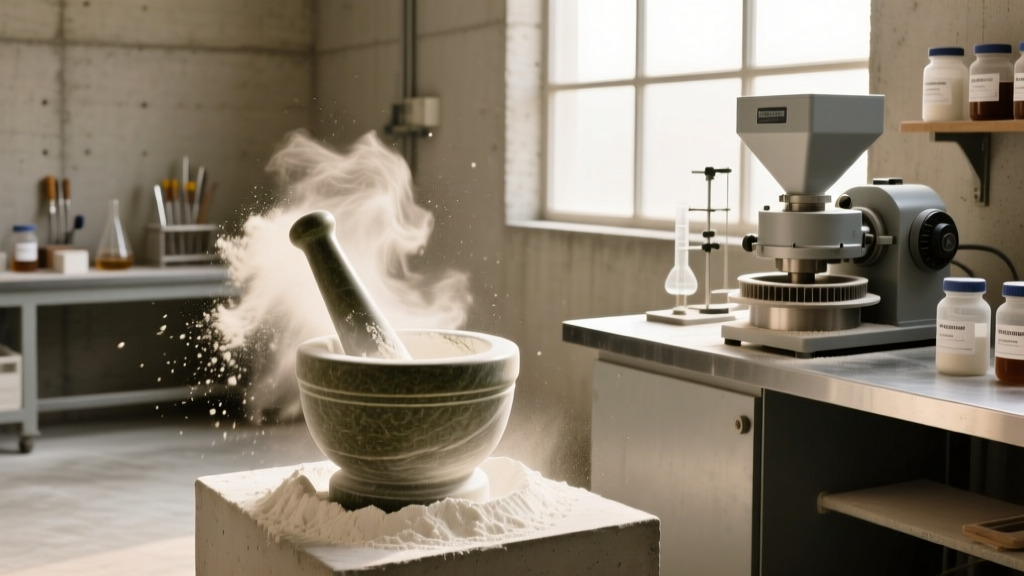
The Linguistic and Practical Divide in Cement Testing
In the construction industry, the word "mortar" almost exclusively refers to the workable paste of cement, lime, sand, and water used to bind masonry. However, in the cement manufacturing and QA/QC laboratory, the mortar and pestle is a critical precision tool used for analytical sample preparation. Confusion occasionally arises when junior lab technicians or field engineers conflate the masonry material with the laboratory apparatus.
This guide bridges that gap by focusing entirely on the application-fit of the manual mortar and pestle in cementitious material analysis. While mechanical ring-and-puck mills dominate high-throughput commercial cement plants, the manual mortar and pestle remains indispensable for specialized, low-volume, and highly sensitive crystallographic testing.
Application-Fit: Where the Mortar and Pestle Excels in QA/QC
The decision to use a manual mortar and pestle rather than a mechanical mill (like a tungsten carbide ring mill or planetary ball mill) hinges on sample size, contamination tolerance, and the specific analytical technique being employed.
X-Ray Diffraction (XRD) and Rietveld Refinement
For quantitative phase analysis of cement clinker using XRD, particle size must typically be reduced to less than 10 micrometers (µm), ideally around 5 µm, to minimize microabsorption effects and ensure sharp diffraction peaks. A manual agate mortar and pestle is the preferred tool for small-batch XRD samples (1 to 5 grams). Mechanical mills often introduce excessive kinetic energy, which can lead to mechanochemical amorphization—a phenomenon where the crystalline structure of alite (C3S) and belite (C2S) degrades into an amorphous state, ruining the Rietveld refinement data.
X-Ray Fluorescence (XRF) Loose Powder Analysis
While pressed pellet XRF requires a strict 200-mesh (75 µm) grind best achieved with mechanical mills, "loose powder" or "quick scan" XRF testing often utilizes a manual mortar and pestle. When a field engineer needs a rapid oxide composition check of a raw meal or kiln dust sample without the 15-minute cleanup protocol of a mechanical mill, a 3-minute manual grind in a porcelain mortar provides sufficient homogeneity for semi-quantitative screening.
Scenario Matching Matrix: Manual vs. Mechanical Milling
Selecting the right comminution equipment prevents data skew and equipment damage. Use the following decision matrix to match your cement testing scenario with the correct tool.
| Testing Scenario | Sample Size | Preferred Tool | Rationale & Constraints |
|---|---|---|---|
| XRD Phase Analysis (Clinker) | 1 - 5 grams | Agate Mortar and Pestle | Prevents amorphization; allows precise control over grinding time to preserve crystal lattices. |
| XRF Pressed Pellet (Cement) | 10 - 20 grams | Tungsten Carbide Ring Mill | Requires strict <75 µm particle size; manual grinding cannot efficiently achieve 100% 200-mesh compliance. |
| Quick Raw Meal Screening | 5 - 10 grams | Porcelain Mortar and Pestle | Fast turnaround; minor silica contamination from porcelain is acceptable for raw meal screening. |
| Concrete Core Dust (Chloride) | 20+ grams | Mechanical Disk Mill | Hardened concrete requires high-impact crushing; manual pestles will bounce off coarse aggregate. |
Material Selection: Agate, Porcelain, or Alumina?
The chemical composition of your mortar and pestle dictates its viability for cement chemistry. Contamination from the grinding vessel is inevitable; the goal is to choose a material whose contamination does not interfere with the target analytes.
- Agate (SiO2): The gold standard for cement XRD and XRF. Hardness of 7 Mohs. Expensive ($150-$300 per set) but chemically compatible with cementitious matrices.
- Porcelain (Glazed): Suitable for rough, non-quantitative grinding of raw limestone or kiln dust. Prone to chipping and glaze degradation over time.
- Alumina (Al2O3): Avoid for cement. Introduces unacceptable aluminum contamination, masking the true C3A (tricalcium aluminate) content of the sample.
Step-by-Step: Preparing Clinker for XRD via Manual Grinding
To achieve the optimal 5 µm particle size without inducing amorphization, follow this wet-grinding protocol validated by modern crystallographic standards.
- Initial Crushing: Place 3 grams of kiln clinker into the agate mortar. Use the pestle in a vertical pounding motion to fracture the nodules down to roughly 1 mm (sand-sized) grains.
- Solvent Addition: Add 5 mL of analytical-grade ethanol (or isopropanol). Do not use water. Water will initiate the hydration of C3S and C3A, altering the phase composition before the X-ray beam even hits the sample.
- Rotary Grinding: Switch from pounding to a firm, circular grinding motion. Apply downward pressure, forcing the slurry against the inner walls of the mortar. Grind for exactly 4 to 6 minutes.
- The 'Thumb Test': Rub a drop of the slurry between your thumb and forefinger. It should feel completely smooth, like toothpaste, with zero grittiness. If grit is detected, continue grinding in 1-minute increments.
- Drying: Transfer the slurry to a glass watch glass and place it in a drying oven at 60°C for 15 minutes to evaporate the ethanol.
- Sieving (Optional but Recommended): Pass the dried powder through a 45 µm (325 mesh) sieve to remove any unground coarse particles before packing into the XRD sample holder.
Common Failure Modes in Manual Cement Grinding
Even experienced lab technicians fall into predictable traps when using a mortar and pestle for cement analysis.
"The most frequent error in manual XRD sample preparation is over-grinding. Technicians assume 'finer is always better,' but grinding cement clinker beyond 15 minutes manually induces localized heat and shear stress that converts crystalline alite into an amorphous glass, rendering quantitative phase analysis impossible."
— Principles of Cement Chemistry Laboratory Protocols
Failure Mode 1: Agglomeration
As particles approach the sub-10 µm range, Van der Waals forces cause them to clump together into hard agglomerates. These agglomerates scatter X-rays poorly and cause severe preferred orientation in the XRD sample holder. Fix: Always use a liquid grinding aid (ethanol) and add 1-2 drops of a dispersant if dry-packing the sample.
Failure Mode 2: Cross-Contamination
Using the same agate mortar for high-sulfate slag cements and standard OPC (Ordinary Portland Cement) without proper decontamination will skew SO3 readings. Fix: Perform a "blank grind" using quartz sand or discarded material from the next sample to scour the microscopic pores of the agate surface before testing.
Industry Standards and Further Reading
Proper sample preparation is governed by strict analytical frameworks. For laboratories operating under ISO or ASTM guidelines, adherence to comminution standards is mandatory for certification. For deeper exploration of cement chemical analysis and crystallographic sample prep, consult the following authoritative resources:
- ASTM C114: Standard Test Methods for Chemical Analysis of Hydraulic Cement - Outlines the baseline requirements for sample homogeneity and particle size reduction in cement chemistry.
- Malvern Panalytical: XRD Sample Preparation Guidelines - Provides critical data on avoiding amorphization and preferred orientation during manual grinding of geological and cementitious materials.
- EAG Laboratories: X-Ray Fluorescence (XRF) Analysis - Details the particle size requirements and matrix effect corrections necessary for accurate oxide profiling in complex building materials.