Roman Concrete vs Modern Mixes: Technical Specs & Longevity
Compare Roman concrete vs modern Portland cement. Explore technical specs, chemical compositions, and why ancient marine structures outlast modern builds.

The Durability Paradox: Strength vs. Service Life
When engineers evaluate Roman concrete vs modern Portland cement, a fundamental misconception often clouds the analysis: conflating compressive strength with structural longevity. Modern Ordinary Portland Cement (OPC) routinely achieves compressive strengths of 40 to 80 MPa (megapascals) within 28 days. In stark contrast, core samples from ancient Roman marine structures, such as the breakwaters at Portus Cosanus, typically exhibit compressive strengths of only 5 to 15 MPa. Yet, while modern reinforced concrete structures in marine environments often suffer critical degradation within 50 to 100 years, Roman opus caementicium has survived continuous seawater exposure for over two millennia.
The divergence lies in the chemical architecture of the binder matrix, the curing thermodynamics, and the long-term mineralogical evolution of the concrete. Understanding these technical specifications is critical for materials scientists and structural engineers looking to design high-durability, low-carbon infrastructure in 2026.
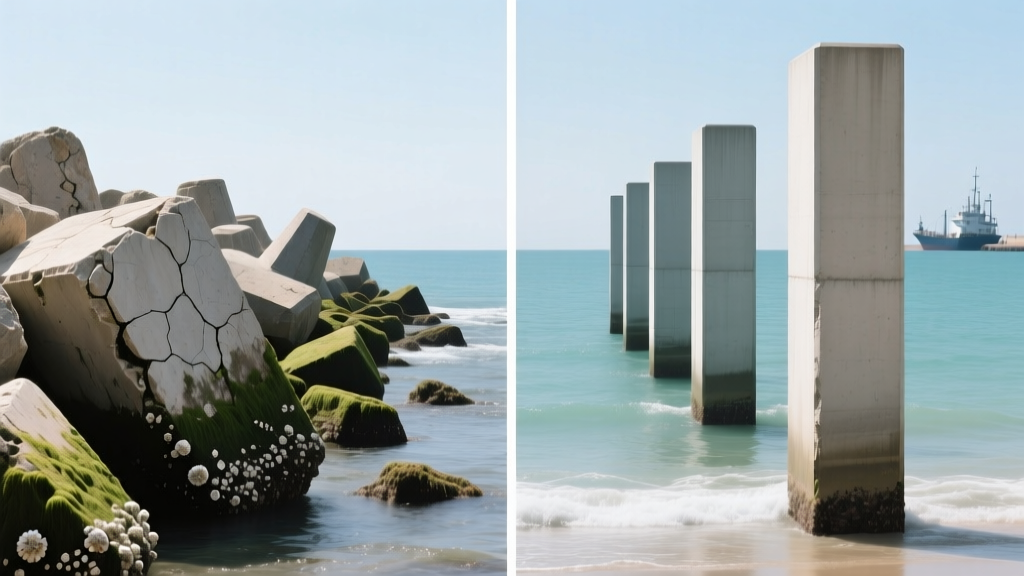
Chemical Composition Matrix: Opus Caementicium vs. OPC
The baseline chemistry of Roman and modern concretes dictates their respective failure modes. Modern OPC relies on the calcination of limestone and clay to form clinker, which is then ground with gypsum. Roman concrete utilized a pozzolanic reaction between slaked or quicklime and volcanic ash (pozzolana).
| Specification Parameter | Modern OPC (Type I/II) | Roman Marine Concrete (Opus Caementicium) |
|---|---|---|
| Primary Binder | Alite (C3S) and Belite (C2S) | Calcium hydroxide + Pozzolana (volcanic ash) |
| Aggregate Type | Crushed limestone, granite, or river gravel | Tuff, pumice, and ceramic/brick fragments |
| Curing Mechanism | Hydration of calcium silicates | Pozzolanic reaction and hot-mixing exotherm |
| Reinforcement | Steel rebar (susceptible to chloride corrosion) | None (mass concrete relies on sheer volume) |
| Typical 28-Day Strength | 30 - 50+ MPa | 5 - 15 MPa |
| Marine Degradation Mode | Chloride ingress, rebar rust expansion, sulfate attack | Continued mineral precipitation (self-healing) |
The Curing Mechanism: Hot Mixing and Lime Clasts
For decades, researchers believed the white, chalky inclusions found in Roman concrete samples were simply the result of poor mixing techniques or low-quality aggregate. A landmark 2023 study by researchers at MIT and the Harvard University Department of Earth and Planetary Sciences fundamentally rewrote this specification. Using high-resolution synchrotron X-ray microdiffraction, the team discovered that these inclusions are actually lime clasts—calcium carbonate remnants formed during a process known as "hot mixing."
The Thermodynamics of Hot Mixing
Roman engineers did not use slaked lime (calcium hydroxide) for their most critical marine applications. Instead, they mixed quicklime (calcium oxide) directly with water and pozzolanic ash. This highly exothermic reaction pushes the temperature of the mix past 200°C (392°F). This extreme heat accomplishes two critical technical objectives:
- High-Temperature Mineral Formation: It facilitates the creation of high-temperature calcium-aluminum-silicate-hydrate (C-A-S-H) phases that would not form in cold-slaked lime mixes.
- Lime Clast Encapsulation: It creates brittle, nanocrystalline lime clasts that act as a built-in self-healing mechanism.
When a micro-crack forms in the Roman matrix, water enters the fissure and dissolves the calcium carbonate from the lime clasts. The calcium-rich solution then flows into the crack and recrystallizes as calcium carbonate, effectively sealing the breach before it can propagate. As noted in the MIT findings on Roman concrete durability, this autogenous healing capability is virtually nonexistent in standard modern OPC mixes, which rely on external sealants or costly crystalline admixtures to achieve similar results.
Marine Durability and Al-Tobermorite Formation
The most striking divergence between Roman concrete vs modern formulations occurs in marine environments. In modern OPC, seawater is an active destroyer. Chloride ions penetrate the porous matrix, reaching the steel reinforcement and causing oxidation. The resulting iron oxide occupies up to six times the volume of the original steel, creating immense internal tensile stresses that spall and shatter the concrete. Furthermore, seawater sulfates react with the aluminate phases in OPC to form ettringite, an expansive mineral that tears the matrix apart from the inside.
Roman concrete, lacking steel reinforcement, turns seawater into a structural asset. Research published in the Proceedings of the National Academy of Sciences (PNAS) detailed how seawater percolating through the volcanic ash matrix dissolves silica and alumina. This fluid then precipitates rare, interlocking minerals—specifically Al-tobermorite and phillipsite.
Technical Insight: The Role of Al-Tobermorite
Al-tobermorite is a rare, hydrothermal calcium-silicate-hydrate mineral. It features a highly stable, stiff crystalline lattice that resists leaching and provides exceptional fracture toughness. While modern C-S-H gels are largely amorphous and prone to long-term creep and shrinkage, the crystalline Al-tobermorite in Roman concrete actually increases in structural cohesion the longer it is exposed to seawater.
Structural Limitations: Why Modern Engineering Still Relies on OPC
Despite the superior longevity of Roman formulations, modern construction cannot simply revert to opus caementicium. The technical limitations of Roman concrete are incompatible with contemporary architectural and structural demands:
- Tensile Deficits: Roman concrete has near-zero tensile strength. Modern high-rises, suspended bridges, and long-span slabs require the immense tensile capacity of steel-reinforced concrete. Roman mass concrete relies entirely on gravity and compressive arching, limiting architectural geometries.
- Setting Times and Formwork: Modern OPC is engineered with precise gypsum additions to control the setting time, allowing for rapid formwork stripping (often within 24 hours) and multi-story pours per week. Roman pozzolanic mixes cure incredibly slowly, requiring massive, static timber formwork that cannot be moved for months.
- Material Sourcing: The specific volcanic ash (pozzolana) from the Campi Flegrei region near Naples possesses a unique, highly reactive amorphous silica profile. Replicating this exact geological profile at a global, industrial scale is logistically unfeasible.
Modern Adaptations: Specifying Roman-Inspired Mixes in 2026
Rather than copying Roman concrete directly, modern materials science is adapting its underlying chemical principles to create high-durability, low-carbon blends. The focus in 2026 is on Supplementary Cementitious Materials (SCMs) and advanced blended cements that mimic the pozzolanic and self-healing traits of ancient mixes while maintaining the high early-strength requirements of modern construction.
Actionable Specification Guidelines for High-Durability Mixes
For engineers and contractors specifying concrete for aggressive environments (marine, de-icing salts, or high-sulfate soils), the following technical specifications bridge the gap between Roman longevity and modern strength:
- Utilize LC3 (Limestone Calcined Clay Cement): LC3 replaces up to 50% of Portland clinker with calcined clay and ground limestone. The calcined clay acts as a highly reactive pozzolan, mimicking the role of Roman volcanic ash. This drastically reduces the carbon footprint while forming a denser, less permeable C-A-S-H gel that resists chloride ingress.
- Specify ASTM C595 Blended Cements: Move away from pure OPC (ASTM C150). Specify Type IP (Portland-Pozzolan) or Type IS (Portland Slag) cements. These blends utilize fly ash, natural pozzolans, or slag to consume the free calcium hydroxide (which is vulnerable to sulfate attack) and convert it into additional, stable C-S-H gel.
- Strict Water-to-Cementitious Materials (w/cm) Ratios: Roman concrete was often placed relatively dry and heavily tamped. For modern pours, restrict the w/cm ratio to a maximum of 0.40 for marine exposure. Use polycarboxylate ether (PCE) superplasticizers to maintain workability without adding excess water, which creates capillary pores and accelerates degradation.
- Incorporate Crystalline Admixtures: To replicate the self-healing properties of Roman lime clasts, specify integral crystalline waterproofing admixtures (conforming to ASTM C1918). These chemicals remain dormant in the matrix until a crack forms and water enters, at which point they precipitate insoluble crystalline structures that seal micro-fissures up to 0.4 mm wide.
"The future of sustainable infrastructure does not lie in inventting entirely new binders, but in reverse-engineering the thermodynamic and mineralogical brilliance of ancient Roman formulations and applying them to modern blended cements."
— Adapted from materials science consensus on historical concrete durability.
The Carbon Footprint Paradox
The production of modern Portland clinker requires heating limestone to 1,450°C, releasing massive amounts of CO2 both from the fuel combustion and the chemical calcination process itself. The cement industry is responsible for approximately 8% of global CO2 emissions. Roman concrete, which utilized quicklime heated to only 900°C and relied heavily on uncalcined volcanic ash, possessed a significantly lower embodied carbon profile. By shifting specifications toward high-volume SCM blends, LC3, and geopolymers, the modern construction industry is effectively tracing a 2,000-year loop—returning to the pozzolanic chemistry of the Romans to secure a sustainable, durable built environment for the future.
Written by
James ThorntonJames Thornton is a construction industry veteran with 25 years of hands-on experience in wood framing, lumber grading, and residential building codes. He started as a framing carpenter in rural Oregon, earned his ICC Residential Building Inspector certification, and eventually became a senior plan reviewer for the City of Portland Bureau of Development Services. James holds a B.S. in Wood Science & Technology from Oregon State University and is a certified lumber grader through the West Coast Lumber Inspection Bureau (WCLIB). He has inspected over 3,000 residential construction sites and authored the city's internal guide on advanced framing techniques (2x6 at 24" O.C.). James lives in Bend, OR, where he builds custom timber-frame cabins and competes in lumberjack sports.
More from James Thornton
View all
Insulation
Best Home Insulation Materials: Complete 2026 Guide
Compare top home insulation materials for 2026. Find R-values, installed costs per square foot, and best uses for fiberglass, spray foam, and mineral wool.
Aug 4, 2026

Sustainable Building
Certify Your Green Building Material for LEED and WELL
Step-by-step guide to certifying a green building material for LEED v5 and WELL v2. Master EPDs, HPDs, and VOC limits for 2026 project specifications.
Aug 4, 2026

Stone & Masonry
Veneer Stacked Stone Panels: Interior Design & Style Showcase
Discover how veneer stacked stone panels transform interiors. Explore modern design profiles, material pairings, and technical installation specs.
Aug 4, 2026