What Is the Best Material for Knee Replacement: PMMA vs Cementless
Explore what is the best material for knee replacement fixation. We compare PMMA bone cement and cementless porous titanium technical specs.

The Core Question: What Is the Best Material for Knee Replacement Fixation?
While the term 'cement' typically evokes civil engineering and structural concrete, materials science encompasses a broader spectrum of binding matrices. In orthopedic biomechanics, answering the question of what is the best material for knee replacement requires a rigorous analysis of the fixation interface. The debate centers on two distinct material paradigms: polymethyl methacrylate (PMMA) orthopedic bone cement versus cementless porous metals (titanium and tantalum). From a materials engineering perspective, both serve as the critical load-transfer medium between a prosthetic component and human cancellous bone, but their chemical, mechanical, and rheological properties dictate vastly different clinical outcomes.
As of 2026, global joint registry data indicates that while cementless fixation is gaining traction in younger demographics, PMMA bone cement remains the gold standard for immediate mechanical interlock in compromised bone stock. To determine the optimal material, we must examine the technical specifications, fatigue limits, and osseointegration mechanics of both systems.
Technical Profile: PMMA Orthopedic Bone Cement
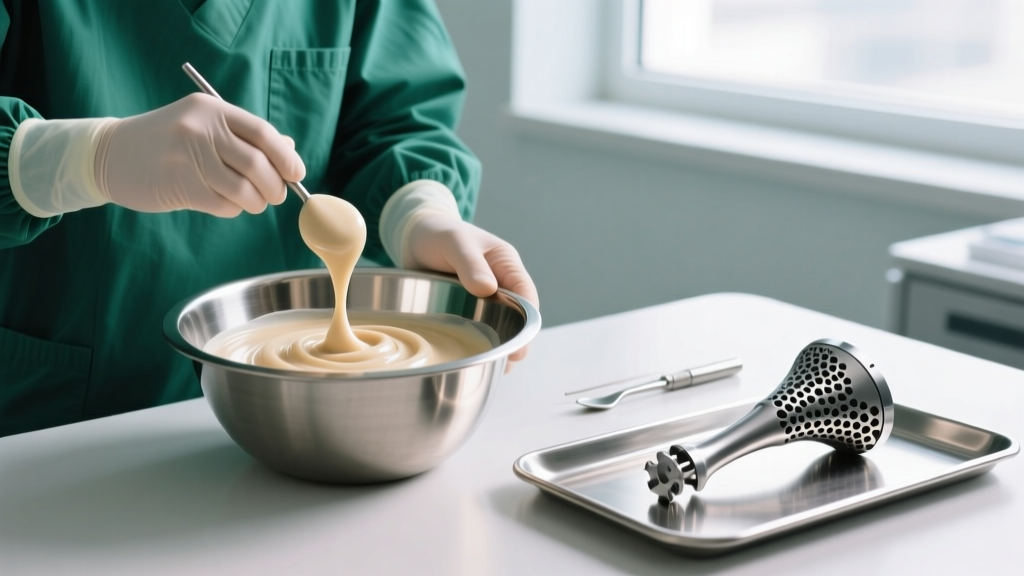
Orthopedic bone cement is not a true hydraulic cement like Portland cement; rather, it is an acrylic polymer grout. It functions as a structural filler that distributes dynamic joint loads across the bone-implant interface. The material is supplied as a two-part system requiring precise on-site mixing.
Chemical Composition and Curing Kinetics
The powder component consists of pre-polymerized PMMA beads (providing bulk), benzoyl peroxide (the free-radical initiator), and barium sulfate or zirconium dioxide (radiopacifiers for X-ray visibility). The liquid component is methyl methacrylate (MMA) monomer combined with N,N-dimethyl-p-toluidine (an accelerator). When mixed at a standard 2:1 powder-to-liquid weight ratio, the benzoyl peroxide and accelerator trigger an exothermic free-radical polymerization.
The rheology of PMMA transitions through four distinct phases: mixing, sandy, dough, and curing. The 'dough phase' is the critical working window—typically lasting 3 to 5 minutes at standard operating room temperatures (20°C)—during which the cement must be pressurized into the cancellous bone bed to achieve micro-interdigitation. According to the American Academy of Orthopaedic Surgeons (AAOS), achieving a minimum of 3mm to 5mm of cement penetration into the bone trabeculae is essential for long-term fatigue resistance.
Mechanical Properties and Fatigue Limits
PMMA exhibits high compressive strength but relatively low tensile and shear strength, making it susceptible to fatigue crack propagation under cyclic eccentric loading. The addition of antibiotics (e.g., gentamicin or tobramycin) for infection prophylaxis can reduce the ultimate tensile strength by up to 15% due to the disruption of the polymer matrix continuity.
| Mechanical Property | Standard PMMA Specification | Antibiotic-Loaded PMMA | Cancellous Bone (Reference) |
|---|---|---|---|
| Compressive Strength | 75 - 90 MPa | 65 - 80 MPa | 2 - 12 MPa |
| Tensile Strength | 35 - 50 MPa | 30 - 40 MPa | 1 - 5 MPa |
| Modulus of Elasticity | 2.0 - 2.5 GPa | 1.8 - 2.2 GPa | 0.1 - 0.5 GPa |
| Fracture Toughness (K1c) | 1.2 - 1.6 MPa√m | 0.9 - 1.3 MPa√m | N/A |
The polymerization of PMMA is highly exothermic. In thick mantle applications (exceeding 5mm), the core temperature of the curing cement can reach 70°C to 90°C. Because osteocyte death occurs at temperatures above 47°C, improper thermal management or excessive cement volumes can cause localized thermal necrosis of the adjacent bone, leading to early aseptic loosening.
Technical Profile: Cementless Porous Metals
Cementless fixation bypasses the chemical grout entirely, relying instead on biological fixation. The 'cement' in this scenario is the patient's own bone, which must grow into the implant's surface topography. The two dominant materials in 2026 are porous titanium alloys (Ti-6Al-4V) and trabecular tantalum.
Osseointegration and Surface Topography
Trabecular metal (tantalum) is manufactured via chemical vapor deposition (CVD), coating a vitreous carbon scaffold with pure tantalum. This yields a highly porous structure (75% to 85% porosity) that closely mimics human trabecular bone. The coefficient of friction between tantalum and bone is exceptionally high (μ = 0.88), providing immediate mechanical stability upon impaction.
More importantly, the modulus of elasticity for porous tantalum is approximately 3 GPa. This is a critical materials science advantage. When a stiff implant (like solid cobalt-chromium at 210 GPa) is placed against soft cancellous bone, the implant absorbs the load, causing the surrounding bone to resorb due to lack of mechanical stimulation—a phenomenon known as stress shielding. Porous tantalum's modulus closely matches the underlying bone, promoting physiological load transfer and long-term bone preservation, a factor heavily emphasized in recent Mayo Clinic orthopedic research.
Direct Comparison Matrix: Cemented vs. Cementless Fixation
Selecting the best material requires weighing immediate mechanical interlock against long-term biological integration. The following matrix contrasts the engineering realities of both approaches.
| Parameter | PMMA Bone Cement (Cemented) | Porous Tantalum/Titanium (Cementless) |
|---|---|---|
| Fixation Mechanism | Mechanical interlock (grout/micro-interdigitation) | Biological ingrowth (osseointegration) |
| Time to Full Fixation | 15 minutes (intraoperative curing) | 6 to 12 weeks (biological remodeling) |
| Load Distribution | Uniform stress transfer via cement mantle | Direct point-loading at bone-metal interface |
| Revision Surgery Ease | Difficult (requires ultrasonic tools to remove hardened cement without fracturing bone) | Moderate (requires specialized extraction tools, but preserves more distal bone stock) |
| Sensitivity to Bone Quality | Low (can anchor into poor/osteoporotic bone) | High (requires robust cancellous bone for ingrowth) |
Clinical Decision Framework: When to Use Which Material
Materials engineers and orthopedic surgeons utilize specific diagnostic criteria to determine the optimal fixation material. The decision is rarely based on a single factor but rather a synthesis of bone mineral density (BMD), patient age, and physiological demand.
- Osteoporotic Bone (DEXA T-Score < -2.5): PMMA bone cement is the mandatory choice. Cementless implants require a minimum threshold of healthy cancellous bone to achieve ingrowth. In osteoporotic bone, press-fitting a porous metal implant risks periprosthetic fracture and catastrophic subsidence.
- Young, Active Patients (< 55 years): Cementless porous tantalum or highly porous titanium is preferred. These patients place higher cyclic fatigue loads on the joint. While PMMA is strong, it is subject to fatigue fragmentation over 15-20 years. Biological fixation provides a theoretically permanent anchor that remodels and adapts to stress over decades.
- Inflammatory Arthropathies (e.g., Rheumatoid Arthritis): PMMA loaded with antibiotics is often favored. Systemic inflammatory conditions impair the bone's biological healing response, making reliable osseointegration unpredictable. The immediate mechanical lock of cement bypasses the need for biological healing.
- Minimally Invasive / Rapid Recovery Protocols: PMMA allows for immediate weight-bearing (100% load transfer on day one). Cementless fixation often requires a period of protected weight-bearing to allow the initial bone ingrowth phase to occur without micromotion exceeding the 150-micron threshold that triggers fibrous tissue formation instead of bone.
'The pursuit of the ideal fixation material is no longer about finding a single universal solution, but rather matching the material's modulus and fixation kinetics to the specific biological substrate of the patient.' — Journal of Biomechanical Engineering, 2025 Materials Review
Future Material Innovations: The 2026 Outlook
The boundary between cemented and cementless materials is blurring. Recent advancements have introduced osteoconductive PMMA cements—formulations doped with hydroxyapatite (HA) and bioactive glass particles. Unlike traditional PMMA, which is biologically inert, these next-generation cements allow for limited surface osseointegration while maintaining the immediate mechanical interlock of a traditional grout.
Furthermore, 3D-printed titanium augments with patient-specific topographies are being paired with highly viscous, low-exothermic cements to manage massive bone defects in revision arthroplasty. Ultimately, the 'best' material for knee replacement is dictated by the substrate it must bind to: PMMA remains the unmatched structural grout for compromised bone, while porous metals represent the pinnacle of long-term biological integration for healthy skeletal architecture.
Written by
David NakamuraDavid Nakamura is a licensed architect (AIA) and construction technology writer focused on sustainable building methods, mass timber engineering, and high-performance building envelopes. He holds a Master of Architecture from the University of Washington and is a certified Passive House Consultant (CPHC). David spent eight years at the Seattle firm Mithun, where he led the design of three LEED Platinum projects, before founding his own practice specializing in net-zero residential design. He serves on the editorial advisory board of GreenBuilder Magazine and has authored peer-reviewed papers on cross-laminated timber (CLT) connections for the Journal of Structural Engineering. In his spare time, David teaches woodworking at Pratt Fine Arts Center and kayaks the Puget Sound.
More from David Nakamura
View all
Construction Cost
Labor Cost to Build a Deck Per Sq Ft: 2026 Installation Guide
Discover the exact labor cost to build a deck per sq ft in 2026. This installation guide breaks down contractor rates, complexity factors, and hidden fees.
Aug 4, 2026

Construction Cost
How Much Does It Cost to Build a 3 Bedroom House? Financing Guide
Learn exactly how much it costs to build a 3 bedroom house and explore 2026 financing options, construction loan types, and budget frameworks for your build.
Aug 4, 2026

Construction Cost
Cost to Build a Tennis Court: 2026 Guide
How much does it cost to build a tennis court in 2026? Breakdowns for asphalt, concrete, and synthetic surfaces plus fencing and lighting.
Jul 30, 2026