Polished vs Sealed Concrete: Cost, Durability & Best Uses
Compare polished vs sealed concrete for your project. Explore costs, durability, slip resistance, and maintenance to choose the right finish.

The Core Difference: Mechanical Abrasion vs. Chemical Topcoats
When specifying architectural concrete floors, the debate between polished vs sealed concrete fundamentally comes down to physical alteration versus chemical protection. Polished concrete relies on heavy planetary grinders equipped with diamond-impregnated tooling to mechanically abrade the surface, exposing the aggregate and densifying the cementitious matrix. Sealed concrete, conversely, leaves the raw concrete surface largely untouched but applies a topical or penetrating chemical barrier to repel water, oils, and stains.
Choosing between the two requires a strict evaluation of the slab's moisture vapor transmission (MVT) rates, expected foot traffic, UV exposure, and long-term maintenance budgets. Below is a technical breakdown of both systems to guide your specification.
Quick Decision Framework
- Choose Polished Concrete if: You have high MVT (moisture vapor transmission), require a 15+ year lifespan without re-coating, and want a low-maintenance, vapor-permeable surface.
- Choose Sealed Concrete if: You are working with a strict budget (under $3.00/sq. ft.), need immediate chemical spill protection for a garage or lab, or want to alter the color with an acid stain before sealing.
Deep Dive: Polished Concrete Specifications & Costs
Polishing is a multi-step mechanical process. It begins with coarse metal-bonded diamonds (30 to 120 grit) to level the slab and expose aggregate, followed by the application of a chemical densifier, and finishes with resin-bonded diamonds (400 to 3000 grit) to achieve the desired sheen.
The Chemistry of Densifiers
The densifier is the most critical chemical component in polished concrete. It reacts with the free lime (calcium hydroxide) in the concrete to form calcium silicate hydrate (C-S-H), which permanently hardens the surface.
- Lithium Silicate: The premium standard. It penetrates deeply, reacts quickly, and does not require scrubbing. It leaves no white efflorescence residue. Cost: $$
- Potassium Silicate: A mid-tier option. Good penetration but requires more mechanical agitation during application than lithium. Cost: $
- Sodium Silicate: The budget option. Highly alkaline and prone to leaving a white, powdery residue (efflorescence) if over-applied or not thoroughly rinsed. Not recommended for high-end architectural finishes. Cost: $
Grit Levels and Pricing
The final grit level dictates both the aesthetic and the cost. According to industry standards outlined by the Concrete Network, the progression typically falls into three categories:
- Honed/Matte (400 Grit): Low sheen, excellent slip resistance. Ideal for industrial spaces. Cost: $3.50 - $5.50 per sq. ft.
- Satin (800 Grit): Medium sheen, reflects some light. The standard for retail and commercial spaces. Cost: $5.00 - $8.00 per sq. ft.
- High Gloss (1500 - 3000 Grit): Mirror-like reflectivity. Requires a high-precision flat slab (FF/FL numbers above 50). Cost: $7.50 - $12.00+ per sq. ft.
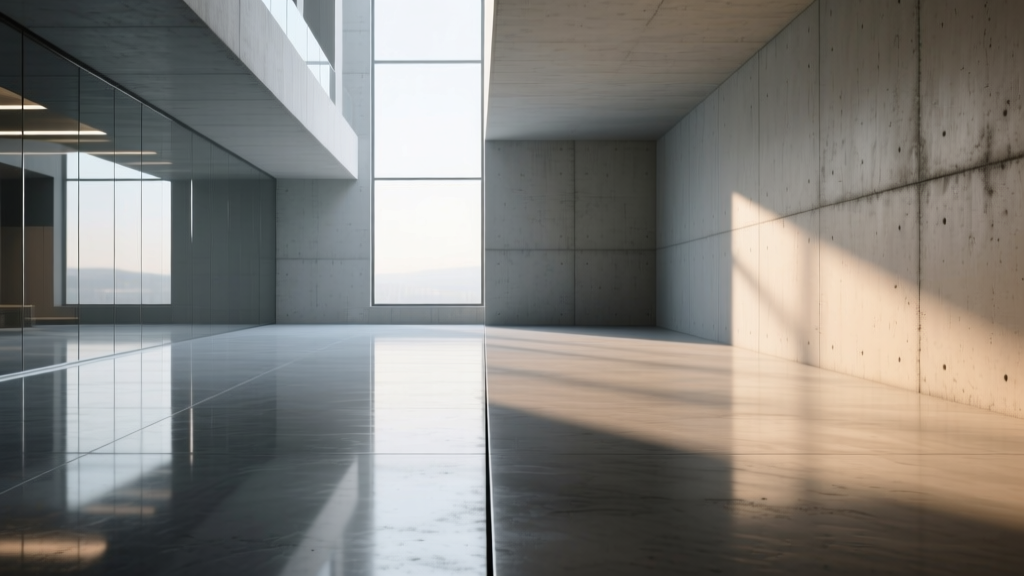
Deep Dive: Sealed Concrete Specifications & Costs
Sealers are categorized by how they interact with the concrete substrate: penetrating (below surface) or topical (film-forming on the surface).
Penetrating Sealers (Silane/Siloxane)
These sealers do not alter the appearance or traction of the concrete. They react within the pores to create a hydrophobic barrier. They are excellent for exterior driveways and freeze-thaw protection but offer zero resistance to surface abrasion or physical scuffing. Cost: $1.25 - $2.50 per sq. ft.
Topical Film-Forming Sealers
- Acrylics: Available in water-based and solvent-based formulas. They provide a wet-look sheen and UV stability but are soft. They scratch easily and require re-application every 1 to 3 years. Cost: $1.50 - $3.00 per sq. ft.
- Epoxies: High-build, extremely hard, and chemical resistant. Standard aromatic epoxies will amber and chalk under UV exposure. Aliphatic epoxies are UV-stable but cost significantly more. Cost: $4.50 - $8.00 per sq. ft.
- Polyurethanes (Urethanes): The gold standard for topical concrete protection. Aliphatic polyurethanes offer superior UV stability, high abrasion resistance, and excellent chemical defense against oils and solvents. Often used as a topcoat over epoxy. Cost: $5.00 - $9.00 per sq. ft.
Head-to-Head Comparison Matrix
| Feature | Polished (800 Grit) | Acrylic Sealer | Aliphatic Polyurethane |
|---|---|---|---|
| Initial Cost | $5.00 - $8.00 / sq ft | $1.50 - $3.00 / sq ft | $5.00 - $9.00 / sq ft |
| Lifespan | 15 - 20+ Years | 1 - 3 Years | 5 - 10 Years |
| Vapor Permeability | High (Breathable) | Moderate | Low (Traps Moisture) |
| UV Stability | Excellent | Excellent | Excellent |
| Chemical Resistance | Moderate (Vulnerable to acids) | Low | High |
The Hidden Trap: Moisture Vapor Transmission (MVT)
The most common point of catastrophic failure in sealed concrete floors is ignoring Moisture Vapor Transmission. Before applying any topical film-forming sealer (epoxy, polyurethane, or acrylic), contractors must perform relative humidity testing per ASTM F2170.
If the internal relative humidity of the concrete slab exceeds 75% (or the manufacturer's specific threshold), the hydrostatic pressure will push moisture vapor upward. Because topical sealers are impermeable, this vapor becomes trapped, causing the sealer to blister, turn white (amine blush), and ultimately delaminate from the substrate. Polished concrete is vapor-permeable, allowing the slab to 'breathe' and completely bypassing the risk of MVT-related coating failures.
Slip Resistance and Safety Standards
When evaluating polished vs sealed concrete for commercial or public spaces, slip resistance is a critical liability factor. The ANSI A326.3 standard requires a Dynamic Coefficient of Friction (DCOF) of at least 0.42 for level interior spaces expected to be walked on when wet.
Highly polished concrete (1500+ grit) can drop below a 0.30 DCOF when wet, creating a severe slip hazard. To mitigate this without sacrificing the aesthetic, specify a micro-etching process during the final polishing stages, or mandate the inclusion of an anti-slip additive (such as aluminum oxide grit) if a topical polyurethane sealer is being applied. For exterior applications, a penetrating siloxane sealer combined with a broom-finished or exposed-aggregate substrate will easily exceed the 0.42 DCOF requirement, whereas a topical acrylic will become dangerously slick in rainy conditions.
Maintenance Realities: What the Contractors Won't Tell You
Both systems require specific maintenance protocols to preserve their lifespan. The most frequent mistake facility managers make is using acidic or highly alkaline cleaning agents.
Polished Concrete Maintenance
Polished concrete is highly vulnerable to acidic spills (e.g., citrus juices, vinegar, battery acid, or acidic tile cleaners). Acids dissolve the calcium carbonate in the concrete, permanently etching the surface and destroying the reflective sheen. Maintenance requires daily dust mopping and weekly wet mopping using a strictly pH-neutral cleaner (pH 7.0 to 8.0). Auto-scrubbers should be fitted with soft pads (white or red), never aggressive black stripping pads.
Sealed Concrete Maintenance
Topical sealers take the abuse so the concrete doesn't have to. However, acrylics and urethanes will show micro-scratches and scuff marks from foot traffic and rolling loads. While they resist acidic etching better than bare polished concrete, they require periodic burnishing to restore the gloss. Furthermore, once a topical sealer wears through to the substrate, the entire floor must be mechanically abraded (scuff-sanded) and re-coated; you cannot simply apply a new coat over a failing, contaminated sealer.
Summary: Specifying the Right System
Specify polished concrete for large-format retail, airports, and modern residential interiors where long-term lifecycle costs, vapor permeability, and high-traffic durability are paramount. Specify sealed concrete (specifically aliphatic polyurethanes or epoxies) for automotive garages, food processing plants, and laboratories where aggressive chemical spills, heavy steel-wheeled traffic, and strict sanitation protocols demand a thick, sacrificial, and chemically impermeable wear layer.
Written by
Priya KapoorPriya Kapoor is a real estate market analyst and construction economics researcher with expertise in housing affordability, development feasibility, and infrastructure investment. She holds a Master of Regional Planning from Cornell University and previously worked as a senior analyst at CBRE's Investment Properties group, where she modeled returns for $4B in mixed-use development pipelines. Priya now runs an independent research practice advising developers, municipalities, and REITs on construction cost forecasting and market timing. She publishes the quarterly "BuildMat Market Pulse" report tracking material price indices across 12 commodity categories. Based in Austin, TX, Priya serves on the board of Habitat for Humanity Austin and is a marathon runner.
More from Priya Kapoor
View all
Construction Cost
Cost to Build a 1600 Sq Ft Home in 2026: Full Breakdown
Accurate 2026 cost to build a 1600 sq ft home—material, labor, and regional pricing breakdowns included. Plan your budget with real-time estimates.
Aug 11, 2026

Wood & Lumber
Name the Types of Wood for Pressure Treatment and Preservation
Learn how to name the types of wood best suited for pressure treatment. Compare species treatability, chemical retention levels, and 2026 preservation costs.
Aug 4, 2026

Stone & Masonry
Stone Veneer Suppliers Lindenhurst: 2026 Cost Analysis
Analyze 2026 stone veneer costs in Lindenhurst, NY. Compare local supplier pricing, delivery fees, and Suffolk County installation labor rates.
Aug 4, 2026