Concrete Dye vs Stain: Choosing by Mix Design & Type
Compare concrete dye vs stain based on mix design. Learn how fly ash, slag, and water-cement ratios dictate your coloring method for flawless results.
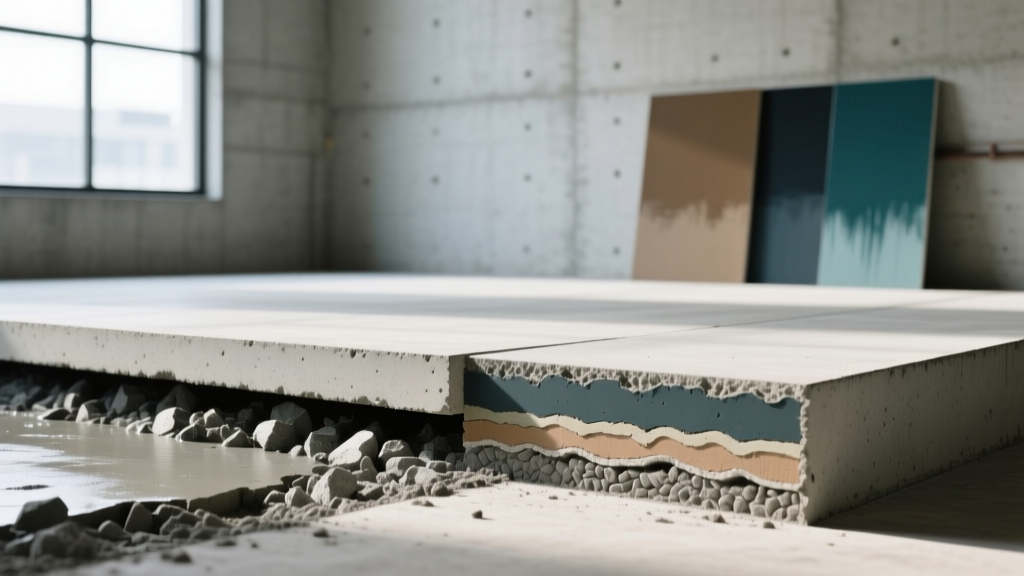
The Chemistry of Color: Why Mix Design Dictates Your Choice
The decision between concrete dye vs stain is rarely just an aesthetic preference; it is a strict chemical compatibility issue dictated by your concrete mix design. In modern construction, where high-performance and sustainable 'green' mixes are standard, applying the wrong coloring agent will result in catastrophic failure—ranging from blotchy, uneven color to complete rejection of the pigment. Understanding the micro-scale interaction between your cementitious matrix and the chosen colorant is the only way to guarantee a durable, vibrant finish.
Acid stains rely on a chemical reaction with calcium hydroxide (lime) in the hydrated cement paste. Dyes, conversely, rely on physical penetration of nano-particles (0.1 to 1 micron) into the capillary pores of the concrete. If your mix design alters the availability of calcium hydroxide or the porosity of the surface, you must pivot your coloring strategy accordingly.
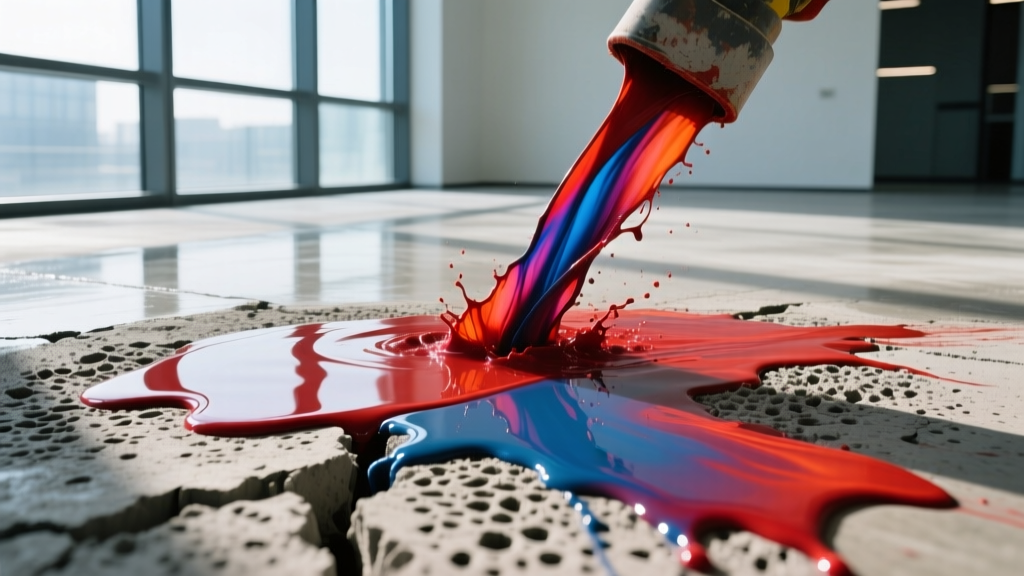
Acid Stains: The Calcium Hydroxide Dependency
Reactive acid stains (typically containing hydrochloric or phosphoric acid mixed with metallic salts) require a highly specific environment to work. The acid etches the surface, allowing metallic ions to react with the free lime (calcium hydroxide) produced during cement hydration. This reaction creates permanent, variegated, earth-toned colors.
Mix Designs That Kill Acid Stain Reactions
If you are specifying an acid stain, you must restrict the use of Supplementary Cementitious Materials (SCMs). Pozzolanic materials react with the very calcium hydroxide your stain needs to create color.
- Class F Fly Ash: Limit to a maximum of 15% by weight of cementitious material. Anything higher will severely deplete free lime, resulting in weak, washed-out, or completely non-reactive color.
- Slag Cement (GGBFS): Limit to 20%. High-slag mixes (often used for mass concrete to control heat of hydration) will yield unpredictable, pale stain reactions.
- Silica Fume: Avoid entirely in stain-grade slabs. Silica fume densifies the matrix and consumes calcium hydroxide rapidly, effectively sealing the pores against acid penetration while removing the reactive chemical target.
Ideal Mix Profiles for Reactive Stains
For flawless acid staining, specify a standard 3,000 to 4,000 psi mix using ASTM C150 Type I or Type I/II Portland cement. Maintain a water-cement (w/c) ratio between 0.45 and 0.55 to ensure adequate capillary porosity. Crucially, avoid hard steel troweling. A hard-troweled surface collapses the surface pores, creating a dense crust that the mild acid solution cannot penetrate. Specify a light float or broom finish for exterior, or a medium-float finish for interior slabs that will be ground later.
Concrete Dyes: Penetrating Denser Matrices
When evaluating concrete dye vs stain for modern, high-SCM, or polished concrete applications, dyes are the undisputed solution. Dyes are non-reactive. They consist of ultra-fine colorants suspended in a solvent (acetone, alcohol) or water carrier. Because they do not require a chemical reaction, they are entirely immune to the pozzolanic depletion caused by fly ash or slag.
Solvent-Based vs. Water-Based Dyes
Solvent-based dyes utilize extremely low surface-tension carriers. They can penetrate highly densified concrete, including slabs with w/c ratios as low as 0.35 and high-silica fume overlays. They flash off rapidly, locking the pigment into the micro-pores before it can be wiped away. Water-based dyes are more environmentally friendly but require a more open pore structure. They are best applied to lightly ground surfaces (e.g., 200-grit metal bonds) before the application of a chemical densifier.
Why Dyes Save High-SCM Mixes
In 2026, sustainability mandates frequently require concrete mixes containing 30% to 50% SCMs to lower the embodied carbon footprint. These 'green' mixes are notoriously hostile to acid stains. Dyes bypass this limitation entirely. Furthermore, dyes are the standard for polished concrete. The standard protocol involves honing the slab to 400-grit resin, applying the solvent-based dye, and then proceeding to 800-grit and densification. The dye provides intense, uniform coloration that acid stains simply cannot achieve on a mechanically refined surface.
Head-to-Head Comparison Matrix
| Feature | Acid Stain (Reactive) | Concrete Dye (Non-Reactive) |
|---|---|---|
| Color Mechanism | Chemical reaction with calcium hydroxide | Physical penetration of nano-particles |
| SCM Tolerance (Fly Ash/Slag) | Low (Max 15-20%) | High (Up to 60%+) |
| Color Palette | Earth tones, variegated, mottled | Full spectrum, vibrant, uniform or translucent |
| Application Surface | Porous, un-troweled, or lightly ground | Dense, polished, hard-troweled, or overlaid |
| UV Stability (Exterior) | Excellent (Inorganic metallic salts) | Poor to Moderate (Requires UV-stable sealer) |
Real-World Application Scenarios & Troubleshooting
Even with the correct product selection, field conditions can introduce variables that compromise the finish. Here are specific failure modes and their technical corrections.
Scenario 1: The Chalky White Acid Stain Failure
Symptom: Acid stain is applied, neutralized, and dried, but the surface exhibits a chalky, white, or pale yellow hue instead of the expected brown or terra cotta.
Cause: This is typically efflorescence masking the color, or a severe lack of calcium hydroxide due to an undisclosed high-fly-ash mix design or excessive use of a calcium-chloride accelerator during winter pours.
Correction: Do not attempt to re-stain. The chemical well is dry. Mechanically grind the surface to 200-grit to remove the failed stain and efflorescence, then pivot to a solvent-based dye to achieve the desired color.
Scenario 2: Dye Wipes Off During Sealing
Symptom: Solvent-based dye looks perfect upon application, but when the contractor applies the final aliphatic polyurethane or acrylic sealer, the color smears, lifts, or turns muddy.
Cause: The dye was applied to a surface that was already fully densified and burnished, meaning the pores were completely closed. The dye sat on the surface as a dry powder rather than penetrating the matrix.
Correction: Dyes must be applied before the final densifier pass, or the surface must be micro-abraded (using a 400-grit resin pad or a light buffing with a white pad) to open the micro-pores just enough for the solvent carrier to pull the pigment inside.
Cost Breakdown and Product Specifications
Material costs for decorative coloring are a fraction of the total installation budget, but selecting premium, contractor-grade products prevents costly rework.
- Acid Stains: Premium products like Kemiko Stone Tone or Butterfield Color Cimarron typically cost between $40 and $55 per gallon. Coverage rates range from 300 to 400 square feet per gallon, translating to a material cost of roughly $0.10 to $0.18 per square foot.
- Concrete Dyes: High-end solvent dyes like L.M. Scofield Formula One or Solomon Colors LithiChrome range from $55 to $75 per gallon. Because they are often diluted with acetone or alcohol on-site, coverage rates can reach 500 to 800 square feet per gallon, bringing the material cost down to $0.07 to $0.15 per square foot.
Exterior UV Considerations
When specifying color for exterior flatwork, UV stability becomes the primary constraint. Acid stains utilize inorganic metallic salts (iron oxides, copper chlorides) that are inherently UV stable and will not fade under direct sunlight. Dyes, however, are largely organic and will degrade and fade when exposed to ultraviolet radiation. If a vibrant dye color is mandated for an exterior patio or pool deck, it must be locked in with a high-solids, UV-stable aliphatic polyurethane sealer, and the owner must be advised that eventual fading over a 5-to-10-year horizon is a physical inevitability. For permanent exterior color without maintenance, integral color or UV-stable water-based acrylic stains remain the superior alternative.
Expert Insight: Always demand the exact batch ticket from the ready-mix plant before finalizing your coloring strategy. Substitutions made by the batch plant (such as swapping Type I cement for a Type I/II blend, or quietly increasing fly ash content to meet slump retention requirements) will drastically alter the performance of reactive acid stains. For further technical guidelines on decorative concrete applications, consult the resources provided by the Concrete Network and the Portland Cement Association.
Written by
Elena RodriguezElena Rodriguez is a civil engineer and technical writer specializing in concrete technology, masonry systems, and ASTM/ACI compliance. She earned her B.S. in Civil Engineering from Texas A&M University and spent a decade at a materials testing laboratory, performing over 2,000 concrete compressive strength tests and masonry prism evaluations. Elena is an ACI-certified Field Testing Technician (Grade I) and a member of ASTM Committee C12 on Natural Building Stone. She currently consults on forensic engineering cases involving concrete failures and moisture intrusion. Based in San Antonio, TX, Elena is a proud member of the Society of Women Engineers (SWE) and coaches her daughter's FIRST Robotics team.
More from Elena Rodriguez
View all
Walls & Panels
Cost Analysis: Light Gauge Steel Framing Advantages and Disadvantages
Evaluate light gauge steel framing advantages and disadvantages through a strict cost analysis lens, comparing material, labor, and lifecycle expenses.
Aug 4, 2026

Walls & Panels
Gypsum Board Types: Exact Specifications, Thickness & Dimensions
Compare standard, Type X, and moisture-resistant gypsum board types. Get exact specifications, thicknesses, dimensions, and ASTM standards for your project.
Aug 4, 2026

Fire Resistance
Best Fire-Resistant Outdoor Decking Materials: 2026 Buyer Guide
Discover the best fire-resistant outdoor decking materials for 2026. Compare Class A PVC, aluminum, and hardwood options for WUI compliance and safety.
Aug 4, 2026