2026 CMU Concrete Block Wall Cost & Material Calculator
Calculate exact 2026 costs and material quantities for your CMU concrete block wall. Includes block, mortar, grout, and rebar estimators.
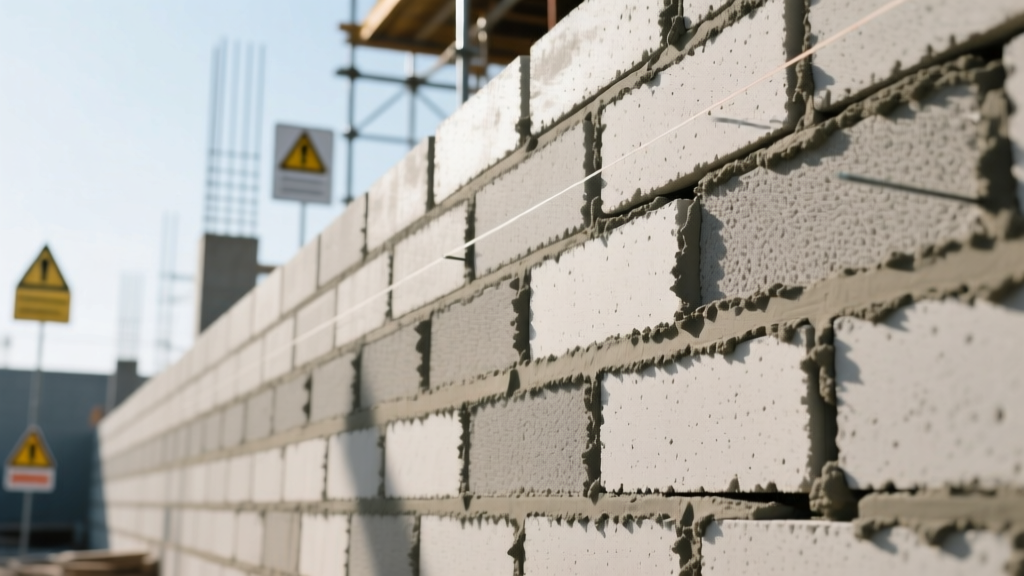
Core Material Formulas: Blocks and Mortar
Estimating a CMU concrete block wall requires moving beyond simple square footage. Concrete Masonry Units (CMUs) are sold by nominal dimensions, but physical layout depends on actual dimensions and mortar joint thickness. The industry standard for residential and light commercial construction is the 8x8x16 nominal block.
Block Coverage Matrix
| Nominal Size | Actual Size (W x H x L) | Blocks per Sq Ft | Primary Application |
|---|---|---|---|
| 4x8x16 | 3 5/8' x 7 5/8' x 15 5/8' | 1.125 | Non-loadbearing partitions, veneer |
| 6x8x16 | 5 5/8' x 7 5/8' x 15 5/8' | 1.125 | Residential foundations, low retaining |
| 8x8x16 | 7 5/8' x 7 5/8' x 15 5/8' | 1.125 | Loadbearing walls, commercial, high retaining |
| 10x8x16 | 9 5/8' x 7 5/8' x 15 5/8' | 1.125 | High-rise structural, heavy seismic zones |
The Base Formula: Total Wall Area (Length x Height) × 1.125 = Base Block Count. Always add a 5% to 8% waste factor for cuts, breakage, and corner adjustments.
Mortar Yield and Joint Sizing
Mortar selection dictates both structural integrity and material yield. According to the Portland Cement Association (PCA), Type N mortar is standard for above-grade loadbearing walls, while Type S is mandatory for below-grade foundations and high lateral-load applications.
- Type N Mortar: Yields approximately 0.85 cubic feet per 80lb bag. Lays roughly 28 to 32 standard 8x8x16 blocks per bag (assuming 3/8' concave joints).
- Type S Mortar: Similar yield, but higher tensile bond strength. Required when soil pressure or wind shear exceeds standard limits.
2026 CMU Concrete Block Wall Cost Breakdown
Material and labor rates have stabilized following the supply chain fluctuations of the early 2020s, but regional labor shortages continue to push installed costs upward. Below is the 2026 national average pricing matrix for standard gray CMU construction.
| Material / Labor Component | Unit | 2026 Average Cost | Notes |
|---|---|---|---|
| Standard 8x8x16 CMU (Gray) | Per Block | $2.85 - $3.40 | Architectural face blocks run $4.50 - $7.00+ |
| Type N/S Mortar (80lb bag) | Per Bag | $9.50 - $11.00 | Pre-mixed; bulk silos reduce cost by 20% on large jobs |
| Coarse Grout (80lb bag) | Per Bag | $13.50 - $16.00 | Required for structural reinforcement cores |
| #4 Rebar (1/2' dia, 20ft) | Per Stick | $18.50 - $22.00 | Epoxy-coated adds ~35% to material cost |
| Unreinforced Masonry Labor | Per Sq Ft | $18.00 - $26.00 | Running bond, standard corners, no grout |
| Reinforced/Grouted Labor | Per Sq Ft | $28.00 - $42.00 | Includes rebar tying, core cleaning, grout pumping |
Structural Reinforcement & Grout Calculators
A CMU concrete block wall is only as strong as its internal skeleton. The National Concrete Masonry Association (NCMA) mandates specific reinforcement spacing based on local wind and seismic codes. Estimating grout and rebar requires calculating the internal void volume of the CMUs.
Rebar Spacing Rules of Thumb
For standard 8-inch retaining walls or loadbearing exterior walls, vertical #4 rebar is typically spaced at 32 inches or 48 inches on center (o.c.). Horizontal joint reinforcement (ladder or truss wire) is placed every two courses (16 inches o.c.).
Calculating Grout Volume
Grout fills the voids containing rebar to create a monolithic structural element. You must account for the net void area of the block.
- Net Void Area of 8x8x16 CMU: Approximately 0.025 cubic feet per cell.
- Grout per 100 Sq Ft (Grouting every 32' o.c.): ~0.28 cubic yards.
- Grout per 100 Sq Ft (Solid Grouting every cell): ~0.85 cubic yards.
Real-World Example: 400 Sq Ft Retaining Wall
Let us apply these formulas to a practical scenario: a 50-foot long, 8-foot high reinforced CMU retaining wall (400 total square feet).
- Block Count: 400 sq ft × 1.125 = 450 blocks. Add 6% waste (27 blocks) = 477 blocks.
- Mortar: 477 blocks / 30 blocks per bag = 15.9. Round up to 16 bags (80lb).
- Vertical Rebar (#4 at 32' o.c.): 50 ft / 2.66 ft spacing = 19 vertical cells. Each cell requires an 8ft stick + 2ft lap splice/embed = 10ft. 19 × 10ft = 190 linear feet. Order ten 20ft sticks.
- Horizontal Wire: Wall height 8ft (10 courses). Place wire every 2nd course = 5 courses. 5 × 50ft = 250 linear feet.
- Coarse Grout (32' o.c. spacing): 400 sq ft / 100 × 0.28 cubic yards = 1.12 cubic yards. Add 15% waste = 1.3 cubic yards (approx. 48 bags if mixing on-site, or order a short-load ready-mix truck).
Avoid These 3 Fatal Estimation Errors
Contractors and DIYers frequently lose their profit margins or stall their projects due to overlooked CMU-specific variables. Integrate these checks into your final takeoff.
1. Forgetting Corner and Half-Blocks
Standard stretcher blocks cannot be used to build corners while maintaining a proper running bond pattern. You must substitute corner blocks (which have one flat end) at every intersection. Failing to order factory-made corner blocks forces masons to cut stretcher blocks with a masonry saw, destroying labor productivity and increasing blade wear costs.
2. Ignoring Lintel and Bond Beam Requirements
Openings for doors and windows require pre-cast or cast-in-place concrete lintels. Furthermore, the top course of a structural wall usually requires a bond beam block (a U-shaped CMU) to hold continuous horizontal rebar. Bond beam blocks cost 20% to 30% more than standard stretchers and must be counted separately in your takeoff.
3. Underestimating Scaffolding and Core Cleaning
Labor rates assume the mason can reach the work face. Any wall exceeding 5 feet in height requires OSHA-compliant scaffolding. Add $1.50 to $2.50 per square foot to your labor estimate for scaffold rental, setup, and teardown. Additionally, reinforced walls require 'core cleaning'—removing dropped mortar from the block cells before grouting. If omitted, grout flow is blocked, resulting in structural failure and costly demolition.