Concrete Calculator Bags Guide: Exact Yields and Cost Estimation
Master your concrete calculator bags formula with exact 80lb and 60lb yields, 2026 cost breakdowns, and ready-mix break-even thresholds for slabs.
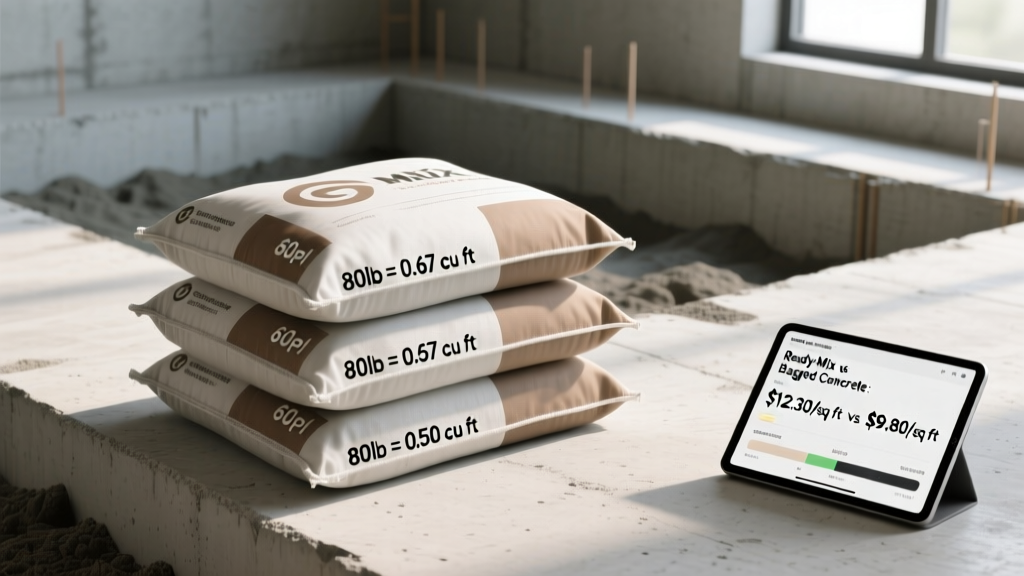
The Core Math Behind Concrete Calculator Bags
Accurately estimating bagged concrete is the difference between a seamless pour and a structurally compromised slab riddled with cold joints. When using a concrete calculator bags formula, the most common error is assuming a direct weight-to-volume translation. Concrete is a dense matrix of Portland cement, sand, and coarse aggregate. According to the Portland Cement Association, standard cured concrete weighs approximately 150 pounds per cubic foot (pcf), but dry bagged mix yields less volume per pound due to the specific aggregate grading used in retail products.
To use a concrete calculator bags tool effectively, you must anchor your math to the manufacturer's exact yield specifications, not generic weight assumptions. The Quikrete Companies and Sakrete engineer their retail mixes to specific cubic foot yields based on an 80-pound baseline.
Standard Bag Yield Reference Chart
- 80-lb Bag: Yields 0.60 cubic feet (requires ~0.85 gallons of water)
- 60-lb Bag: Yields 0.45 cubic feet (requires ~0.65 gallons of water)
- 40-lb Bag: Yields 0.30 cubic feet (requires ~0.45 gallons of water)
- 50-lb Fast-Setting Mix: Yields 0.375 cubic feet (requires ~0.55 gallons of water)
Step-by-Step Slab and Footing Estimation
Whether you are pouring a 4-inch thick patio or a 12-inch deep post footing, the volumetric calculation remains the foundation of your estimate. Follow this precise framework to determine your exact bag count.
Step 1: Calculate the Raw Volume
Convert all dimensions to feet. For a 10-foot by 12-foot patio slab poured at a standard 4-inch thickness:
- Convert thickness to feet: 4 inches ÷ 12 = 0.333 feet.
- Multiply Length × Width × Depth: 10 × 12 × 0.333 = 39.96 cubic feet.
Step 2: Apply the Real-World Waste Factor
Never order to the exact decimal. Subgrade irregularities, formwork bowing, and material left in the mixer or wheelbarrow always consume extra volume. The American Concrete Institute (ACI) recommends factoring in environmental and site-specific variables. For standard slab work, add a 10% waste factor. For complex footings or uneven trench pours, increase this to 15%.
- Adjusted Volume (10% waste): 39.96 × 1.10 = 43.95 cubic feet.
Step 3: Divide by Bag Yield
Divide your adjusted volume by the yield of your chosen bag size. Using 80-lb bags (0.60 cu ft yield):
- 43.95 ÷ 0.60 = 73.25 bags.
- Final Purchase Order: 74 bags (always round up to the nearest whole bag).
Cost Breakdown: Bagged vs. Ready-Mix in 2026
One of the most critical outputs of a concrete calculator bags exercise is determining whether bagged mix or ready-mix delivery is more cost-effective. While bagged concrete appears cheaper per cubic yard on the shelf, the break-even point shifts rapidly when accounting for short-load fees and labor.
| Metric | Bagged Concrete (80-lb) | Ready-Mix Truck Delivery |
|---|---|---|
| Cost per Cubic Yard | $245 - $290 (approx. 45 bags) | $135 - $165 base rate |
| Short-Load Fees | N/A | $75 - $120 for loads under 3 yards |
| Equipment Rental | $40 - $60/day (mortar mixer) | $0 (included in delivery) |
| Labor Time (1 Yard) | 3 to 5 hours (mixing and placing) | 20 to 30 minutes (placing only) |
| Best Use Case | Under 1.5 cubic yards total volume | Over 2.5 cubic yards total volume |
Advanced Adjustments for Real-World Conditions
A basic calculator provides a baseline, but professional estimators adjust for site-specific variables that alter both volume and water demand.
Subgrade Absorption and Moisture Theft
Pouring directly onto a dry, compacted gravel or soil subgrade will cause the earth to rapidly wick moisture out of the bottom of your concrete matrix. This leads to premature curing, shrinkage cracking, and a weak bottom crust. Always dampen the subgrade before pouring. If the subgrade is highly porous, increase your volume estimate by 3% to account for the slight bleed-water loss and surface settling.
Admixtures and Liquid Colors
If you are adding liquid acrylic fortifiers or concrete colorants to the mix, you must reduce your clean water addition. Most liquid admixtures are water-based. Adding the standard 0.85 gallons of water per 80-lb bag plus a liquid admixture will push the water-cement ratio above the critical 0.50 threshold, resulting in a weak, dusty surface that scales easily. Subtract the volume of the liquid admixture from your clean water calculation.
Temperature and Setting Time
Ambient temperature drastically alters working time. In peak summer heat (above 85°F), bagged concrete can flash-set in under 20 minutes. In these conditions, use cold water for mixing and consider switching to a specific slow-set bagged mix. Conversely, in temperatures below 50°F, hydration slows to a crawl, and the concrete must be protected with insulating blankets to prevent freeze-thaw damage during the initial 48-hour cure.
Frequently Asked Questions
Can I mix 80-lb and 60-lb bags in the same pour?
Yes, provided they are the same mix design (e.g., standard 4000 PSI crack-resistant). However, you must adjust your water additions precisely for each bag size. Mixing different bag sizes in the same batch in a mortar mixer often leads to inconsistent water-cement ratios, which can cause localized weak spots and uneven color curing.
How many 80-lb bags make exactly one cubic yard?
One cubic yard equals 27 cubic feet. Since an 80-lb bag yields 0.60 cubic feet, you need exactly 45 bags to produce one cubic yard of mixed concrete (27 ÷ 0.60 = 45). Factoring in a standard 10% waste allowance, you should purchase 50 bags per cubic yard.
Does the weight of the bag include the water?
No. The 80-lb or 60-lb designation refers strictly to the dry pre-blended material (cement, sand, and aggregate). Once you add the required water, an 80-lb bag yields roughly 120 pounds of wet, plastic concrete, aligning with the industry standard density of 150 pounds per cured cubic foot.