Asphalt vs Concrete Driveway Cost: Pricing and Lifespan Breakdown
Compare asphalt vs concrete driveway cost, lifespan, and maintenance. Discover which paving material offers the best long-term ROI for your property.
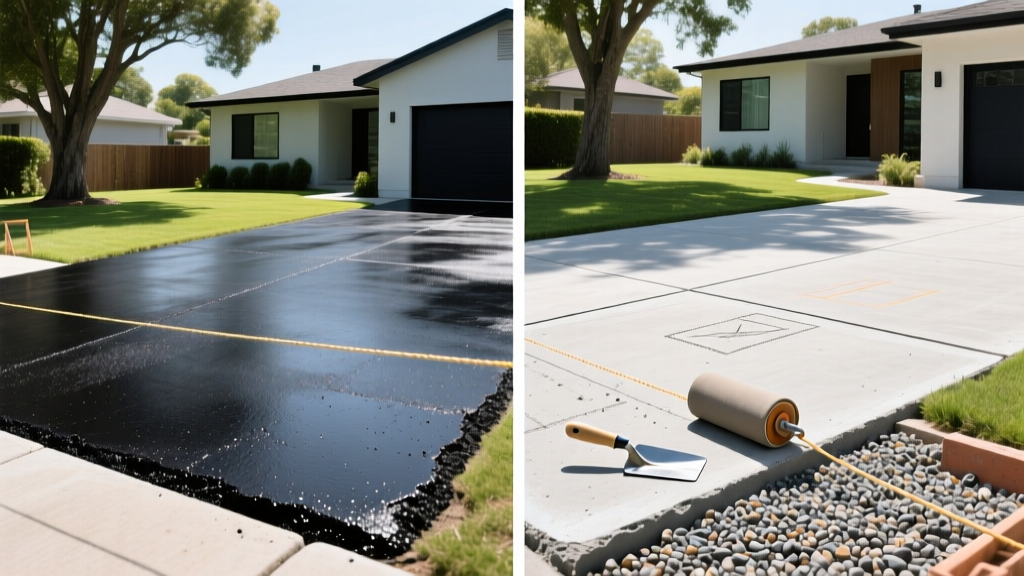
Choosing between asphalt and concrete hinges on more than just the initial contractor quote. While asphalt generally presents a lower upfront expense, concrete's extended lifespan and minimal maintenance can invert the total cost of ownership over a 30-year period. Evaluating the true asphalt vs concrete driveway cost requires analyzing material specifications, regional climate impacts, subgrade preparation, and long-term maintenance schedules. This guide breaks down the exact pricing, technical requirements, and lifecycle costs to help you make an engineered decision for your property.
The Upfront Asphalt vs Concrete Driveway Cost Breakdown
The initial installation cost is driven by material prices, labor intensity, and the thickness of the paving layers. Standard residential driveways require a 4-inch to 6-inch compacted aggregate base, regardless of the surface material. However, the surface layer specifications diverge significantly.
For asphalt, contractors typically use Hot Mix Asphalt (HMA) placed at temperatures between 275°F and 300°F, compacted to 92-96% of its theoretical maximum specific gravity. Concrete driveways require a minimum 4000 PSI compressive strength mix with 5-7% air entrainment to resist freeze-thaw scaling, placed over a vapor barrier or compacted subgrade.
| Material Type | Material Cost (per sq ft) | Labor & Equipment (per sq ft) | Total Installed Cost (per sq ft) | Standard Thickness |
|---|---|---|---|---|
| Asphalt (Standard HMA) | $2.50 - $4.00 | $4.50 - $8.00 | $7.00 - $12.00 | 2 - 3 inches |
| Concrete (Broom Finish) | $4.00 - $6.50 | $5.00 - $10.50 | $9.00 - $17.00 | 4 inches |
| Concrete (Stamped/Exposed) | $8.00 - $14.00 | $10.00 - $18.00 | $18.00 - $32.00 | 4 - 5 inches |
According to data referenced by the Federal Highway Administration, the structural design of the pavement must account for expected traffic loads. While passenger vehicles exert minimal stress, frequent parking of heavy RVs or dump trucks requires increasing the concrete slab thickness to 5 or 6 inches, or adding a thicker asphalt binder course, which will push these baseline costs up by 15% to 25%.
Long-Term ROI: Maintenance and Lifecycle Costs
The initial savings of asphalt are frequently eroded by its aggressive maintenance schedule. Asphalt is a flexible pavement bound by bitumen, which oxidizes and becomes brittle when exposed to UV radiation and oxygen. Concrete is a rigid pavement that cures via hydration, making it highly resistant to UV degradation but susceptible to tensile cracking if the subgrade shifts.
Asphalt Maintenance Schedule
- Sealcoating: Required every 3-5 years. Costs $0.15 to $0.25 per square foot. For a 600 sq ft driveway, expect to pay $90 to $150 per application.
- Crack Filling: Annual inspection and routing/filling of cracks wider than 1/4 inch using hot-pour rubberized sealant ($1 to $3 per linear foot).
- Patching: Potholes and alligator cracking require infrared patching or full-depth removal, costing $150 to $300 per localized repair.
Concrete Maintenance Schedule
- Sealing: Optional but recommended every 5-7 years using a penetrating silane/siloxane sealer to prevent chloride and water ingress ($0.20 to $0.40 per square foot).
- Joint Resealing: Control joints should be cleaned and resealed with polyurethane caulk every 10 years to prevent subgrade washout ($2 to $4 per linear foot).
- Cleaning: Periodic power washing to remove oil stains and biological growth, which can degrade the surface paste over decades.
Over a 40-year horizon, a concrete driveway installed for $12,000 may incur $2,500 in total maintenance. An asphalt driveway installed for $8,000 will require at least two full mill-and-overlay replacements (at $6,000 each) plus $3,000 in sealcoating, bringing the 40-year asphalt cost to over $20,000.
Climate and Environmental Performance Matrix
Regional weather patterns dictate which material will perform optimally. The National Asphalt Pavement Association notes that asphalt binder grades (Performance Grade or PG) must be selected based on local temperature extremes. In northern climates, a PG 58-28 binder is used to resist low-temperature thermal cracking, while southern climates require a PG 76-22 binder to prevent high-temperature rutting.
| Environmental Factor | Asphalt Performance | Concrete Performance |
|---|---|---|
| Extreme Heat (95°F+) | Poor. Softens, rutting occurs under heavy static loads (e.g., RV jacks). Can track into homes. | Excellent. Rigid structure remains unaffected by high ambient temperatures. |
| Freeze-Thaw Cycles | Good to Fair. Highly dependent on sealcoating and base drainage. Frost heave causes alligator cracking. | Good. Requires proper air-entrainment (ASTM C457) and control joints to survive expansion. |
| Urban Heat Island Effect | High Impact. Black surface absorbs up to 95% of solar radiation, radiating heat at night. | Low Impact. Lighter albedo reflects solar radiation, reducing ambient microclimate temperatures. |
| Snow and Ice Melting | Fast. Dark color absorbs solar heat, melting snow faster once the sun emerges. | Slow. Reflective surface retains snow longer, often requiring chemical de-icers (which can cause spalling). |
Hidden Costs and Edge Cases
When soliciting bids, homeowners often overlook site-specific variables that drastically alter the final invoice. Both the Portland Cement Association and asphalt industry guidelines emphasize that the subgrade is the actual foundation of the pavement.
Subgrade Preparation and Soil Types
If your site features expansive clay soils, both materials will fail prematurely without stabilization. Clay expands when wet and shrinks when dry, causing differential settlement. Concrete will snap along stress lines, while asphalt will sink and pool water. Stabilizing a clay subgrade requires excavating an additional 6 to 12 inches and importing engineered fill (ASTM D2940 graded aggregate), adding $2.00 to $4.50 per square foot to the project before paving even begins.
Demolition and Removal Costs
If you are replacing an existing driveway, removal costs differ vastly. Asphalt can be milled and recycled efficiently, typically costing $1.50 to $2.50 per square foot to remove. Concrete demolition requires heavy machinery (skid steers with hydraulic breakers), hauling, and higher dump fees, pushing removal costs to $3.00 to $5.00 per square foot.
Permitting and Impervious Surface Limits
Many municipalities enforce strict stormwater management codes that limit the total square footage of impervious surfaces on a lot. Standard asphalt and concrete are 100% impervious. If your lot is near the maximum allowance, you may be forced to use permeable pavers or porous concrete, which carry a 30% to 50% price premium over standard materials but satisfy municipal drainage requirements.
Decision Framework: Which Material Fits Your Scenario?
Use this practical framework to finalize your material selection based on your specific property constraints and financial goals.
Choose Asphalt If:
- Your strict budget cap is under $10 per square foot and the subgrade is already stable.
- You live in a heavily shaded, wooded lot where UV oxidation of asphalt is significantly slowed.
- You plan to sell the property within 5 to 7 years and want to maximize immediate curb appeal without paying for a 50-year lifespan you won't utilize.
- You live in a region with heavy, prolonged snowfall where the dark surface's passive solar melting provides a distinct winter safety advantage.
Choose Concrete If:
- You live in a high-heat southern climate where asphalt rutting and tracking are chronic issues.
- You need to park heavy point-loads, such as boat trailers, motorhomes, or commercial trucks, which will permanently deform flexible asphalt pavements.
- You want a 'install and forget' solution with a verified 30 to 50-year structural lifespan.
- You are integrating radiant snow-melting tubing (hydronic heating) beneath the surface, which requires the thermal mass and rigidity of a concrete slab.
Frequently Asked Questions
Can I pave asphalt directly over an old concrete driveway?
While technically possible, this is highly discouraged. Concrete slabs have expansion joints and inherent cracks. These movements will quickly 'reflect' through the new asphalt layer, causing reflective cracking within the first year. Furthermore, the trapped moisture between the two impermeable layers will blister the asphalt. Full removal of the concrete is the only engineered solution.
Does adding rebar or wire mesh to concrete prevent cracking?
Rebar and welded wire mesh do not prevent concrete from cracking; concrete will inevitably crack due to shrinkage during the hydration process. Instead, steel reinforcement holds the cracks tightly together, maintaining structural integrity and preventing the edges from chipping or shifting vertically. For residential driveways, properly spaced saw-cut control joints (cut to 25% of the slab depth) are often more effective at controlling crack placement than wire mesh.
How soon can I drive on a newly paved driveway?
Asphalt can typically handle passenger vehicle traffic within 48 to 72 hours, provided ambient temperatures remain moderate and the mat has cooled to ambient temperature. However, you should avoid sharp, stationary steering maneuvers for the first 30 days. Concrete requires a minimum of 7 days of curing to reach roughly 70% of its design strength before driving on it, and 28 days to reach full structural maturity. Driving heavy trucks on concrete before day 14 risks severe structural micro-fracturing.
Written by
Sarah WhitfieldSarah Whitfield is a chartered quantity surveyor (MRICS) and construction cost analyst with 15 years of experience in material pricing, procurement strategy, and project budgeting. She earned her degree in Construction Management from the University of Reading (UK) and has worked on projects ranging from $2M custom homes to $180M mixed-use developments across North America and Europe. Sarah currently leads cost estimating for BuildMat Insight, maintaining a proprietary database of 4,000+ material price points updated quarterly. She is a frequent contributor to RSMeans cost data panels and has presented at the International Cost Engineering Council (ICEC) congress. Based in Denver, CO, Sarah is an avid trail runner and volunteer mentor for Women in Construction.
More from Sarah Whitfield
View all
Wood & Lumber
What Are the Different Types of Wood? A Builder's Guide
Compare structural softwoods, finish hardwoods, and engineered lumber. Analyze Janka ratings, MOE values, and 2026 pricing for construction.
Aug 4, 2026

Walls & Panels
Steel Framing vs Wood Framing: Corrosion and Moisture Defense
Compare steel framing vs wood framing for moisture resistance. Learn about galvanized coatings, condensation risks, and corrosion protection strategies.
Jul 21, 2026

Stone & Masonry
How to Cut Stone Veneer: Wet Saw vs Grinder Comparison
Compare the best tools for cutting stone veneer. We review wet saws, angle grinders, and chop saws to help you achieve clean, chip-free cuts.
Jul 21, 2026