Cinder Block vs Concrete Block: Strength, Cost & Uses
Discover the real differences in the cinder block vs concrete block debate. Compare weight, PSI strength, costs, and modern CMU alternatives for builds.

The Great Terminology Mix-Up: What Are You Actually Buying?
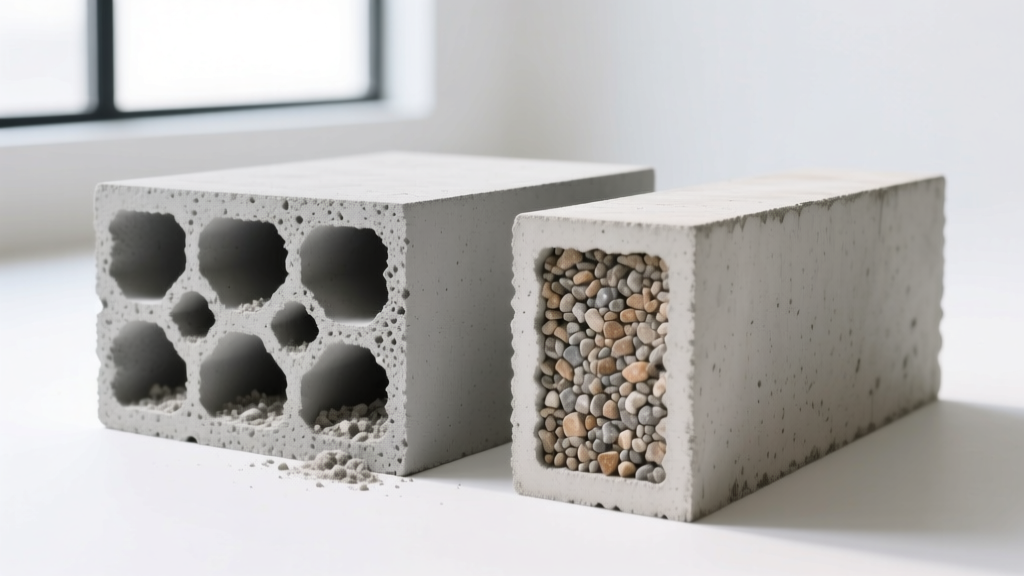
Walk into any hardware store and ask for a cinder block, and the staff will point you toward a stack of gray, hollow concrete blocks. This widespread colloquialism has blurred the lines between two fundamentally different building materials. To make informed structural and budgetary decisions, you must first separate historical manufacturing from modern masonry supply chains.
True cinder blocks are largely obsolete. Manufactured primarily between the 1920s and 1950s, they utilized coal cinders (clinkers) and ash as the primary aggregate. When the coal industry declined and environmental regulations tightened, manufacturers switched to sand, gravel, and crushed stone, giving birth to the modern Concrete Masonry Unit (CMU). Today, the phrase "cinder block vs concrete block" is less about choosing between two current products and more about understanding the severe performance gap between vintage salvage materials and modern engineered masonry.
Material Composition and Manufacturing
The physical properties of any masonry block are dictated by its aggregate. The binding agent—Portland cement—remains constant, but the filler determines the block's weight, thermal resistance, and compressive strength.
True Cinder Blocks (Vintage/Salvage)
Vintage cinder blocks rely on coal ash and clinkers. These aggregates are highly porous, resulting in a block that is significantly lighter than its concrete counterpart. However, this porosity introduces microscopic air voids that compromise structural integrity. The coal ash also contains sulfur compounds, which can lead to efflorescence and internal degradation when exposed to constant moisture.
Modern Concrete Blocks (CMUs)
Standard CMUs use dense aggregates like crushed limestone, granite, or quartzite. Lightweight CMUs use expanded shale, clay, or slate that has been kiln-fired to create a stable, lightweight aggregate. According to the Portland Cement Association, modern lightweight CMUs offer a superior balance of reduced dead load and high compressive strength without the structural vulnerabilities of coal ash.
Head-to-Head Comparison Matrix
The following matrix breaks down the exact specifications you will encounter when sourcing materials for a 2026 construction project.
| Feature | True Cinder Block (Vintage) | Standard Weight CMU (Concrete) | Lightweight CMU (Concrete) |
|---|---|---|---|
| Primary Aggregate | Coal cinders, ash, clinkers | Sand, crushed gravel, limestone | Expanded shale, slate, or clay |
| Weight (8x8x16 in.) | 25 - 30 lbs | 35 - 42 lbs | 25 - 30 lbs |
| Compressive Strength | Variable (typically < 1,000 psi) | 2,000 - 4,000+ psi | 1,900 - 3,000+ psi |
| Thermal Resistance (R-Value) | R-1.5 to R-2.0 (unfilled) | R-1.1 to R-1.5 (unfilled) | R-1.5 to R-2.2 (unfilled) |
| Water Absorption | High (prone to freeze-thaw spalling) | Low to Moderate | Moderate |
| Primary Modern Use | Architectural salvage, non-load garden walls | Foundations, structural walls, commercial builds | Above-grade walls, multi-story partitions |
Structural Integrity and Load-Bearing Limits
When engineers evaluate the "cinder block vs concrete block" debate, the conversation immediately turns to compressive strength, measured in pounds per square inch (PSI). Modern structural masonry is governed by strict testing protocols to ensure life-safety standards.
The ASTM C90 Standard
All load-bearing concrete blocks manufactured in the United States must comply with the ASTM C90 Standard Specification for Loadbearing Concrete Masonry Units. This standard mandates a minimum compressive strength of 1,900 psi for lightweight units and 2,000 psi for standard weight units. In practice, most high-quality CMUs produced for commercial applications test between 2,800 and 3,500 psi.
True cinder blocks have no modern ASTM equivalent because they are no longer manufactured for structural use. A vintage cinder block might withstand 800 to 1,200 psi, but the variance between individual blocks from the same batch can be massive due to inconsistent historical mixing practices.
Shear Strength and Reinforcement
Modern concrete blocks are designed with specific core geometries to accommodate vertical steel rebar and horizontal joint reinforcement. The cores are subsequently filled with high-slump grout, creating a composite structural system capable of resisting seismic shear forces and high wind loads. The brittle nature of coal cinders prevents true cinder blocks from achieving adequate bond strength with grout, making them unsuitable for reinforced masonry assemblies.
Cost Analysis: Salvage vs. Modern CMU
Pricing for masonry materials fluctuates based on regional aggregate availability and cement markets. Here is a realistic breakdown of material costs for 2026.
- Standard 8x8x16 CMU (Concrete Block): $2.15 to $2.85 per unit at major big-box retailers. Bulk pallet pricing from local block plants can drop this to $1.85 per unit for orders exceeding 2,000 blocks.
- Lightweight 8x8x16 CMU: $2.40 to $3.10 per unit. The premium reflects the cost of kiln-fired expanded shale aggregates.
- Vintage Cinder Blocks (Salvage): $3.50 to $8.00 per unit. Sourced from architectural salvage yards or demolition sites. The high cost reflects the labor-intensive reclamation process, not structural superiority.
- Mortar Requirements: Standard weight CMUs pair best with Type S mortar for below-grade or high-load applications. Lightweight CMUs and porous vintage blocks require Type N mortar to prevent the block from cracking under the higher compressive strength of Type S as it cures.
Modern Alternatives to Traditional CMUs
If your project requires the fire resistance and mass of masonry but demands better thermal performance or faster installation, the industry has developed several advanced alternatives to standard concrete blocks.
Autoclaved Aerated Concrete (AAC)
AAC blocks (such as those from Hebel or Aercon) are manufactured using Portland cement, lime, sand, and an aluminum powder expanding agent. The blocks are autoclaved under high heat and pressure.
• Weight: 16 lbs (8x8x24 in. block)
• Compressive Strength: 580 - 870 psi (requires specific engineering for multi-story load-bearing)
• R-Value: R-10 to R-12 (solid, no cavity insulation required)
• Installation: Applied with specialized thin-bed mortar; can be cut with a standard wood saw.
Insulated Concrete Forms (ICF)
For residential and light-commercial above-grade walls, ICF systems (like Fox Blocks or Nudura) replace the block-laying process entirely. Expanded polystyrene (EPS) foam panels are stacked, braced, and filled with poured concrete.
- Thermal Performance: Achieves R-22 to R-26 continuously, eliminating the thermal bridging inherent in standard CMU walls.
- Structural Capacity: The monolithic poured concrete core provides superior tensile and shear strength compared to segmented block walls.
- Labor Efficiency: Reduces framing and insulation labor phases, though the initial material cost is 15-20% higher than traditional CMU construction.
Decision Framework: Which Block Should You Specify?
Use the following logic tree to finalize your material specification based on project parameters.
Scenario A: Below-Grade Foundation or Retaining Wall
Decision: Standard Weight Concrete Block (CMU) or Poured Concrete.
Reasoning: High compressive strength and low water absorption are mandatory. Use ASTM C90 compliant blocks with Type S mortar, parged exterior waterproofing, and fully grouted cores with vertical #5 rebar.
Scenario B: Above-Grade Multi-Story Commercial Partition
Decision: Lightweight Concrete Block (CMU).
Reasoning: Reduces the overall dead load on the steel or concrete structural frame, lowering foundation costs while maintaining required 2-hour fire ratings and acoustic STC ratings.
Scenario C: Non-Load Bearing Garden Wall or Landscaping Feature
Decision: Salvaged Cinder Block or Standard CMU.
Reasoning: If you desire the vintage, porous aesthetic of a true cinder block for a low-stakes, above-grade landscaping project, salvage yards are your only source. Ensure the wall is capped to prevent water pooling in the cores, which will accelerate freeze-thaw spalling in the coal ash aggregate.
Scenario D: High-Performance Residential Envelope
Decision: AAC Blocks or ICF.
Reasoning: Standard CMUs require extensive additional framing, furring, and cavity insulation to meet modern energy codes. AAC and ICF provide structural mass and continuous insulation in a single installation phase.
Understanding the distinct material science behind these units prevents costly specification errors. While the term "cinder block" remains entrenched in the DIY lexicon, professional construction relies on the verified, standardized performance of modern concrete masonry units and advanced aerated alternatives.
Written by
David NakamuraDavid Nakamura is a licensed architect (AIA) and construction technology writer focused on sustainable building methods, mass timber engineering, and high-performance building envelopes. He holds a Master of Architecture from the University of Washington and is a certified Passive House Consultant (CPHC). David spent eight years at the Seattle firm Mithun, where he led the design of three LEED Platinum projects, before founding his own practice specializing in net-zero residential design. He serves on the editorial advisory board of GreenBuilder Magazine and has authored peer-reviewed papers on cross-laminated timber (CLT) connections for the Journal of Structural Engineering. In his spare time, David teaches woodworking at Pratt Fine Arts Center and kayaks the Puget Sound.
More from David Nakamura
View all
Construction Cost
Labor Cost to Build a Deck Per Sq Ft: 2026 Installation Guide
Discover the exact labor cost to build a deck per sq ft in 2026. This installation guide breaks down contractor rates, complexity factors, and hidden fees.
Aug 4, 2026

Construction Cost
How Much Does It Cost to Build a 3 Bedroom House? Financing Guide
Learn exactly how much it costs to build a 3 bedroom house and explore 2026 financing options, construction loan types, and budget frameworks for your build.
Aug 4, 2026

Construction Cost
Cost to Build a Tennis Court: 2026 Guide
How much does it cost to build a tennis court in 2026? Breakdowns for asphalt, concrete, and synthetic surfaces plus fencing and lighting.
Jul 30, 2026