Brick Driveway vs Concrete: 2026 Cost Breakdown & ROI
Compare brick driveway vs concrete costs in 2026. Detailed breakdown of material, labor, base prep, and long-term ROI to guide your paving decision.
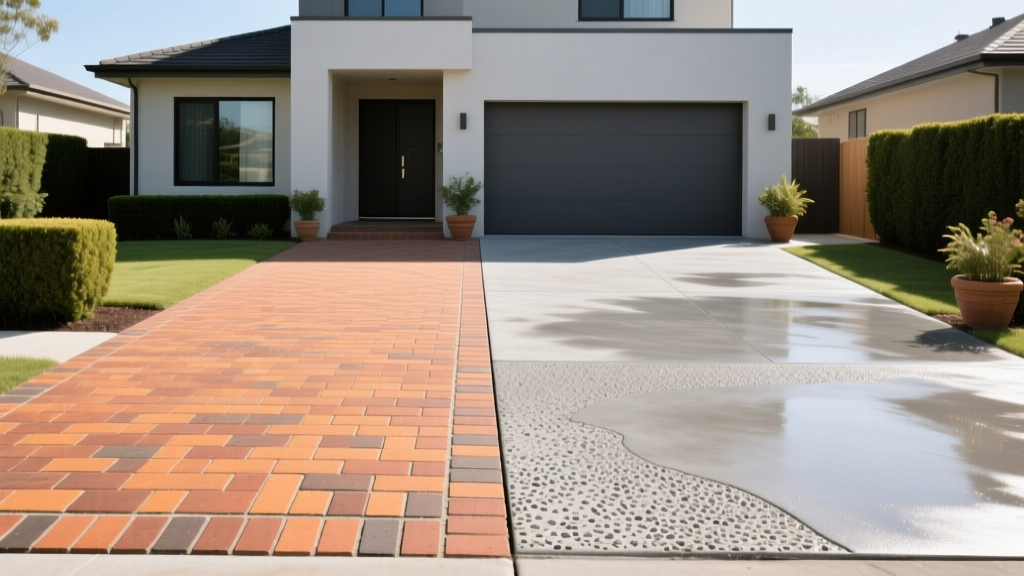
The True Cost of Curb Appeal: Brick vs. Concrete in 2026
When evaluating a brick driveway vs concrete, homeowners often conflate true kiln-fired clay brick with concrete pavers. This distinction fundamentally alters the cost breakdown, structural longevity, and lifecycle maintenance of your driveway. In 2026, material supply chain stabilization has normalized pricing, but labor rates for specialized masonry and concrete finishing continue to drive the total installed cost upward.
A standard poured concrete driveway offers the lowest barrier to entry, typically ranging from $8.00 to $13.50 per square foot. In contrast, a true clay brick paver driveway commands a premium, averaging $18.00 to $33.00 per square foot. However, analyzing the upfront cost alone provides an incomplete financial picture. To determine the true return on investment (ROI), we must deconstruct the hidden subgrade preparation costs, long-term maintenance schedules, and structural failure modes inherent to each material.
Comprehensive Cost Matrix: Materials and Installation
The following matrix breaks down the 2026 national average costs for a standard 600-square-foot residential driveway. Labor costs assume a moderately accessible site with standard soil conditions.
| Material Type | Material Cost (per sq ft) | Labor Cost (per sq ft) | Total Installed (per sq ft) | Expected Lifespan |
|---|---|---|---|---|
| Poured Concrete (Broom Finish) | $3.50 - $5.50 | $4.50 - $8.00 | $8.00 - $13.50 | 25 - 30 Years |
| Stamped / Colored Concrete | $6.00 - $10.00 | $8.00 - $14.00 | $14.00 - $24.00 | 25 - 30 Years |
| Concrete Pavers (ASTM C936) | $4.00 - $8.00 | $7.00 - $12.00 | $11.00 - $20.00 | 30 - 40 Years |
| True Clay Brick (ASTM C902) | $8.00 - $15.00 | $10.00 - $18.00 | $18.00 - $33.00 | 50+ Years |
Subgrade Preparation: The Hidden Cost Driver
The most frequent cause of driveway failure—whether concrete or brick—is inadequate subgrade preparation. The Federal Highway Administration (FHWA) emphasizes that pavement performance is directly tied to the California Bearing Ratio (CBR) of the underlying soil. If your soil has a low CBR (common in expansive clays), base preparation costs will increase significantly.
Base Requirements for Poured Concrete
- Excavation: 6 to 8 inches below final grade.
- Subbase: 4 inches of compacted DOT Class 5 aggregate (crushed stone).
- Vapor Barrier: 10-mil polyethylene sheeting (optional but recommended to prevent moisture wicking and efflorescence).
- Reinforcement: 6x6 W1.4xW1.4 welded wire mesh or #3 rebar on 18-inch centers.
- Concrete Slab: Minimum 4 inches thick, 4,000 PSI mix design with 5-7% air entrainment for freeze-thaw resistance.
Base Requirements for Brick and Pavers
- Excavation: 8 to 10 inches below final grade (accommodating the paver thickness).
- Subbase: 6 inches of compacted angular aggregate. For heavy vehicle loads, a geogrid stabilization fabric may be required, adding $1.50 to $2.50 per square foot.
- Bedding Course: 1 inch of coarse, sharp concrete sand (never use masonry sand, which retains moisture).
- Edge Restraint: Rigid PVC or aluminum edge restraints secured with 10-inch steel spikes every 12 inches. This is non-negotiable; without it, the driveway will spread and fail.
Lifecycle Maintenance and Repair Economics
When comparing a brick driveway vs concrete, the maintenance profiles represent diverging financial commitments over a 30-year horizon.
Concrete Maintenance Costs
Poured concrete is a monolithic slab. While it requires less frequent day-to-day maintenance, it is highly susceptible to random cracking due to thermal expansion, ground settling, and tree root intrusion.
- Sealing: Penetrating silane/siloxane sealers must be applied every 3 to 5 years at a cost of $0.50 to $1.00 per square foot. Acrylic sealers for stamped concrete require reapplication every 2 to 3 years.
- Crack Repair: Routing and sealing structural cracks costs $5 to $10 per linear foot.
- Slab Replacement: If a section settles or heaves, you cannot spot-repair it seamlessly. Mudjacking (slab jacking) costs $5 to $8 per square foot, while full panel replacement costs $15 to $25 per square foot, and the new concrete will never perfectly match the weathered existing slab.
Brick and Paver Maintenance Costs
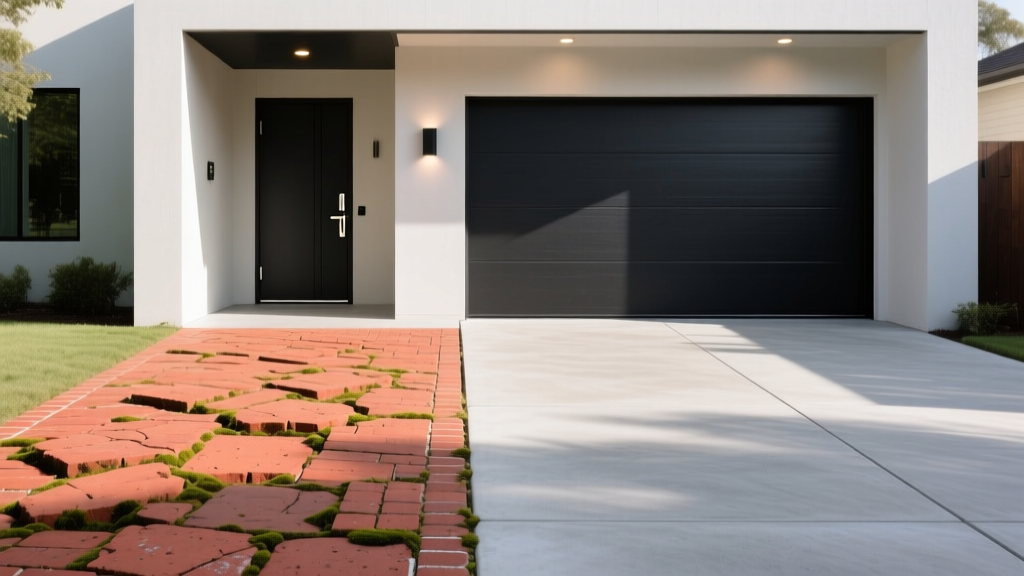
Flexible pavements like brick do not crack; they shift. This makes them infinitely more forgiving in regions with severe frost heave or expansive soils.
- Joint Sand Replenishment: The joints between bricks require sand to lock them in place. Upgrading to polymeric sand (which hardens when wet and resists weed growth and ant excavation) costs $35 to $50 per 50-lb bag, covering roughly 100 square feet. Expect to re-sand every 5 to 8 years.
- Spot Repairs: If a utility line needs to be trenched beneath the driveway, or if severe localized settling occurs, you simply unzip the bricks, fix the subbase, and relay the exact same bricks. The repair is 100% invisible. The cost is purely labor, typically $75 to $125 per hour for a mason.
Decision Framework: Matching Budget to Material
Use this practical framework to select the right material based on your specific site conditions and financial parameters.
- Choose Poured Concrete If: Your budget is strictly capped below $12 per square foot, your subgrade soil is stable and well-draining, and you prioritize a low-maintenance, monolithic surface over high-end aesthetics.
- Choose Stamped Concrete If: You desire the look of stone or brick but have a mid-tier budget ($14–$22 per sq ft). Understand that you are paying for aesthetic surface treatments that will require strict resealing schedules to prevent flaking and UV fading.
- Choose Concrete Pavers If: You need a flexible pavement system to combat frost heave or tree roots, want a modular look, and have a budget between $11 and $20 per square foot. Be prepared for color fading over the second decade.
- Choose True Clay Brick If: You are building a legacy home, demand a material that will never fade, require a 50+ year lifespan, and have the capital to invest $18 to $33 per square foot upfront. This is the only option that consistently yields a 100%+ ROI at the time of property resale, according to data from the Brick Industry Association (BIA).
Technical Specifications and Standards
When sourcing materials or reviewing contractor bids, ensure the specifications meet current industry standards. The American Concrete Institute (ACI) and ASTM International provide the benchmark testing for these materials.
- Concrete Mix Design: Require a minimum compressive strength of 4,000 PSI at 28 days. For driveways in freeze-thaw zones, mandate 5% to 7% air entrainment to create microscopic voids that allow water to expand without spalling the concrete surface.
- Clay Brick Standard: Specify ASTM C902 (Standard Specification for Pedestrian and Light Traffic Paving Brick). Ensure the brick is rated for severe weathering (SW), which dictates a maximum water absorption rate to prevent cracking during freezing.
- Concrete Paver Standard: Specify ASTM C936 (Standard Specification for Solid Concrete Interlocking Paving Units). The minimum compressive strength must be 8,000 PSI, with a maximum water absorption of 5%.
Frequently Asked Questions
Can I install a brick driveway over an existing concrete slab?
Yes, this is known as an overlay. If your existing concrete slab is structurally sound, free of major heaving, and slopes away from the garage for drainage, you can lay a 1-inch sand bedding and install brick pavers directly over it. This saves $4 to $8 per square foot in demolition and subbase preparation costs. However, you must ensure the added height of the pavers and sand will not interfere with garage door thresholds or municipal sidewalk elevations.
Which material handles vehicle oil leaks better?
Concrete is highly porous and will absorb motor oil, transmission fluid, and rust stains, requiring aggressive chemical degreasers and pressure washing to remove. Kiln-fired clay brick is significantly denser and less porous. While oil can stain the surface of a clay brick, it rarely penetrates deeply, making it much easier to clean or simply replace a single stained brick if necessary.
How do I prevent weeds from growing between driveway bricks?
The most effective modern solution is polymeric sand. Unlike traditional masonry sand, polymeric sand contains silica and binding agents that activate when misted with water, creating a rigid, flexible joint that locks out weed seeds and prevents ants from mining the sand out of the joints. Ensure the joints are completely dry and free of debris before application, and mist gently to avoid washing the polymers out of the joint before they set.
Written by
Elena RodriguezElena Rodriguez is a civil engineer and technical writer specializing in concrete technology, masonry systems, and ASTM/ACI compliance. She earned her B.S. in Civil Engineering from Texas A&M University and spent a decade at a materials testing laboratory, performing over 2,000 concrete compressive strength tests and masonry prism evaluations. Elena is an ACI-certified Field Testing Technician (Grade I) and a member of ASTM Committee C12 on Natural Building Stone. She currently consults on forensic engineering cases involving concrete failures and moisture intrusion. Based in San Antonio, TX, Elena is a proud member of the Society of Women Engineers (SWE) and coaches her daughter's FIRST Robotics team.
More from Elena Rodriguez
View all
Walls & Panels
Cost Analysis: Light Gauge Steel Framing Advantages and Disadvantages
Evaluate light gauge steel framing advantages and disadvantages through a strict cost analysis lens, comparing material, labor, and lifecycle expenses.
Aug 4, 2026

Walls & Panels
Gypsum Board Types: Exact Specifications, Thickness & Dimensions
Compare standard, Type X, and moisture-resistant gypsum board types. Get exact specifications, thicknesses, dimensions, and ASTM standards for your project.
Aug 4, 2026

Fire Resistance
Best Fire-Resistant Outdoor Decking Materials: 2026 Buyer Guide
Discover the best fire-resistant outdoor decking materials for 2026. Compare Class A PVC, aluminum, and hardwood options for WUI compliance and safety.
Aug 4, 2026