Best Cement Stain Brands & Product Lines for 2026
Compare top cement stain brands for 2026. Deep dive into Kemiko, Behr, and Direct Colors, plus coverage rates, failure modes, and cost matrices.
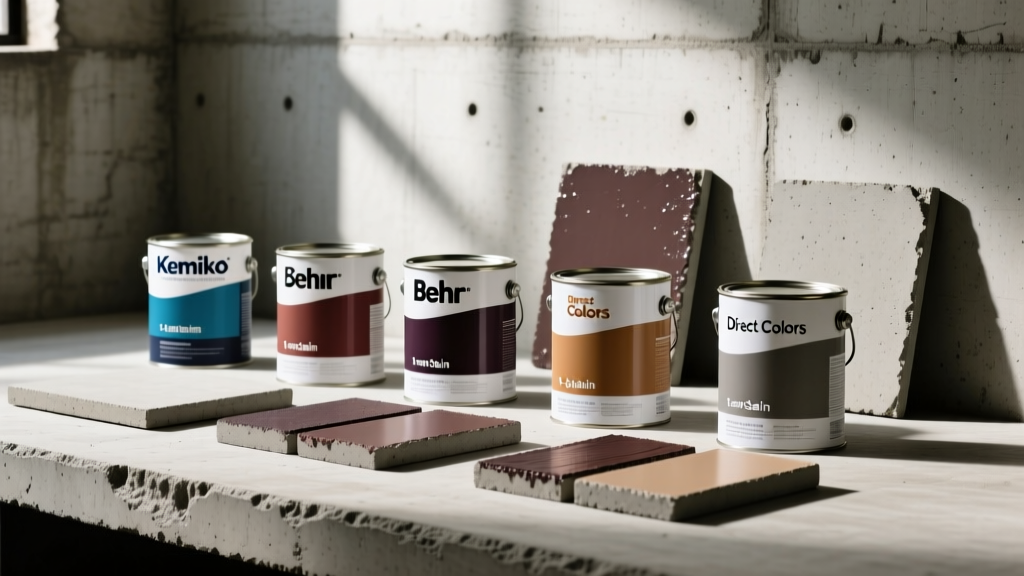
The Chemical Divide: Acid vs. Water-Based Cement Stain
Selecting the correct cement stain requires a fundamental understanding of substrate porosity and chemical reactivity. Unlike concrete paints or epoxies that sit on the surface, true cement stains penetrate the capillary network of the slab. In 2026, the market is strictly divided into two chemical categories: reactive acid stains and penetrating water-based acrylics.
Acid stains rely on a reaction between metallic salts, hydrochloric acid, and the calcium hydroxide (hydrated lime) present in cured concrete. This reaction permanently alters the color of the substrate, yielding variegated, marble-like earth tones. Water-based stains, conversely, utilize nano-acrylic polymers and microscopic pigments that physically lodge into the concrete pores without a chemical reaction, offering a vastly broader, more predictable color spectrum.
- Choose Acid Stain if: You want permanent, UV-stable, mottled earth tones (browns, tans, terra cottas) on interior floors or exterior patios, and you are willing to perform a multi-step neutralization process.
- Choose Water-Based Stain if: You require specific, vibrant, or uniform colors (blues, reds, grays), need low-VOC compliance for interior occupied spaces, or are working with older concrete where the lime content has been depleted.
Tier 1: Professional Acid Cement Stain Brands
Kemiko Stone Tone II
Kemiko remains the industry benchmark for reactive acid stains. The Stone Tone II line is a concentrated, two-part system that requires on-site dilution. Because it relies on the slab's inherent lime content, the final color is highly dependent on the concrete mix design and trowel finish.
- Coverage Rate: 250 to 300 sq. ft. per gallon (when diluted 1:1 with water).
- Color Palette: 8 core earth tones (e.g., Cola, Seagrass, Amber). Colors can be layered or diluted for custom shading.
- Cost: $45 to $52 per gallon (concentrate).
- Expert Insight: Kemiko requires a mandatory neutralization step post-application. You must scrub the floor with a baking soda and water solution (or Kemiko's proprietary neutralizer) to halt the acid reaction and raise the surface pH above 7.0 before applying any sealer. Failure to neutralize will cause acrylic sealers to turn white and delaminate within weeks.
Direct Colors Artist Grade Acid Stain
Direct Colors engineered their Artist Grade line to eliminate the on-site mixing variables that plague novice installers. This product is pre-diluted and ready to spray or brush directly from the container.
- Coverage Rate: 200 to 250 sq. ft. per gallon.
- Color Palette: 10 standard colors, including darker, richer tones like English Red and Aztec Gold that are difficult to achieve with other brands.
- Cost: $38 to $42 per gallon.
- Expert Insight: Because it is pre-diluted, the acid concentration is lower than Kemiko's concentrate. On hard-troweled, dense commercial slabs, you may need to apply a light etching solution prior to staining to open the pores sufficiently for the metallic salts to penetrate.
Tier 2: Premium Water-Based & Acrylic Cement Stains
Behr Premium Semi-Transparent Concrete Stain
Widely available at big-box retailers, Behr's 100% acrylic semi-transparent formula is the most accessible water-based option for DIYers and residential contractors. It penetrates the surface but leaves a microscopic acrylic film that enhances color uniformity.
- Coverage Rate: 250 to 400 sq. ft. per gallon, depending on surface roughness.
- Color Palette: Over 70 custom-tintable colors via the Behr color matching system.
- Cost: $32 to $36 per gallon.
- VOC Compliance: Meets strict EPA guidelines on VOC emissions, making it safe for interior basements and living spaces without specialized respiratory equipment.
Quikrete Concrete & Masonry Stain
Quikrete targets the masonry and vertical concrete market. While it can be used on horizontal slabs, its viscosity is optimized for retaining walls, cinder blocks, and stamped concrete verticals where traditional thin stains would run and drip.
- Coverage Rate: 150 to 200 sq. ft. per gallon on porous masonry.
- Cost: $28 to $34 per gallon.
- Expert Insight: This product contains UV-resistant iron oxide pigments. It is highly recommended for exterior architectural blocks but should be top-coated with a breathable silane-siloxane water repellent rather than a film-forming polyurethane to prevent moisture entrapment.
Substrate Failure Modes & Edge Cases
The most expensive mistake in concrete staining is applying premium products to an unprepared or incompatible substrate. According to the Portland Cement Association surface preparation standards, the substrate must be entirely free of curing compounds, sealers, and laitance.
Modern concrete contractors frequently spray membrane-forming curing compounds (like ASTM C309 compliant resins) on fresh pours to retain moisture. These compounds completely block the pores. No cement stain will penetrate a curing compound. You must mechanically profile the slab via shot-blasting or diamond grinding (using a 40-grit metal bond pad) to physically remove the membrane before staining.
Moisture Vapor Transmission (MVT) Edge Case
Before applying any water-based stain or subsequent sealer, conduct a calcium chloride MVT test (ASTM F1869). If the slab emits more than 5 lbs. of moisture vapor per 1,000 sq. ft. per 24 hours, film-forming acrylic sealers applied over the stain will blister and peel. In high-MVT scenarios, you must use a penetrating, breathable siloxane sealer over your stain, or apply a moisture-mitigating epoxy primer before staining (which requires a water-based stain, as acid stains will not react with epoxy).
Comprehensive Cost & Coverage Matrix (500 Sq. Ft. Patio)
The following matrix breaks down the realistic material costs for a 500 sq. ft. exterior patio project in 2026, comparing an acid stain workflow against a water-based workflow.
| Material / Step | Acid Stain Workflow (Kemiko) | Water-Based Workflow (Behr) |
|---|---|---|
| Surface Prep (Cleaner/Etcher) | $35 (Muriatic acid wash) | $45 (Behr Cleaner/Degreaser) |
| Stain Material (2 Gallons) | $95 (Concentrate + dilution) | $70 (2 Gallons Semi-Transparent) |
| Neutralization / Rinse | $15 (Baking soda / ammonia) | $0 (Not required) |
| Sealer (Solvent Acrylic) | $85 (2 Gal. Eagle Supreme Seal) | $85 (2 Gal. Wet-Look Acrylic) |
| Total Material Cost | $230 ($0.46 / sq. ft.) | $200 ($0.40 / sq. ft.) |
Execution Protocol: 5-Step Application Standard
To ensure maximum penetration and longevity, follow this strict application protocol for reactive acid stains:
- Mechanical Profiling: Test water absorption. Sprinkle water on the slab; if it beads up, grind the surface with a 40-grit diamond pad until water absorbs instantly within 15 seconds.
- Application: Apply the acid stain using an acid-resistant pump sprayer. Maintain a wet edge and agitate the surface immediately with a stiff-bristled nylon masonry brush to work the metallic salts into the pores. Allow to react for 2 to 4 hours.
- Neutralization: Mop the floor with a solution of 1 cup baking soda per gallon of water. Scrub thoroughly. Rinse with clean water and wet-vacuum the residue.
- pH Verification: Use litmus paper to test the surface moisture. The pH must read between 7.0 and 9.0. If it reads below 7.0, repeat the neutralization step.
- Sealing: Once the slab is bone-dry (minimum 24 hours, verified via moisture meter reading below 4%), apply two thin coats of a solvent-based acrylic sealer using a 1/4-inch nap roller. Solvent-based sealers will pop the muted acid colors, revealing the final translucent depth.