Concrete Filler Durability: Which Crack Repair Lasts Longest
Compare the durability and lifespan of top concrete filler types. Discover which epoxy, polyurethane, and cementitious repairs last longest.
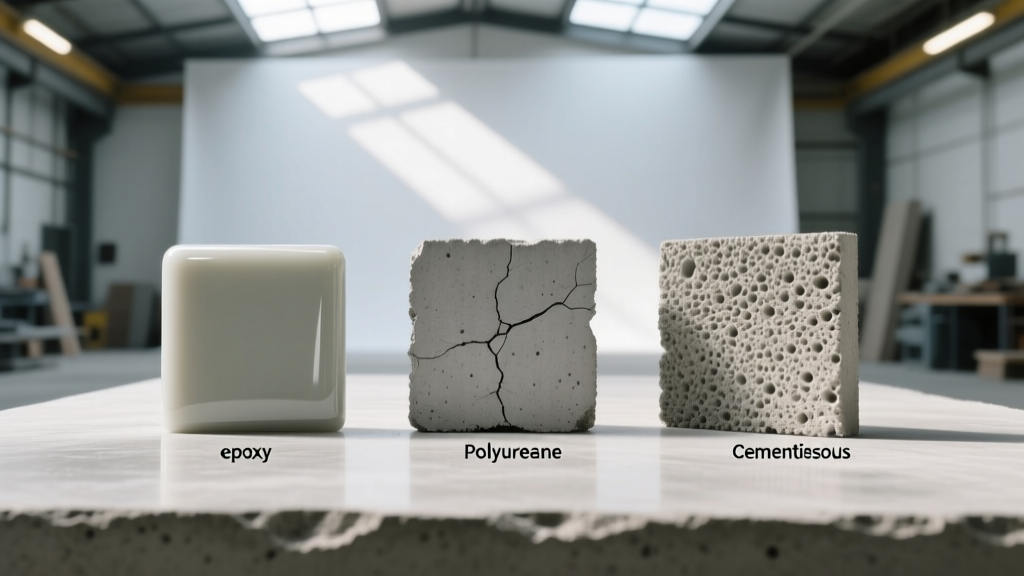
The Hidden Cost of Premature Concrete Filler Failure
Industry audits consistently reveal that up to 40% of concrete crack repairs fail within the first five years. This high failure rate rarely stems from the structural integrity of the surrounding slab; rather, it is driven by material mismatch. Selecting the wrong concrete filler for a specific crack profile guarantees premature debonding, cohesive tearing, or secondary micro-cracking. According to ACI Committee 224 on Cracking in Concrete, the longevity of a repair is dictated by the modulus of elasticity, elongation capacity, and environmental resistance of the chosen filler relative to the host substrate.
This analysis breaks down the lifecycle durability of the three primary concrete filler chemistries—epoxy, polyurethane, and polymer-modified cementitious compounds—providing exact performance metrics to inform your material selection.
Concrete Filler Lifespan Matrix: Material vs. Environment
The table below outlines the baseline durability expectations for standard commercial-grade fillers when applied to correctly prepared substrates.
| Filler Chemistry | Tensile Strength | Elongation at Break | Expected Lifespan | Primary Failure Mode |
|---|---|---|---|---|
| Low-Viscosity Epoxy | 8,000 - 10,000 psi | 1% - 3% | 20 - 30+ Years | Substrate tearing (if crack reactivates) |
| Hydrophobic Polyurethane | 300 - 800 psi | 400% - 600% | 10 - 15 Years | UV degradation / Surface chalking |
| Polymer-Modified Cementitious | 1,500 - 3,000 psi | 2% - 5% | 5 - 12 Years | Shrinkage cracking / Freeze-thaw spalling |
Deep Dive: Chemistry and Durability Mechanics
Epoxy Injection Resins: The Structural Heavyweight
Epoxies are thermosetting polymers that form a rigid, structural bond stronger than the concrete itself. For dormant, structural cracks (typically 0.05mm to 3mm wide), low-viscosity epoxies (100 to 500 centipoise) like Sikadur-52 or MasterEmaco 810 are the definitive choice. Because they achieve tensile strengths exceeding 8,000 psi, they restore monolithic load transfer across the fracture plane.
When used correctly on dormant cracks, epoxy is virtually immortal. It does not degrade from moisture, alkalis, or standard de-icing salts. Its 20-to-30-year lifespan is generally limited only by the lifespan of the host concrete structure.
Polyurethane Sealants and Foams: The Flexible Survivor
Polyurethane fillers prioritize flexibility over compressive strength. They are the mandatory choice for active cracks, control joints, and perimeter isolation joints. High-quality hydrophobic polyurethanes (such as SikaFlex or Emseal systems) offer elongation capacities exceeding 400%, allowing them to absorb thermal expansion and contraction cycles without losing adhesion.
The durability limitation of polyurethane is environmental. While the material deep within a crack remains stable for decades, exposed polyurethane degrades under ultraviolet (UV) radiation. Without a UV-stable topcoat or a recessed application profile (minimum 1/4 inch below the surface), the top layer will chalk, crack, and allow water ingress within 3 to 5 years. Properly recessed and shielded, polyurethane joints reliably last 10 to 15 years before requiring routing and resealing.
Polymer-Modified Cementitious Fillers: The Surface Workhorse
For wide, non-structural spalls, honeycombing, or surface scaling, polymer-modified cementitious fillers (e.g., Euclid EucoRepair or MasterEmaco S 488) provide a cost-effective, vapor-permeable solution. The addition of acrylic or latex polymers reduces the water-cement ratio required for workability, drastically lowering drying shrinkage and improving bond strength.
However, cementitious fillers remain susceptible to freeze-thaw cycling if the air-entrainment profile is compromised during mixing or application. Their lifespan of 5 to 12 years is heavily dependent on the International Concrete Repair Institute (ICRI) surface preparation standards. If applied over a poorly profiled substrate, micro-cleavage occurs at the bond line, allowing chlorides to bypass the repair and corrode underlying rebar.
Diagnostic Decision Tree: Matching Filler to Crack Behavior
Maximizing the lifespan of a concrete filler requires accurate diagnosis before material selection. Use this framework to determine the correct chemistry:
- Step 1: Is the crack active or dormant?
- Active (width changes with temperature/load): Proceed to Polyurethane. Do not use epoxy or standard cementitious patches.
- Dormant (static width): Proceed to Step 2.
- Step 2: Is the repair structural (load-bearing) or cosmetic/waterproofing?
- Structural (beams, columns, suspended slabs): Use Low-Viscosity Epoxy Injection.
- Non-Structural (waterproofing, cosmetic spalls): Proceed to Step 3.
- Step 3: What is the void geometry?
- Narrow fissure (< 3mm): Use penetrating epoxy or fluid-applied polyurethane.
- Wide spall or honeycomb (> 10mm): Use Polymer-Modified Cementitious Filler with a bonding agent.
The Role of Surface Profile (CSP) in Filler Longevity
The most durable concrete filler will fail prematurely if the substrate is not mechanically prepared. The ICRI defines Concrete Surface Profiles (CSP) on a scale of 1 to 9. The required CSP directly correlates to the filler's thickness and rigidity.
"A common field error is applying thick, polymer-modified cementitious fillers over a CSP 1 or 2 (acid etched or light grind) surface. These materials require a CSP 4 to 6 (achieved via scarifying or light shotblasting) to create the mechanical undercut necessary to resist shear forces and shrinkage pull."
For thin epoxy injections, the primary preparation metric is not roughness, but cleanliness. Compressed air blowing is insufficient; cracks must be flushed with oil-free air and, if moisture is present, treated with a moisture-tolerant epoxy primer to prevent amine blush and bond failure.
Lifecycle Cost Analysis: ROI of Premium Fillers
Evaluating concrete fillers strictly by initial material cost leads to false economies. A lifecycle cost analysis over a 30-year facility management horizon reveals the true value of high-durability materials.
| Material Choice | Initial Cost (per Linear Foot) | Service Life | 30-Year Replacements | Total 30-Year Cost per LF |
|---|---|---|---|---|
| Premium Epoxy Injection | $14.50 | 25+ Years | 0 | $14.50 |
| Standard Polyurethane Joint Sealant | $6.00 | 10 Years | 2 | $18.00 (plus mobilization costs) |
| Basic Unmodified Cementitious Patch | $3.50 | 4 Years | 6 | $24.50 (plus mobilization costs) |
As demonstrated, while basic cementitious patches appear cheap initially, the labor mobilization and surface re-preparation required for multiple replacements over three decades make them the most expensive option long-term. Investing in structural epoxy or high-grade polyurethane minimizes lifecycle disruption and total cost of ownership. For comprehensive infrastructure guidelines, refer to the Federal Highway Administration's Bridge Preservation protocols, which mandate high-elongation sealants and structural epoxies to minimize lifecycle maintenance on critical concrete assets.