Concrete vs Vinyl Pool: Material Costs, Lifespan & Installation Guide
Compare concrete vs vinyl pool materials. Analyze installation costs, long-term durability, maintenance needs, and customization limits to make the right choice.

The Core Difference: Structural Integrity vs. Flexible Liners
Choosing between a concrete and vinyl pool dictates the structural engineering, chemical maintenance, and long-term financial commitment of your backyard project. A concrete pool (typically applied as pneumatically projected shotcrete or gunite) is a monolithic, steel-reinforced structure. Builders excavate the site, tie a grid of #3 or #4 steel rebar at 10-inch centers, and spray a 4,000 PSI concrete mixture to a thickness of 8 to 12 inches. The interior is then finished with plaster, quartz, or pebble aggregate.
Conversely, a vinyl pool relies on a structural perimeter wall—usually extruded aluminum, galvanized steel, or structural polymer—backfilled with gravel or soil. The floor is typically a 2-to-3-inch layer of vermiculite or grout troweled over the native soil. The waterproofing is entirely dependent on a 20-mil to 30-mil embossed vinyl liner that hangs from a coping track and stretches over the floor and walls.
Quick Decision Framework
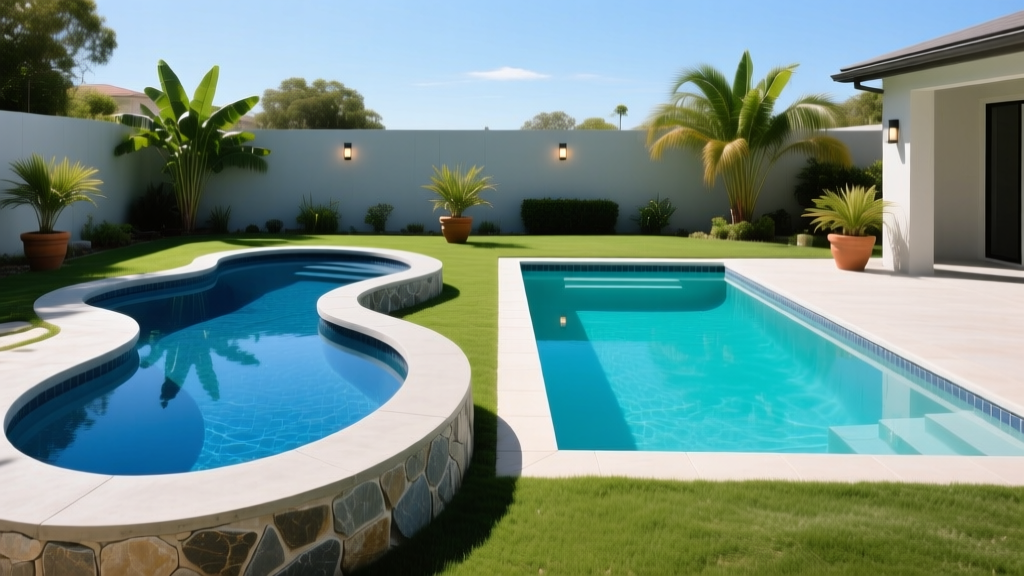
- Choose Concrete if: You require a custom freeform shape, want integrated structural features (like vanishing edges or built-in tanning ledges), and have a budget exceeding $80,000.
- Choose Vinyl if: You have a strict budget under $65,000, prefer a smoother surface that resists algae, and are satisfied with standard rectangular or modified-kidney footprints.
Upfront Installation Costs & Timelines
The initial capital expenditure for concrete pools is significantly higher due to the labor-intensive rebar tying, shotcrete application, and multi-stage curing process. Vinyl pools benefit from modular wall panels and rapid liner installation.
| Cost & Timeline Factor | Concrete (Shotcrete/Gunite) | Vinyl Liner |
|---|---|---|
| Average Initial Cost | $75,000 – $125,000+ | $45,000 – $75,000 |
| Installation Timeline | 60 – 90 days | 30 – 45 days |
| Excavation & Soil Removal | Higher (overspray and thicker walls) | Lower (precise panel footprints) |
| Standard Coping Material | Natural stone, poured concrete, travertine | Extruded aluminum, thermoplastic |
Hidden Cost Variables
When pricing a concrete pool, site access is a massive variable. If a concrete pump truck cannot reach the backyard, builders must use smaller equipment or manual wheelbarrows, adding $3,000 to $8,000 in labor. For vinyl pools, a high water table requires the installation of a sump pit and potentially a permanent de-watering system to prevent the pool from floating out of the ground when empty, adding $2,500 to $4,500 to the base price.
Long-Term Durability and Structural Failure Modes
Both materials have distinct failure modes dictated by soil mechanics and hydrostatic pressure.
Concrete Pool Failure Modes
- Structural Cracking: Expansive clay soils can exert lateral pressure exceeding the tensile strength of the steel-reinforced shell, leading to horizontal shear cracks.
- Plaster Delamination: If the concrete shell is not properly cured (kept moist for 7 to 14 days) before plastering, the interior finish can bond poorly and pop off in sheets.
- Hydrostatic Uplift: Without properly functioning hydrostatic relief valves in the main drain, groundwater pressure can crack the pool floor or lift the entire structure.
Vinyl Pool Failure Modes
- Liner Punctures and Tears: Pet claws, sharp landscaping tools, or shifting vermiculite floors can easily pierce a 20-mil liner. Even 30-mil liners are vulnerable at the seams.
- Wall Corrosion: If galvanized steel walls are used and the protective zinc coating is scratched during installation, groundwater exposure will cause rust-jacking, eventually bowing the walls inward.
- Liner Floatation: If the water table rises and the pool is drained for winter, the vinyl liner can detach from the track and balloon upward, permanently stretching the material.
Maintenance Realities: Chemistry and Surface Porosity
The interior surface of the pool drastically alters your weekly chemical requirements and long-term maintenance costs. According to guidelines published by the U.S. Department of Energy, maintaining proper water balance is critical for both efficiency and material longevity, but the two materials react differently to chemical loads.
Water Chemistry Insight: Concrete plaster is highly alkaline and porous. During the first 30 days of a new concrete pool, the curing plaster leaches calcium hydroxide into the water, requiring daily acid additions to maintain a pH of 7.4. Vinyl is an inert, non-porous plastic that does not interact with water chemistry, making pH stabilization significantly easier.
Because concrete is porous, it provides microscopic harbors for algae spores. Concrete pools generally require higher baseline chlorine levels (2.0 - 4.0 ppm) and more frequent brushing. Vinyl pools, featuring a smooth, non-porous surface, can often be maintained at the lower end of the CDC's recommended disinfection thresholds (1.0 - 3.0 ppm). However, chronically high chlorine levels or improper shock treatments will prematurely bleach and degrade the vinyl liner's printed pattern.
The 10-Year Total Cost of Ownership
Initial installation is only half the financial equation. You must factor in mandatory material replacements and resurfacing over the first decade of ownership.
Concrete 10-Year Costs
- Acid Washing (Years 5 & 10): $400 - $600 per treatment to remove mineral scaling.
- Surface Resurfacing: Standard Marcite plaster lasts 7-10 years. Resurfacing costs $8,000 - $12,000. Upgrading to Pebble Tec extends life to 20+ years but costs $12,000 - $16,000.
- Chemical Consumption: ~15% higher annually due to porous surface algae prevention.
Vinyl 10-Year Costs
- Liner Replacement (Year 7-10): A new 28-mil custom-cut liner, including labor and water refill, costs $4,500 - $6,500.
- Foam Pad Replacement: Often required during liner swaps if the wall foam has degraded ($500 - $800).
- Chemical Consumption: Lower baseline cost, but requires UV-protectant stabilizers (cyanuric acid) to prevent sun-fading the liner pattern.
Customization and Design Limitations
If architectural freedom is your priority, concrete is the undisputed winner. Because the shell is formed by spraying concrete over a hand-tied rebar frame, builders can create any geometry: naturalistic lagoons, negative edges, integrated spa spillways, and shallow beach entries. Depth transitions can be highly customized to accommodate diving boards or specialized lap-swim lanes.
Vinyl pools are constrained by the manufacturing limits of the wall panels and the liner itself. While modern CNC routing allows for some custom floor contours, the walls are generally restricted to standard straight, curved, or radius panels. Sharp inside corners are impossible in vinyl pools because the liner cannot be welded into a tight 90-degree angle without creating extreme stress points that will tear under hydrostatic load. Furthermore, integrating structural water features like vanishing edges is practically impossible with a flexible liner system.
Final Verdict: Matching Material to Property
Selecting between concrete and vinyl requires aligning your property's physical constraints with your financial timeline. If you are building in an area with highly expansive soils or a high water table, a structural polymer-walled vinyl pool with a robust de-watering system often presents fewer structural risks than a rigid concrete shell prone to shear cracking. Conversely, if you are integrating the pool into a complex, multi-tiered landscape design requiring custom retaining walls and freeform geometry, the premium paid for shotcrete is a mandatory investment in structural versatility.
Written by
Elena RodriguezElena Rodriguez is a civil engineer and technical writer specializing in concrete technology, masonry systems, and ASTM/ACI compliance. She earned her B.S. in Civil Engineering from Texas A&M University and spent a decade at a materials testing laboratory, performing over 2,000 concrete compressive strength tests and masonry prism evaluations. Elena is an ACI-certified Field Testing Technician (Grade I) and a member of ASTM Committee C12 on Natural Building Stone. She currently consults on forensic engineering cases involving concrete failures and moisture intrusion. Based in San Antonio, TX, Elena is a proud member of the Society of Women Engineers (SWE) and coaches her daughter's FIRST Robotics team.
More from Elena Rodriguez
View all
Walls & Panels
Cost Analysis: Light Gauge Steel Framing Advantages and Disadvantages
Evaluate light gauge steel framing advantages and disadvantages through a strict cost analysis lens, comparing material, labor, and lifecycle expenses.
Aug 4, 2026

Walls & Panels
Gypsum Board Types: Exact Specifications, Thickness & Dimensions
Compare standard, Type X, and moisture-resistant gypsum board types. Get exact specifications, thicknesses, dimensions, and ASTM standards for your project.
Aug 4, 2026

Fire Resistance
Best Fire-Resistant Outdoor Decking Materials: 2026 Buyer Guide
Discover the best fire-resistant outdoor decking materials for 2026. Compare Class A PVC, aluminum, and hardwood options for WUI compliance and safety.
Aug 4, 2026