What Type of Ice Melt Is Safe for Concrete Surfaces?
Discover what type of ice melt is safe for concrete. Learn chemical differences, application rates, and winterization steps to prevent scaling and spalling.
The Chemistry of Concrete Scaling: Why Deicers Cause Damage
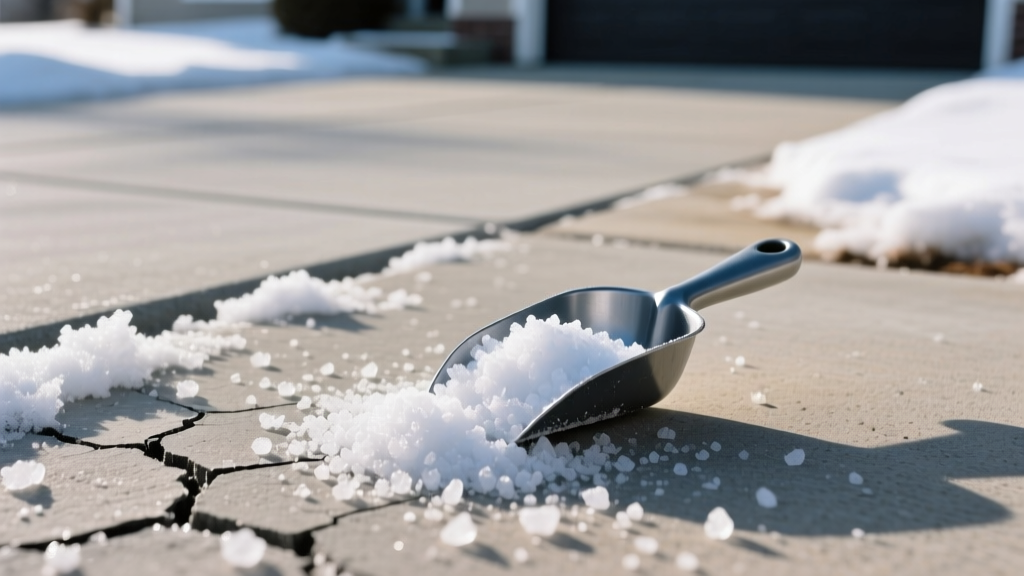
When homeowners and facility managers ask what type of ice melt is safe for concrete, the answer requires understanding how deicing chemicals interact with cementitious materials. Concrete is inherently porous. When snow melts and the resulting water infiltrates the capillary network of the slab, a subsequent drop in temperature causes that water to freeze and expand by approximately 9%. This creates internal hydraulic pressure.
Chloride-based ice melts exacerbate this process through osmotic pressure and chemical attack. Chloride ions can penetrate the concrete matrix and react with calcium hydroxide (a byproduct of cement hydration), forming calcium oxychloride. This compound expands and crystallizes within the pores, leading to scaling (surface flaking) and, in severe cases, spalling (deep structural fracturing). According to the Portland Cement Association (PCA), properly air-entrained concrete with 4% to 8% microscopic air voids provides the necessary relief valves for this expansion, but chemical deicers can still degrade the surface paste if misapplied.
Never apply chemical ice melters to concrete that is less than 12 months old. New concrete has not yet reached its full design compressive strength (typically 3,500 to 4,000 psi) or developed a mature, impermeable surface paste. Using chlorides on first-year concrete will almost guarantee severe scaling. Use only mechanical removal and clean sand for traction during the first winter.
Comparing Deicers: What Type of Ice Melt Is Safe for Concrete?
Not all ice melts are created equal. The market offers several chemical formulations, each with distinct thermal thresholds, environmental impacts, and effects on concrete durability. Below is a 2026 market matrix evaluating the most common deicing agents.
| Deicer Type | Chemical Formula | Lowest Effective Temp | Concrete Risk Level | Avg. Cost (50lb Bag) |
|---|---|---|---|---|
| Calcium Magnesium Acetate (CMA) | CaMg2(C2H3O2)6 | 20°F (-6°C) | Very Low (Safest) | $35 - $45 |
| Magnesium Chloride | MgCl2 | 5°F (-15°C) | Moderate | $20 - $28 |
| Calcium Chloride | CaCl2 | -25°F (-31°C) | High (if over-applied) | $18 - $25 |
| Sodium Chloride (Rock Salt) | NaCl | 20°F (-6°C) | High | $8 - $14 |
| Urea | CO(NH2)2 | 25°F (-4°C) | Moderate (Nitrogen leaching) | $15 - $22 |
The Safest Option: Calcium Magnesium Acetate (CMA)
If your primary concern is preserving the structural integrity of a stamped, exposed aggregate, or high-finish concrete driveway, CMA is the undisputed champion. It is a chloride-free, biodegradable salt derived from limestone and acetic acid. Rather than melting ice through an exothermic reaction, CMA works by preventing water molecules from bonding to each other and to the pavement. While its upfront cost is significantly higher, the elimination of concrete repair costs makes it the most economical choice for high-value hardscapes over a 10-year lifecycle.
The Pragmatic Option: Magnesium Chloride
For regions experiencing deep freezes where CMA’s 20°F threshold is insufficient, Magnesium Chloride is the safest chloride-based alternative. It extracts moisture from the air to form a brine, melting ice down to 5°F. It leaves less white residue than sodium chloride and is generally less damaging to the concrete matrix, provided the slab is fully cured and sealed.
Step-by-Step Application Guide for Cured Concrete
Even the safest ice melt will cause damage if applied incorrectly. Over-application is the leading cause of deicer scaling. Follow this precise protocol to maintain traction while protecting your slab.
Step 1: Mechanical Clearing First
Never use ice melt as a substitute for shoveling. Use a poly-blade snow shovel (steel blades will gouge the surface) to remove the top layer of snow. Ice melt should only be used to break the bond of the remaining 1/8-inch ice layer, not to melt through 4 inches of snowpack.
Step 2: Calculate the Broadcast Rate
The industry standard application rate for most granular deicers is 1 cup per square yard (approximately 150 lbs per acre). For CMA, follow the manufacturer's exact instructions, but generally, a light, even broadcasting is sufficient. Use a handheld rotary spreader to ensure uniform distribution and prevent localized chemical pooling.
Step 3: Allow Time for the Brine Reaction
Once broadcast, give the product 15 to 30 minutes to penetrate the ice and form a brine solution. Do not immediately re-apply if the ice doesn't vanish instantly. Patience prevents the chemical overload that eats away at the concrete's surface paste.
Step 4: Remove Slush and Residue
Once the ice bond is broken, shovel the slush off the driveway. Leaving the slush to refreeze creates a highly concentrated saline layer directly against the concrete pores. In the spring, use a pressure washer (minimum 2,500 PSI with a 25-degree nozzle tip) to blast away any invisible chloride or acetate residue that crystallized in the pores over the winter.

The 'First Winter' Protocol: Treating Uncured Concrete
As highlighted by the National Ready Mixed Concrete Association (NRMCA), concrete placed in late summer or fall will not possess adequate freeze-thaw durability to survive chemical deicers during its first winter. If you must maintain traction on a newly poured driveway or patio, follow this uncured concrete protocol:
- Use Clean Traction Sand: Apply coarse, washed masonry sand. Avoid playground sand, which is too fine and will turn into a muddy paste that tracks into your home.
- Avoid Kitty Litter: While popular in emergencies, clay-based kitty litter absorbs water, swells, and creates a massive cleanup hazard in the spring. It can also stain unsealed concrete.
- Install Snow Melting Mats: For high-traffic walkways on new concrete, electric snow melting mats provide a chemical-free, zero-damage alternative to keep paths clear.
"Air-entrainment is your concrete's immune system against winter. Without those microscopic air bubbles giving water room to expand, no chemical deicer on the market is truly 'safe'. Always verify your contractor used an air-entraining admixture targeting 5% to 7% air content for exterior flatwork."
Frequently Asked Questions
Does sealing concrete make it immune to ice melt damage?
A high-quality penetrating silane/siloxane sealer significantly reduces water and chloride absorption, acting as a hydrophobic barrier. However, it does not make the concrete immune. Sealers degrade over 2 to 5 years due to UV exposure and traffic wear. If the sealer fails in patches, deicers will penetrate unevenly, potentially causing localized spalling. Reapply sealers every 3 years in freezing climates.
Are liquid deicers safer than granular pellets?
Liquid deicers (often pre-wetted magnesium chloride or calcium chloride brines) offer superior control over application rates, virtually eliminating the dangerous "over-piling" that occurs when homeowners dump granular salt in one spot. However, the chemical interaction with the concrete remains the same. Liquid brines are excellent for anti-icing (applied before a storm to prevent bonding) but are less effective at melting thick, existing ice sheets compared to exothermic granular pellets.
What is the white powdery residue left behind by rock salt?
This is efflorescence, combined with unreacted sodium chloride and calcium carbonate deposits. While primarily a cosmetic issue on standard gray concrete, this residue can permanently etch and stain decorative stamped concrete or exposed aggregate. This etching is another primary reason why CMA is the recommended choice for architectural concrete finishes.
Written by
Priya KapoorPriya Kapoor is a real estate market analyst and construction economics researcher with expertise in housing affordability, development feasibility, and infrastructure investment. She holds a Master of Regional Planning from Cornell University and previously worked as a senior analyst at CBRE's Investment Properties group, where she modeled returns for $4B in mixed-use development pipelines. Priya now runs an independent research practice advising developers, municipalities, and REITs on construction cost forecasting and market timing. She publishes the quarterly "BuildMat Market Pulse" report tracking material price indices across 12 commodity categories. Based in Austin, TX, Priya serves on the board of Habitat for Humanity Austin and is a marathon runner.
More from Priya Kapoor
View all
Construction Cost
Cost to Build a 1600 Sq Ft Home in 2026: Full Breakdown
Accurate 2026 cost to build a 1600 sq ft home—material, labor, and regional pricing breakdowns included. Plan your budget with real-time estimates.
Aug 11, 2026

Wood & Lumber
Name the Types of Wood for Pressure Treatment and Preservation
Learn how to name the types of wood best suited for pressure treatment. Compare species treatability, chemical retention levels, and 2026 preservation costs.
Aug 4, 2026

Stone & Masonry
Stone Veneer Suppliers Lindenhurst: 2026 Cost Analysis
Analyze 2026 stone veneer costs in Lindenhurst, NY. Compare local supplier pricing, delivery fees, and Suffolk County installation labor rates.
Aug 4, 2026