Concrete Paint Taxonomy: How to Select the Right Coating
Navigate the concrete paint taxonomy. Compare epoxy, acrylic, polyurethane, and silicate coatings for specific substrates, traffic, and moisture levels.
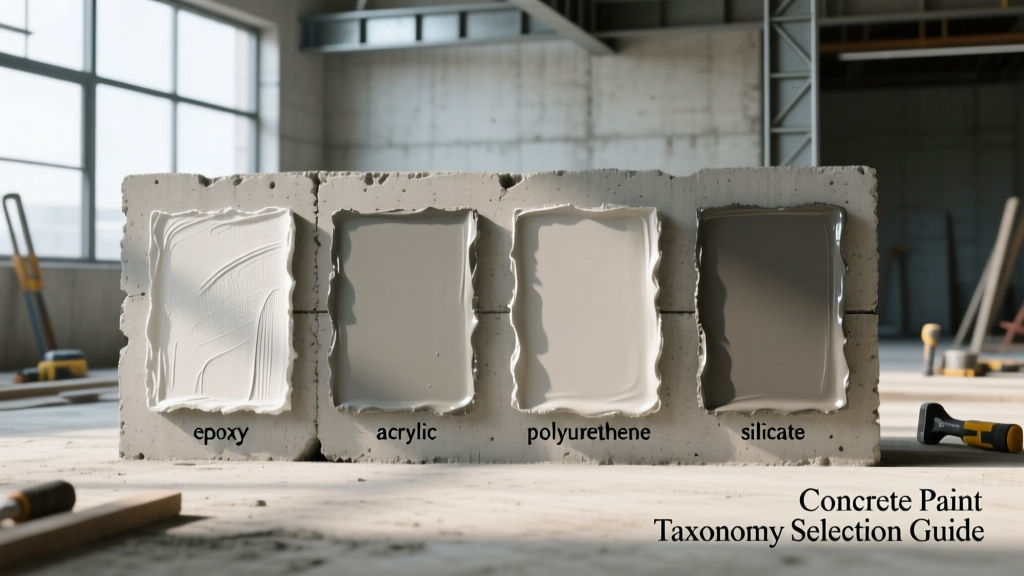
The Chemical Taxonomy of Concrete Paint
The term 'concrete paint' is an industry misnomer that collapses a highly specialized spectrum of architectural and industrial coatings into a single bucket. Selecting the correct product requires understanding the underlying resin chemistry, as each formulation interacts differently with the alkaline, porous nature of cementitious substrates. In 2026, the market is dominated by five distinct chemical categories, each engineered for specific performance thresholds.
1. Acrylic Coatings (Water-Based)
Acrylics are single-component, breathable coatings that form a mechanical bond with the concrete pores. They offer excellent UV resistance and color retention but lack the chemical and abrasion resistance required for heavy industrial use. They typically yield a Dry Film Thickness (DFT) of 1.5 to 2.5 mils. Acrylics are the default choice for exterior vertical surfaces, such as tilt-up panels and foundation walls, where moisture vapor transmission (MVT) from the backside of the slab would blister non-breathable coatings.
2. Epoxy Systems (Two-Component)
Epoxies rely on a polyamine hardener and an epoxy resin to create a highly cross-linked, thermosetting polymer. They provide exceptional adhesion, chemical resistance, and build thickness (8 to 15 mils DFT). However, standard epoxies are aliphatic and highly susceptible to UV degradation, resulting in severe chalking and yellowing when exposed to direct sunlight. They are strictly specified for interior high-traffic environments like warehouses, commercial garages, and manufacturing floors.
3. Aliphatic Polyurethanes
Polyurethanes are rarely applied directly to bare concrete due to their low build and high solvent content, which can cause outgassing bubbles. Instead, they are utilized as a 3 to 5 mil topcoat over an epoxy base. Their primary function is to provide a UV-stable, high-gloss, and highly abrasion-resistant wear surface that protects the underlying epoxy from sunlight and physical scuffing.
4. Silicate and Mineral Paints
Potassium silicate coatings do not form a surface film; instead, they penetrate the capillary network of the concrete and undergo a process called petrification, chemically bonding with the free lime (calcium hydroxide) in the cement matrix. This creates a micro-crystalline structure that is entirely vapor-permeable and immune to peeling. Mineral paints are mandatory for historic masonry restoration and exterior concrete structures where trapping moisture behind a film-forming paint would cause spalling during freeze-thaw cycles.
5. Elastomeric Coatings
Formulated with high-build acrylic or polyurethane resins, elastomerics are designed to bridge dynamic hairline cracks (up to 1/16 inch). Applied at a massive 10 to 20 mils DFT, they stretch and recover with the thermal expansion and contraction of the concrete substrate. They are heavily utilized on exterior balconies, plaza decks, and stucco-finished concrete walls.
Applying a film-forming concrete paint (like epoxy or standard acrylic) over a slab with high MVT is the leading cause of catastrophic coating failure. Before specifying any non-breathable coating, conduct a calcium chloride test per ASTM F1869. If the emission rate exceeds 3 lbs per 1,000 square feet per 24 hours, you must first apply a moisture-mitigating epoxy primer (such as Mapei Primer SN or Sikafloor-81 EpoCem) capable of blocking up to 98% relative humidity within the slab. Ignoring this metric will result in osmotic blistering within 60 days of application.
Selection Matrix: Matching Coating to Application
Use the following decision matrix to align your substrate conditions and environmental requirements with the correct concrete paint chemistry. Costs reflect 2026 market averages for material only, excluding surface preparation labor.
| Application Environment | Recommended Chemistry | Required CSP Profile | Expected Lifespan | Material Cost (per sq ft) |
|---|---|---|---|---|
| Interior Garage / Light Industrial | 2-Part Waterborne Epoxy | CSP 2 - 3 | 5 - 8 Years | $0.35 - $0.60 |
| Heavy Industrial / Forklift Traffic | 100% Solids Epoxy + Poly Topcoat | CSP 3 - 4 | 10 - 15 Years | $0.85 - $1.40 |
| Exterior Vertical (Foundation/Tilt-up) | 100% Acrylic or Silicate | CSP 1 - 2 | 7 - 10 Years | $0.15 - $0.30 |
| Exterior Horizontal (Patios/Decks) | Elastomeric Acrylic | CSP 2 | 4 - 6 Years | $0.40 - $0.65 |
| Historic / Vapor-Permeable Masonry | Potassium Silicate (Mineral) | CSP 1 (No mechanical profiling) | 15+ Years | $0.25 - $0.50 |
Surface Preparation & Profiling Standards
The adhesion of any concrete paint is entirely dependent on the surface preparation. Bare concrete is highly alkaline (pH 11-13) and often contaminated with laitance, curing compounds, and form release oils. The American Concrete Institute (ACI) Committee 546 outlines strict protocols for substrate remediation and coating adhesion.
Mechanical vs. Chemical Profiling
To achieve the necessary Concrete Surface Profile (CSP), contractors must choose between mechanical and chemical methods:
- Diamond Grinding & Shotblasting (Mechanical): The gold standard for interior floors. Shotblasting opens the pores and removes laitance without introducing water, achieving a CSP 3 or 4 required for high-build epoxies. However, dry mechanical preparation generates massive amounts of respirable crystalline silica dust. Contractors must strictly adhere to OSHA's Respirable Crystalline Silica Standard (29 CFR 1926.1153), utilizing HEPA-filtered shrouds and enclosed vacuums to maintain exposure limits below 50 µg/m³.
- Acid Etching (Chemical): Traditionally done with 10% muriatic acid, this method dissolves the top layer of cement paste to expose the aggregate. While cheaper and dust-free, acid etching is increasingly banned by commercial specifications due to the environmental hazards of neutralizing and disposing of heavy-metal-laden acidic runoff. If utilized, the slab must be neutralized with a baking soda solution and thoroughly rinsed until the pH returns to a neutral 7.0.
Real-World Failure Modes & Diagnostic Protocols
When concrete paint fails, it is rarely a defect in the coating itself; it is almost always a failure in site diagnosis or preparation. Recognizing these specific failure modes allows for accurate remediation.
Symptom: Dome-shaped bubbles filled with a clear, alkaline liquid appear across the floor, eventually rupturing and leaving craters.
Cause: Hydrostatic pressure pushes water vapor through the slab, which becomes trapped beneath a non-breathable epoxy or acrylic film.
Fix: Remove the blistered coating. Perform an ASTM F1869 test. Apply a penetrating, moisture-mitigating epoxy primer before recoating.
Symptom: An exterior patio or sunroom floor coated with epoxy turns chalky, loses its gloss, and shifts to a yellow/brown hue.
Cause: Aromatic epoxies lack UV stabilizers. The sun's ultraviolet rays break down the polymer chains on the surface.
Fix: Epoxy cannot be stabilized against UV once applied. The floor must be mechanically scuffed, and a UV-stable aliphatic polyurethane topcoat must be applied immediately to halt degradation.
Symptom: Water-based acrylic paints applied to new concrete turn gummy, lose adhesion, and wipe off with a damp cloth.
Cause: New concrete contains high levels of free alkali. When moisture reacts with these alkalis, it creates a soap-like substance (saponification) that destroys the water-based binder.
Fix: Ensure new concrete cures for a minimum of 28 days. Test the surface pH. If above 9.0, wash with a phosphoric acid solution and apply an alkali-resistant masonry primer (e.g., Sherwin-Williams Loxon Primer) before topcoating.
Environmental Compliance & VOC Limits
The selection of concrete paint is increasingly dictated by environmental regulations regarding Volatile Organic Compounds (VOCs). The EPA's Architectural and Industrial Maintenance (AIM) Coatings rule establishes baseline federal limits, but regional air quality management districts enforce much stricter thresholds.
For example, under the South Coast Air Quality Management District (SCAQMD) Rule 1113, which influences formulations across North America, flat concrete sealers are capped at 100 g/L of VOCs, while non-flat and high-build coatings are capped at 150 g/L. This regulatory pressure has forced manufacturers to reformulate traditional solvent-based epoxies into high-solids, low-VOC waterborne hybrids. When specifying coatings for interior occupied spaces, such as schools, hospitals, or residential basements, always verify that the selected concrete paint carries a GREENGUARD Gold certification to ensure compliance with stringent indoor air quality standards for off-gassing.
Ultimately, successful concrete painting is an exercise in diagnostic chemistry. By matching the precise moisture, traffic, and UV conditions of your substrate to the correct polymer taxonomy, and enforcing rigorous CSP preparation standards, you transform a vulnerable cement slab into a high-performance, durable surface.