Concrete vs Shake Roofing: Application & Durability Showcase
Explore the concrete vs shake roofing debate with our application showcase. Compare structural needs, wildfire ratings, and 2026 installation costs.
The Architectural Divide: Material Profiles
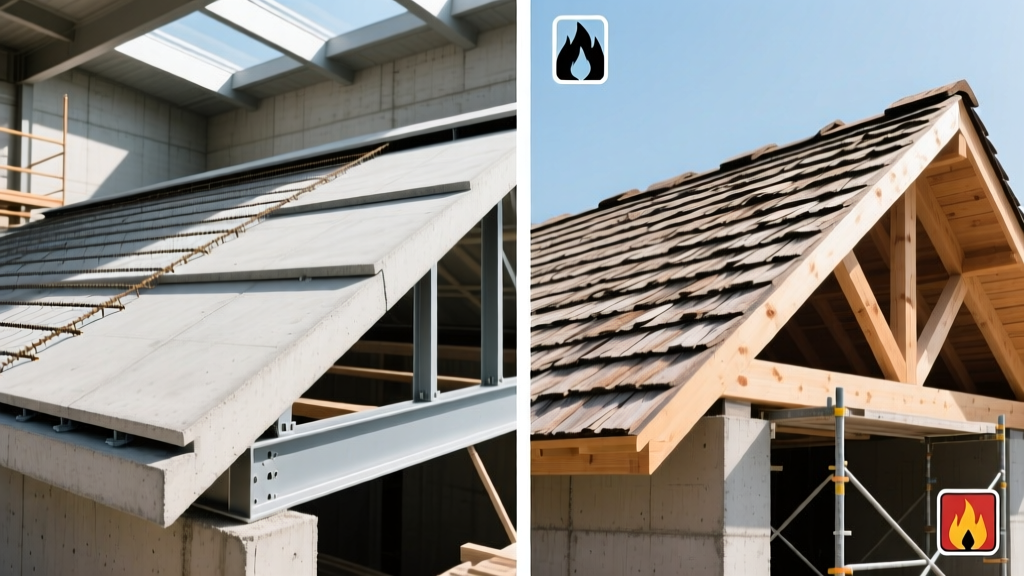
When specifying roofing for high-end residential or commercial projects, the concrete vs shake debate centers on three distinct material categories: extruded concrete tiles, natural cedar shakes, and engineered composite shakes. Each material dictates a fundamentally different structural, aesthetic, and environmental strategy.
- Concrete Tiles: 900–1,100 lbs per square (100 sq ft). Class A fire rating. Extruded Portland cement and sand mix with acrylic slurry coatings.
- Natural Cedar Shakes: 250–350 lbs per square. Class C fire rating (Class B with pressure-treated fire retardants). Taper-split Western Red Cedar.
- Composite Shakes: 300–400 lbs per square. Class A fire rating. Engineered from virgin polymers, rubber, and UV stabilizers (e.g., DaVinci Roofscapes, CeDUR).
Application Showcase: Real-World Performance
Scenario 1: Wildland-Urban Interface (WUI) Construction
In regions governed by strict WUI codes (such as California's Chapter 7A or Colorado's Douglas County standards), material combustibility is the primary constraint. According to the Insurance Institute for Business & Home Safety (IBHS), roof coverings are the most vulnerable component during a wildfire due to wind-blown embers.
Concrete Tiles: Excel in WUI zones due to their non-combustible nature and Class A assembly rating. However, the curved profiles of S-tiles or Roman pans create voids at the eaves. Installers must use fire-resistant bird stops and eave closures to prevent ember intrusion into the underlayment.
Natural Shakes: Strictly prohibited in most severe WUI zones. Even fire-retardant-treated (FRT) cedar loses its Class B rating over time as rain leaches the chemical retardants, leaving the roof vulnerable to ignition.
Composite Shakes: The optimal compromise for WUI zones requiring a rustic aesthetic. Products like CeDUR synthetic shakes maintain a Class A rating without chemical leaching, passing the stringent UL 790 external fire test.
Scenario 2: Coastal and High-Salinity Environments
Coastal applications introduce salt spray, high UV indices, and driving rain. The concrete vs shake decision here hinges on moisture management and chemical degradation.
Concrete tiles in coastal zones are susceptible to efflorescence—a white, powdery calcium carbonate deposit that migrates to the surface when moisture reacts with unhydrated calcium in the cement. While purely cosmetic, it requires periodic acid washing. Furthermore, the steel hooks or nails used to fasten concrete tiles must be hot-dipped galvanized or stainless steel; standard electroplated fasteners will corrode within five years in salt air, leading to catastrophic tile slippage.
Natural cedar shakes perform surprisingly well in coastal environments if left untreated. The natural tannins and oils in Western Red Cedar resist rot, and the wood weathers to a uniform silver-gray patina. However, they require a minimum 4:12 pitch and a breathable synthetic underlayment to prevent trapped moisture from causing fungal decay on the north-facing slopes.
Scenario 3: Historic Craftsman and Tudor Restorations
For architectural purists, the Cedar Shake and Shingle Bureau (CSSB) notes that natural wood is often the only material accepted by historic preservation boards. Concrete tiles possess a high visual mass and rigid shadow lines that clash with the delicate, staggered butt lines of traditional Craftsman architecture. In these applications, heavy concrete tiles are typically rejected in favor of hand-split, taper-sawn cedar shakes, which offer the authentic variable exposure (typically 5.5 to 7.5 inches) required for period-accurate restorations.
The Hidden Variable: Structural Load and Framing Costs
The most frequent point of failure in the concrete vs shake evaluation is underestimating dead load requirements. The Tile Roofing Institute (TRI) mandates that structural framing must support the weight of concrete tiles plus a snow/ice load factor.
A standard asphalt shingle or cedar shake roof imposes a dead load of roughly 2.5 to 3.5 lbs per square foot (psf). Concrete tiles impose 9.5 to 11.0 psf. If you are retrofitting an existing home from shakes to concrete, the existing 2x4 or 2x6 trusses spaced at 24 inches on-center will likely fail deflection limits. Structural reinforcement—such as sistering trusses, adding mid-span bearing walls, or installing steel flitch plates—adds $3.50 to $6.00 per square foot to the project cost. For new construction, specifying engineered I-joists or 2x8 trusses at 16 inches on-center from the blueprint phase mitigates this, adding only $1.20 to $1.80 per square foot to the framing budget.
Head-to-Head Matrix: Concrete vs. Cedar vs. Composite Shakes
| Metric | Concrete Tile | Natural Cedar Shake | Composite Shake |
|---|---|---|---|
| Installed Cost (2026) | $14.00 – $22.00 / sq ft | $18.00 – $28.00 / sq ft | $16.00 – $24.00 / sq ft |
| Wind Resistance | 110–130 mph (requires foam adhesion) | 90–110 mph (mechanical nail) | 110+ mph (mechanical nail) |
| Impact Rating | Class 3 or 4 (hail can spall slurry coat) | Class 2 (prone to splitting) | Class 4 (UL 2218 certified) |
| Expected Lifespan | 50+ years (underlayment fails first) | 25–35 years | 50+ years |
Lifecycle Maintenance and Fastening Systems
The longevity of any roof is dictated by its weakest link. For concrete tile systems, the tiles themselves will easily outlast a 50-year mortgage, but the underlying 43-pound felt or synthetic underlayment will degrade in 30 to 40 years due to thermal cycling and condensation. Modern best practices dictate the use of self-adhering peel-and-stick ice and water shield across the entire deck (a "hot roof" assembly) in high-wind or coastal zones, which adds $2.50 per square foot but ensures the secondary water barrier matches the tile's lifespan.
Fastening protocols have also evolved. While traditional concrete installations relied on two copper or stainless steel nails per tile, modern high-wind applications utilize two-part polyurethane foam adhesives (such as Polyset or Anchor). This foam bonding eliminates nail-hole penetration through the underlayment and provides superior uplift resistance, capable of withstanding Category 3 hurricane wind uplifts.
Cedar shakes require periodic maintenance to clear debris from the keyways (the gaps between shakes) to prevent water damming and moss growth. Composite shakes, conversely, require zero routine maintenance beyond standard gutter clearing, as their non-porous polymer surfaces inhibit algae and moss colonization.
Final Specification Framework
Use this decision matrix to finalize your material specification:
- Specify Concrete Tile If: The project is new construction (or structurally reinforced), located in a high-wildfire or high-hail zone, and the architectural style suits Mediterranean, Spanish, or modern flat-tile profiles.
- Specify Natural Cedar If: The project is a historic restoration, strict HOA/architectural review boards mandate authentic natural materials, and the owner accepts a 30-year replacement lifecycle and routine maintenance.
- Specify Composite Shake If: The project requires a traditional wood-shake aesthetic but is located in a WUI zone, coastal environment, or the existing framing cannot support the dead load of concrete tiles.
Written by
Priya KapoorPriya Kapoor is a real estate market analyst and construction economics researcher with expertise in housing affordability, development feasibility, and infrastructure investment. She holds a Master of Regional Planning from Cornell University and previously worked as a senior analyst at CBRE's Investment Properties group, where she modeled returns for $4B in mixed-use development pipelines. Priya now runs an independent research practice advising developers, municipalities, and REITs on construction cost forecasting and market timing. She publishes the quarterly "BuildMat Market Pulse" report tracking material price indices across 12 commodity categories. Based in Austin, TX, Priya serves on the board of Habitat for Humanity Austin and is a marathon runner.
More from Priya Kapoor
View all
Construction Cost
Cost to Build a 1600 Sq Ft Home in 2026: Full Breakdown
Accurate 2026 cost to build a 1600 sq ft home—material, labor, and regional pricing breakdowns included. Plan your budget with real-time estimates.
Aug 11, 2026

Wood & Lumber
Name the Types of Wood for Pressure Treatment and Preservation
Learn how to name the types of wood best suited for pressure treatment. Compare species treatability, chemical retention levels, and 2026 preservation costs.
Aug 4, 2026

Stone & Masonry
Stone Veneer Suppliers Lindenhurst: 2026 Cost Analysis
Analyze 2026 stone veneer costs in Lindenhurst, NY. Compare local supplier pricing, delivery fees, and Suffolk County installation labor rates.
Aug 4, 2026