Exposed Aggregate Concrete vs Stamped Concrete: Material Guide
Compare exposed aggregate concrete vs stamped concrete for driveways and patios. Explore costs, slip resistance, durability, and installation details.

The Anatomy of Two Premium Finishes
Choosing between exposed aggregate concrete and stamped concrete dictates not only the visual character of your hardscape but also its long-term maintenance profile, slip resistance, and structural resilience. While both methods utilize the same foundational material—typically a 3,500 to 4,000 PSI air-entrained mix conforming to ASTM C94—the surface treatment processes diverge dramatically. Exposed aggregate relies on chemical retarders and mechanical washing to reveal the internal stone matrix, whereas stamped concrete utilizes polyurethane mats and broadcast color hardeners to mimic natural masonry. This guide dissects the material science, failure modes, and application-specific performance of both finishes to help you specify the correct system for your project.
Head-to-Head Material Matrix
| Performance Metric | Exposed Aggregate | Stamped Concrete |
|---|---|---|
| Surface Texture | Rough, highly tactile, 3D stone profile | Smooth to semi-smooth, simulated grout lines |
| Slip Resistance (Wet) | Excellent (High coefficient of friction) | Poor to Fair (Highly dependent on sealer grit) |
| Color Methodology | Natural stone color; optional integral dye | Broadcast hardeners, antiquing releases, stains |
| Snow Removal Impact | Metal blades can dislodge surface stones | Sealer can scratch or delaminate under blades |
| Freeze-Thaw Resilience | High (if properly air-entrained and sealed) | Moderate (Surface sealer traps moisture if failing) |
| Average Lifespan | 25+ years (structural), 3-5 years (sealer) | 25+ years (structural), 2-3 years (sealer) |
Exposed Aggregate: Traction and Natural Durability
Exposed aggregate is achieved by spraying a chemical surface retarder (such as Sika Film or Master Builders series) onto freshly finished concrete. This retarder penetrates the top 1/8 to 1/4 inch, delaying the hydration of the cement paste. The following morning, the surface is washed with a pressure washer and stiff-bristled broom to remove the unset paste, revealing the underlying aggregate—typically pea gravel, river rock, or crushed granite.
Mix Design and Placement Specifics
The success of exposed aggregate hinges on the concrete mix design. The aggregate size is typically 3/8-inch to 1/2-inch for a uniform, tightly packed exposure. For driveways in freeze-thaw climates, the mix must include 4% to 7% air entrainment per Portland Cement Association guidelines. This microscopic air bubble network provides expansion chambers for freezing water, preventing catastrophic surface spalling. The slump should be strictly controlled between 4 and 5 inches; a higher slump risks aggregate segregation, where heavy stones sink to the bottom of the slab, leaving only fine sand at the surface to be exposed.
Exposed aggregate is highly susceptible to 'pop-outs' if exposed to magnesium chloride or calcium chloride de-icing salts during the first winter. These chemicals cause osmotic pressure beneath the porous stones, literally popping them out of the cement matrix. Always specify a penetrating silane/siloxane sealer rather than a topical acrylic for winter-exposed driveways, and use only calcium magnesium acetate (CMA) for ice melting.
Stamped Concrete: Aesthetic Versatility and Design
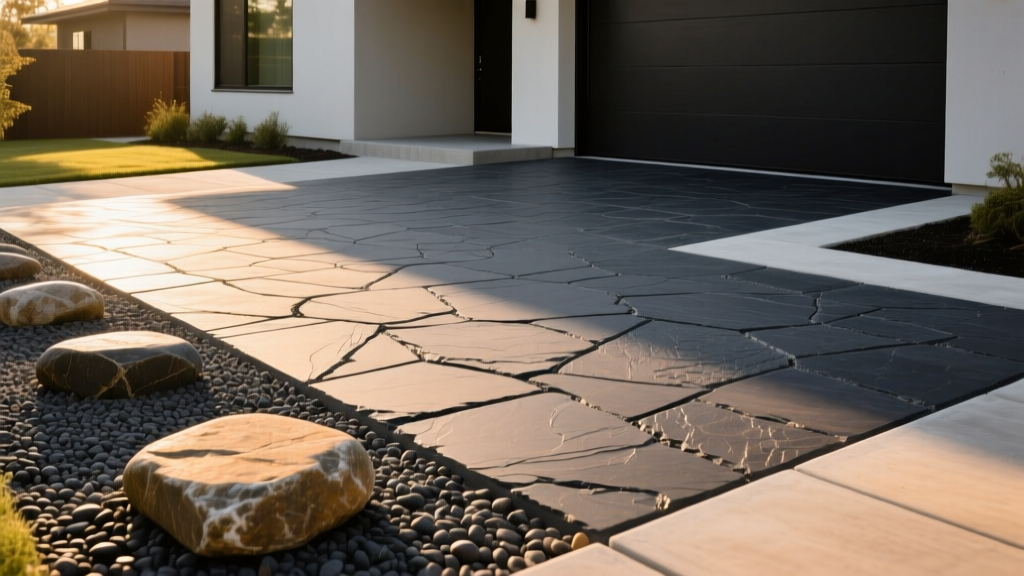
Stamped concrete transforms a monolithic grey slab into a high-fidelity replica of flagstone, cobblestone, brick, or even wood planks. The process involves broadcasting a dry-shake color hardener onto the wet concrete, troweling it into the surface, and then applying an antiquing release agent (powder or liquid) before pressing textured polyurethane mats into the slab.
Color Systems: Integral vs. Broadcast Hardeners
While integral color (adding liquid pigment to the truck at the batch plant) colors the entire slab, it lacks the surface durability required for high-traffic areas. Professional installers rely on broadcast color hardeners—a mixture of cement, fine silica sand, and iron-oxide pigments. Troweled into the top 1/8 inch, broadcast hardeners increase surface compressive strength to over 8,000 PSI, making stamped concrete significantly more resistant to abrasion and surface scaling than standard concrete. The secondary color, which provides the realistic 'antiqued' look in the simulated grout lines, is achieved via a colored release powder that prevents the stamping mats from sticking to the concrete.
Vulnerabilities: Sealer Blushing and Efflorescence
The primary failure mode for stamped concrete is not the concrete itself, but the topical sealer. Stamped concrete requires a high-solids acrylic solvent-based or water-based sealer conforming to ASTM C1315. If the slab is sealed before it has fully off-gassed its internal moisture (which takes a minimum of 28 days), the trapped water vapor reacts with the acrylic resin, causing 'blushing'—a permanent, cloudy white haze trapped beneath the film. Furthermore, water-soluble salts within the concrete can migrate to the surface, creating efflorescence that lifts the sealer away from the substrate.
Because stamped concrete is notoriously slippery when wet, always specify the addition of a polymer anti-slip grit (such as SureCrete SureGrip or SharkGrip) to the final coat of sealer. This additive suspends in the liquid sealer and creates a micro-textured surface without altering the visual clarity of the stamp pattern.
Application-Specific Decision Framework
Selecting between these two materials requires matching the physical properties of the finish to the environmental and functional demands of the specific site.
- Driveways and Steep Grades: Winner - Exposed Aggregate. The deep, 3D texture of exposed aggregate provides superior tire traction, especially in rainy or icy conditions. Stamped concrete, even with anti-slip additives, can become hazardous on slopes exceeding a 10% grade when wet.
- Pool Decks and Wet Areas: Winner - Exposed Aggregate. Barefoot traction is paramount around pools. Exposed aggregate offers excellent grip. Furthermore, lighter-colored exposed aggregate reflects solar radiation, keeping the surface cooler than dark-stained stamped concrete, which can absorb enough heat to burn bare skin in direct summer sun.
- Patios and Entertainment Areas: Winner - Stamped Concrete. For dining and lounging areas, stamped concrete provides a smoother surface that is comfortable for bare feet and stable for patio furniture. Chairs will not wobble on stamped concrete, whereas the uneven, rocky profile of exposed aggregate makes leveling tables and chairs difficult.
- Wheelchair and ADA Accessibility: Winner - Stamped Concrete. ADA guidelines require firm, stable, and slip-resistant surfaces. The deep grooves of exposed aggregate create high rolling resistance for manual wheelchairs and can be jarring for mobility scooters. Stamped concrete offers a much smoother, more compliant transition.
2026 Installation Cost & ROI Breakdown
Pricing for decorative concrete varies by region, site accessibility, and the complexity of the pattern or aggregate chosen. The following table outlines current national averages for residential installations.
| Cost Factor | Exposed Aggregate | Stamped Concrete |
|---|---|---|
| Base Installation (per sq. ft.) | $10.00 - $14.00 | $14.00 - $18.00 |
| Premium Upgrades (Custom stone, borders, integral dyes) | $15.00 - $19.00 | $19.00 - $25.00+ |
| Demolition & Haul-away (Existing slab) | $3.00 - $5.00 | $3.00 - $5.00 |
| Initial Sealing (Included in most bids) | Penetrating Silane ($0.50/sq ft) | Acrylic Topcoat ($1.00/sq ft) |
| Ongoing Maintenance (Resealing every 3 years) | $0.75 - $1.25 per sq. ft. | $1.50 - $2.50 per sq. ft. (requires cleaning & stripping) |
While stamped concrete commands a 20% to 35% premium over exposed aggregate during initial installation, it often yields a higher return on investment (ROI) for patios and outdoor living spaces due to its high-end aesthetic appeal that mimics expensive natural stone masonry. Conversely, exposed aggregate remains the most cost-effective, low-maintenance premium finish for large-scale functional areas like driveways and municipal walkways, where its rugged durability and natural slip resistance outperform stamped alternatives over a 20-year lifecycle.
Written by
James ThorntonJames Thornton is a construction industry veteran with 25 years of hands-on experience in wood framing, lumber grading, and residential building codes. He started as a framing carpenter in rural Oregon, earned his ICC Residential Building Inspector certification, and eventually became a senior plan reviewer for the City of Portland Bureau of Development Services. James holds a B.S. in Wood Science & Technology from Oregon State University and is a certified lumber grader through the West Coast Lumber Inspection Bureau (WCLIB). He has inspected over 3,000 residential construction sites and authored the city's internal guide on advanced framing techniques (2x6 at 24" O.C.). James lives in Bend, OR, where he builds custom timber-frame cabins and competes in lumberjack sports.
More from James Thornton
View all
Insulation
Best Home Insulation Materials: Complete 2026 Guide
Compare top home insulation materials for 2026. Find R-values, installed costs per square foot, and best uses for fiberglass, spray foam, and mineral wool.
Aug 4, 2026

Sustainable Building
Certify Your Green Building Material for LEED and WELL
Step-by-step guide to certifying a green building material for LEED v5 and WELL v2. Master EPDs, HPDs, and VOC limits for 2026 project specifications.
Aug 4, 2026

Stone & Masonry
Veneer Stacked Stone Panels: Interior Design & Style Showcase
Discover how veneer stacked stone panels transform interiors. Explore modern design profiles, material pairings, and technical installation specs.
Aug 4, 2026