Acid Stain vs Water Based Stain for Concrete: Troubleshooting Guide
Diagnose and repair concrete stain failures. Compare acid stain vs water based stain for concrete, including chemical fixes, moisture testing, and costs.
The Chemistry of Failure: Why Stains Reject or Fade
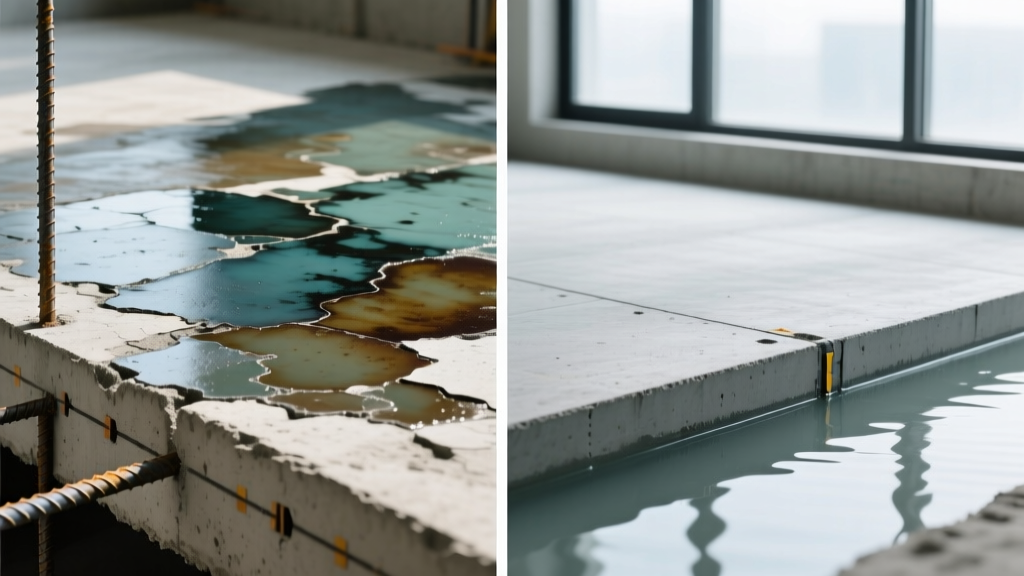
When decorative concrete floors fail, the root cause almost always traces back to a mismatch between the stain chemistry and the substrate condition. Understanding the fundamental differences in an acid stain vs water based stain for concrete is not just about aesthetics; it is the primary diagnostic tool for contractors troubleshooting peeling, fading, or unreactive floors. Acid stains rely on a chemical reaction with calcium hydroxide, while water-based stains rely on physical penetration or film formation. When a floor fails, identifying which mechanism was disrupted dictates the repair protocol.
Diagnostic Matrix: Acid Stain vs Water Based Stain for Concrete
The following matrix isolates the mechanical differences between the two systems, highlighting the specific vectors that lead to field failures.
| Failure Vector | Acid Stain (Metallic Salts) | Water-Based Stain (Acrylic/Silicate) |
|---|---|---|
| Primary Mechanism | Chemical reaction with calcium hydroxide | Physical pigment suspension / polymer film |
| Substrate Sensitivity | High (requires reactive lime, open pores) | Moderate (requires clean, dry, profiled surface) |
| Most Common Failure | No color change (chalky surface) | Peeling, blistering, or flaking |
| Moisture Impact | Dilutes reaction, causes splotching | Hydrostatic pressure causes delamination |
| UV Stability | 100% UV stable (inorganic oxides) | Varies (acrylics degrade without UV inhibitors) |
Troubleshooting Acid Stain Reactions (and Non-Reactions)
Symptom: Chalky, Unreactive Surface
If the acid stain (such as Kemiko Stone Tone) dries to a chalky powder and wipes away without leaving permanent color, the concrete lacks sufficient calcium hydroxide. This is overwhelmingly common in modern mix designs utilizing high volumes of Class F fly ash (typically >20% replacement) or slag cement, which consume calcium hydroxide during the pozzolanic reaction. It also occurs on over-troweled surfaces where the burnished paste seals the pores, preventing the metallic salts from penetrating.
Symptom: Splotchy, Inconsistent Color
Uneven coloration usually indicates the presence of residual curing compounds, form release agents, or localized moisture variations. According to guidelines from the Concrete Network, even water-based curing compounds that claim to be 'stain-friendly' can leave microscopic films that block acid penetration.
Repair Protocol for Acid Failures
- Mechanical Profiling: For over-troweled or fly-ash-rich slabs, chemical etching will not suffice. Use a planetary concrete grinder equipped with 40-grit metal-bond diamond segments to cut through the burnished surface and expose the reactive paste beneath.
- Faux Finishing Alternative: If the slab is heavily depleted of calcium hydroxide and grinding is not an option, abandon the acid stain. Transition to a water-based penetrating silicate stain or an acrylic dye, which do not rely on lime for color development.
- Neutralization Verification: Always mop the floor with a baking soda and water solution (1 cup per gallon) after staining. Residual acid will continue to eat the concrete and destroy the subsequent sealer.
Troubleshooting Water-Based Acrylic and Silicate Stains
Symptom: Peeling, Blistering, and Delamination
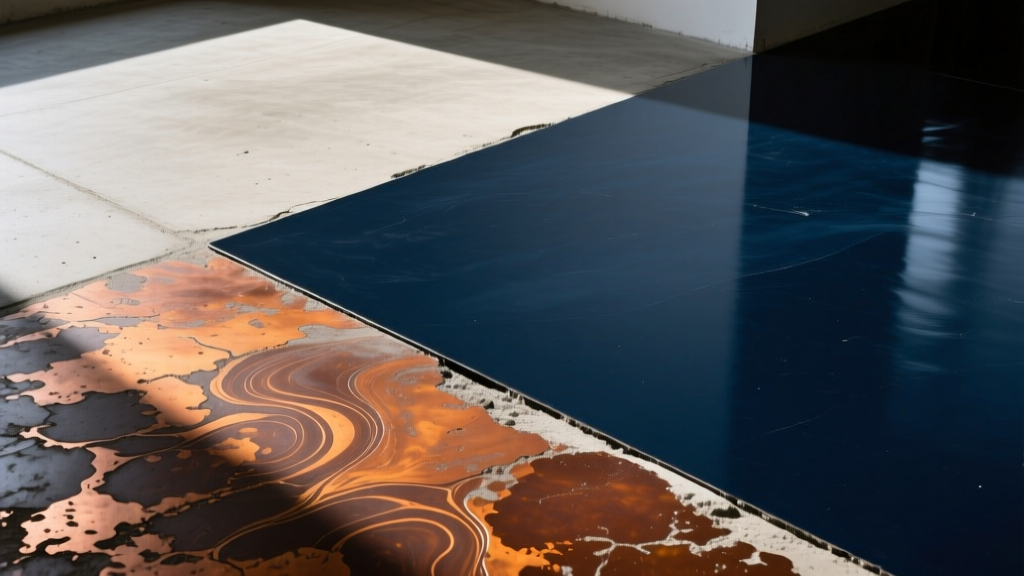
Water-based acrylic stains (like L.M. Scofield Formula One) form a micro-film within the pores of the concrete. When applied over a damp slab, or over a slab experiencing hydrostatic pressure from below, water vapor pushes against the acrylic film, causing blisters that eventually rupture and peel. This is the most frequent and costly failure in decorative concrete repair.
Symptom: Rapid UV Fading Outdoors
If a water-based stain is fading rapidly on an exterior patio or pool deck, it is likely an interior-grade organic pigment was used, or the acrylic carrier lacks sufficient UV cross-linkers. Unlike acid stains, which use inorganic metallic oxides that are impervious to sunlight, many cheaper water-based stains rely on carbon-based pigments that break down under UV exposure.
Repair Protocol for Water-Based Failures
- Chemical Stripping: Remove the failing acrylic stain and sealer using a soy-based or citrus-based gel stripper (e.g., Franmar Soy Gel). Avoid harsh methylene chloride strippers, which can leave residues that interfere with re-staining.
- Moisture Mitigation: If ASTM F2170 testing reveals RH levels above 75%, you must apply a penetrating moisture vapor barrier (such as a 100% solids epoxy primer designed for high-moisture slabs) before re-applying any film-forming product.
- Substrate Transition: For exterior applications experiencing UV failure, strip the floor and transition to an acid stain or a UV-stable penetrating lithium silicate densifier with integral inorganic pigments.
The Remediation Decision Tree
Use this logic flow to determine the correct repair path when diagnosing a failed decorative floor:
- Is the stain peeling or flaking?
- Yes → The stain is film-forming (water-based acrylic). Strip entirely, test for moisture, and apply moisture mitigation before recoating.
- No → Proceed to next question.
- Did the acid stain fail to react (wipes off dry)?
- Yes → Slab lacks calcium hydroxide (fly ash/over-troweling). Diamond grind the surface (40-grit) and re-apply, or switch to a water-based dye.
- No → Proceed to next question.
- Is the color splotchy or localized?
- Yes → Contaminants (curing compound, grease, drywall mud) are present. Solvent-wipe with denatured alcohol or xylene, re-profile, and spot-stain.
2026 Remediation Cost Breakdown
Repairing a failed concrete stain is significantly more expensive than the initial installation. The following table outlines current market rates for commercial and high-end residential remediation.
| Remediation Step | Cost per Sq. Ft. (2026) | Equipment / Material Required |
|---|---|---|
| Chemical Stripping (Acrylics) | $2.00 - $3.50 | Soy gel stripper, floor scrubber, wet vacuum |
| Diamond Grinding (Profiling) | $1.50 - $2.50 | Planetary grinder, 40-grit metal bond diamonds, HEPA shroud |
| Moisture Mitigation (Epoxy Primer) | $3.00 - $4.50 | 100% solids moisture vapor barrier epoxy, squeegee, spike roller |
| Re-Staining (Acid or Water-Based) | $2.50 - $5.00 | Pump sprayers, microfiber mops, neutralizing agents |
Expert Product Specifications and Sourcing
When executing repairs, relying on big-box store products leads to recurring failures. Industry professionals specify commercial-grade chemistry. The American Concrete Institute (ACI) and the International Concrete Repair Institute (ICRI) emphasize the importance of surface preparation and material compatibility in their technical guidelines.
- For Acid Stain Repairs: Use Kemiko Stone Tone Concrete Stain or Direct Colors Vivid! Acid Stain. These contain high concentrations of metallic salts and penetrating surfactants that maximize reaction on marginally reactive slabs.
- For Water-Based Penetrating Repairs: Use L.M. Scofield Company Formula One Lithium Silicate Stains. Because they chemically bond with the concrete matrix rather than forming a topical film, they are immune to hydrostatic delamination.
- For Stripping Failed Acrylics: Use Franmar Soy Gel or Citrus King Paint and Urethane Remover. These biodegradable options do not raise the pH of the concrete, which is critical before applying a new acid stain.
Ultimately, resolving the debate of acid stain vs water based stain for concrete in a repair scenario requires abandoning aesthetic preferences and strictly following the diagnostic data provided by the substrate's moisture levels, mix design, and surface profile.
Written by
Marcus ChenMarcus Chen is a licensed structural engineer (PE) and building materials analyst with over 12 years of experience across residential, commercial, and industrial construction. He holds a Master of Science in Civil Engineering from UC Berkeley and spent six years at Thornton Tomasetti before transitioning to independent consulting and technical writing. Marcus specializes in material selection for seismic-prone regions, concrete reinforcement strategies, and lifecycle cost analysis. His work has been cited by the American Concrete Institute (ACI) and the Structural Engineers Association of California (SEAOC). When he is not on a job site or at his desk, you will find him hiking the Sierra Nevada or restoring a 1920s craftsman bungalow in Oakland, CA.
More from Marcus Chen
View all
Construction Cost
How Much Did the Eiffel Tower Cost to Build?
How much did the Eiffel Tower cost to build in 1889? We adjust for inflation and compare its budget to modern skyscraper construction.
Aug 4, 2026

Fire Resistance
What Is a Fire Resistant Material? Testing & Certification Guide
Discover what is a fire resistant material through ASTM and UL testing. Learn how fire ratings, certifications, and assemblies work in construction.
Aug 4, 2026

Construction Cost
How Much Did the Burj Khalifa Cost to Build?
How much did the Burj Khalifa cost to build? We break down the $1.5B project and extract 5 money-saving strategies for your next build.
Jul 30, 2026