Concrete Planter Lifespan: Durability Analysis & Crack Prevention
Discover the true lifespan of concrete planters. Learn how mix ratios, sealing, and freeze-thaw cycles impact durability and prevent cracking.
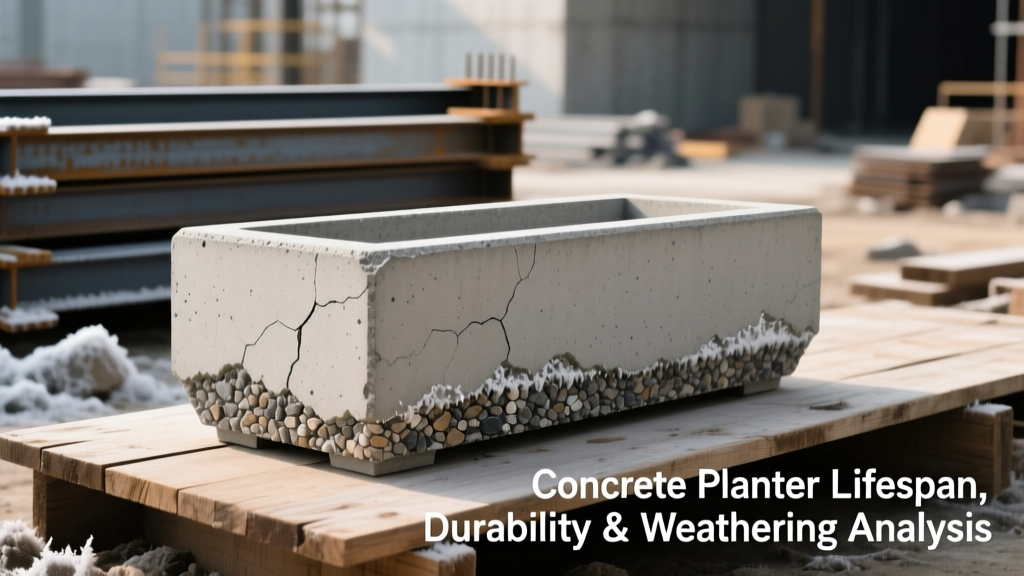
The Real Lifespan of a Concrete Planter
When evaluating outdoor receptacles for landscaping, the concrete planter is frequently chosen for its mass and aesthetic permanence. However, permanence is a misconception. Unsealed, poorly drained standard precast concrete planters typically exhibit structural spalling and micro-fracturing within 12 to 15 years in climates with seasonal freezing. Conversely, architecturally specified Glass Fiber Reinforced Concrete (GFRC) or Ultra-High Performance Concrete (UHPC) planters, when properly sealed and drained, routinely exceed 50 years of structural integrity.
- Standard Precast (Wet-Cast): 15–25 years
- GFRC (Glass Fiber Reinforced): 35–50 years
- UHPC (Ultra-High Performance): 75+ years
- Cast-in-Place (Site Poured): 40–60 years (highly dependent on formwork and curing)
Material Science: Why Concrete Planters Degrade
Concrete possesses immense compressive strength but relatively low tensile strength. The primary failure modes for concrete planters are rarely driven by the weight of the soil; they are driven by environmental thermodynamics and hydraulic pressure.
Freeze-Thaw Spalling and Hydraulic Pressure
Water expands by approximately 9% in volume when it transitions to ice. Standard concrete is a porous matrix. If a concrete planter's internal saturation level exceeds 80% of its total pore volume and the temperature drops below freezing, the internal hydraulic pressure generated by the expanding ice exceeds the concrete's tensile strength (typically 300 to 500 psi for standard mixes). This results in micro-cracking, which coalesces into visible spalling and structural delamination over successive winter cycles. The Portland Cement Association emphasizes that air-entrainment in the mix design is the only reliable defense against this internal pressure, creating microscopic voids that give expanding ice room to expand without fracturing the cement paste.
Efflorescence and Mineral Leaching
As water moves through the porous walls of a concrete planter, it dissolves calcium hydroxide (free lime) present in the hydrated cement paste. When this moisture reaches the exterior surface and evaporates, it leaves behind white, crystalline calcium carbonate deposits known as efflorescence. Beyond the aesthetic degradation, this leaching process actively raises the pH of the soil inside the planter, creating an alkaline environment that can induce iron chlorosis in acid-loving plants like azaleas, rhododendrons, and Japanese maples.
Root Pressure and Structural Stress
Aggressive root systems, particularly from woody shrubs and small ornamental trees, exert significant radial pressure as they thicken. In standard precast planters with wall thicknesses under 1.5 inches, the hoop stress generated by expanding root balls can easily exceed the flexural capacity of the concrete, resulting in vertical splitting.
Lifespan and Performance Comparison Matrix
Selecting the right concrete formulation dictates the structural ceiling of the planter. The table below contrasts the physical properties of the three most common concrete planter materials specified in modern landscape architecture.
| Material Type | Compressive Strength | Flexural Strength | Weight (lbs/cu ft) | Min. Wall Thickness | Relative Cost |
|---|---|---|---|---|---|
| Standard Precast | 4,000 - 5,000 psi | 400 - 600 psi | 140 - 150 | 2.0 inches | Baseline (1x) |
| GFRC | 6,000 - 8,000 psi | 2,500 - 4,000 psi | 110 - 125 | 0.5 - 0.75 inches | 2.5x - 3x |
| UHPC | 18,000 - 24,000 psi | 3,500 - 5,000 psi | 150 - 160 | 0.75 - 1.0 inches | 5x - 8x |
The Sealing Imperative: Penetrating vs. Film-Forming
Applying a sealer to a concrete planter is non-negotiable for maximizing lifespan, but selecting the wrong chemistry will accelerate failure. The American Concrete Institute provides extensive guidelines on surface protection, highlighting the critical difference between pore-lining and pore-plugging sealers.
Never apply an acrylic or polyurethane film-forming sealer to the interior of a concrete planter. Film-forming sealers create a non-breathable membrane. If moisture enters the concrete matrix from the top rim or via a microscopic exterior crack, it becomes trapped. During freeze-thaw cycles or intense solar heating, this trapped moisture vaporizes or expands, causing the interior sealer to blister and the concrete face to spall violently.
The Correct Sealing Protocol
- Interior Walls: Apply a heavy-duty, breathable silane/siloxane penetrating sealer. These molecules are small enough to penetrate 1/4 to 1/2 inch into the pore structure, where they react with the silica in the concrete to form a hydrophobic resin. This prevents water ingress while allowing water vapor to escape. Apply at a rate of 150 to 200 square feet per gallon.
- Exterior Walls: You may use a penetrating sealer for a natural matte finish, or a high-quality, UV-stable aliphatic polyurethane if a wet-look or satin sheen is desired. If using a film-former exteriorly, ensure the top rim and bottom base remain unsealed or treated only with a penetrant to allow the wall to "breathe."
Step-by-Step Drainage and Winterization Specifications
Even the highest-grade UHPC planter will fail if hydrostatic pressure builds up behind the retaining walls. Proper drainage engineering is the single most impactful factor in achieving maximum lifespan.
- Weep Hole Drilling: If the planter lacks integrated drainage, drill 3/8-inch weep holes through the base and the lower 2 inches of the side walls. Space these holes every 12 linear inches.
- Base Gravel Layer: Place a 2-inch layer of clean, washed 3/4-inch crushed gravel at the bottom of the planter. Do not use pea gravel, as its rounded edges compact and impede water flow.
- Geotextile Separation: Line the interior walls and drape over the gravel layer with a non-woven geotextile fabric (minimum 4 oz per square yard). This prevents fine soil particles from migrating into the gravel and clogging the weep holes over time.
- Soil Selection: Never use native topsoil or heavy garden soil in a concrete planter. These soils retain excessive moisture and expand when wet. Use a highly porous, soilless container mix containing at least 30% perlite or pumice to ensure rapid drainage and reduce lateral swelling pressure against the concrete walls.
- Winter Elevation: In hardiness zones 6 and below, elevate the planter 1/2 inch off the hardscape using high-density polyethylene (HDPE) planter feet. This prevents the weep holes from freezing shut against the patio surface, which would turn the planter into an ice-filled bathtub during spring thaws.
Expert Troubleshooting: Diagnosing Planter Failure
When a concrete planter begins to show signs of distress, early diagnosis allows for intervention before structural collapse. Use this diagnostic matrix to identify the root cause of degradation.
| Symptom | Primary Cause | Corrective Action |
|---|---|---|
| White, powdery crust on exterior | Efflorescence (calcium leaching) | Dry-brush the surface. Apply a silane-siloxane penetrating sealer to the interior to halt moisture migration. Avoid acid washing, which can etch the aggregate. |
| Horizontal cracking near the base | Hydrostatic pressure / Clogged drainage | Clear weep holes immediately using a masonry bit. Excavate the top 6 inches of soil to verify the geotextile fabric has not collapsed and blocked the gravel layer. |
| Surface pitting and flaking (Spalling) | Freeze-thaw damage / Lack of air-entrainment | Chip away all loose material. Patch with a polymer-modified, air-entrained vertical concrete repair mortar. Seal the entire unit with a penetrating water repellent. |
| Vertical splitting from top to bottom | Root expansion / Insufficient flexural strength | Remove the plant. The structural integrity is compromised. For future plantings in standard precast, restrict to herbaceous perennials; use GFRC or UHPC for woody shrubs. |
| Dark, localized staining | Organic matter / Fertilizer salt accumulation | Clean with a diluted oxygen bleach solution (sodium percarbonate). Avoid chlorine bleach, which can degrade the cement paste and harm surrounding landscaping. |
Ultimately, the lifespan of a concrete planter is not dictated by the material alone, but by the intersection of mix design, chemical sealing, and hydraulic management. By specifying GFRC or UHPC for large-scale applications, utilizing breathable penetrating sealers, and engineering rigorous internal drainage, landscape professionals and homeowners can ensure these structural elements outlast the very plants they hold.