What Type of Salt Is Safe for Concrete Driveways & Slabs
Discover what type of salt is safe for concrete. Compare deicers, prevent spalling, and protect your driveway from chloride damage and freeze-thaw scaling.
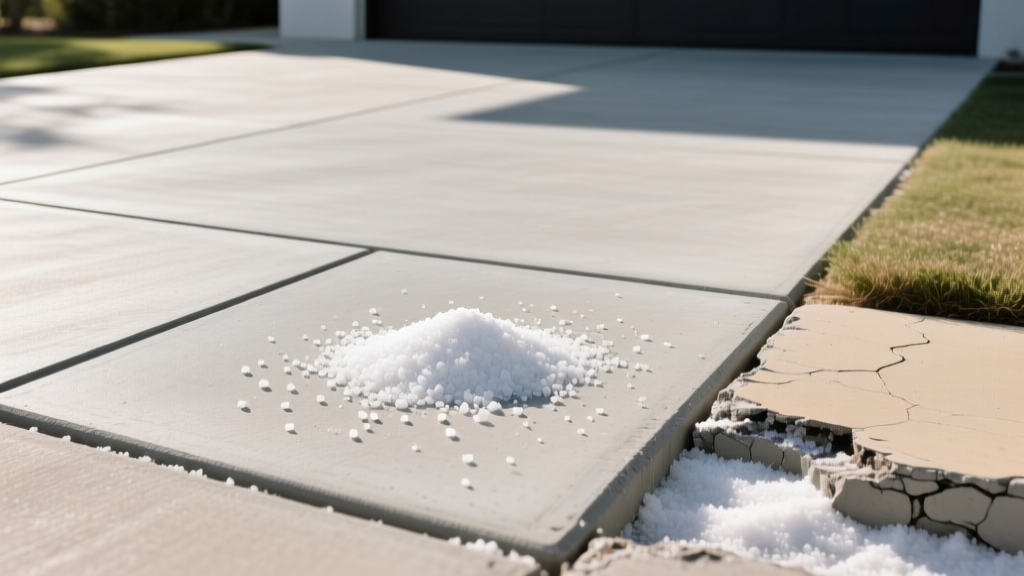
Winter maintenance presents a severe paradox for property owners and facility managers: the very chemicals used to melt ice and prevent slips are often the same agents that destroy the concrete beneath them. When asking what type of salt is safe for concrete, the immediate answer from materials engineers is that no traditional chloride-based salt is entirely safe. However, by understanding the chemical interactions between deicers and cementitious matrices, you can select compounds that mitigate structural damage while maintaining winter traction.
The Chemistry of Concrete Damage: Why Most Salts Cause Spalling
Concrete deterioration from deicing salts occurs through two primary mechanisms: physical freeze-thaw cycling and chemical alteration. According to the Portland Cement Association, salt lowers the freezing point of water, creating a concentrated brine that penetrates the capillary pores of the concrete. When temperatures eventually drop below the brine's freezing point, the water expands by approximately 9%, generating internal hydraulic pressure that exceeds the tensile strength of the cement paste, resulting in surface scaling and spalling.
More insidious is the chemical attack caused by specific salts. Calcium chloride (CaCl2) and magnesium chloride (MgCl2) react with calcium hydroxide (portlandite) present in the hydrated cement paste. This reaction forms calcium oxychloride crystals (CaCl2·3Ca(OH)2·15H2O). These crystals expand significantly within the concrete matrix, causing internal microcracking that is entirely independent of freeze-thaw cycles. This phenomenon explains why driveways treated heavily with calcium chloride often suffer severe surface spalling even in winters with minimal temperature fluctuations.
Deicer Comparison Matrix: Efficacy vs. Concrete Safety
To determine the optimal deicer, we must weigh melting efficacy against concrete degradation and rebar corrosion risks. The following matrix evaluates the five most common deicing agents available in 2026, with pricing reflecting current market averages for 50-pound bags.
| Deicer Type | Chemical Formula | Lowest Effective Temp | Concrete Safety Rating | Rebar Corrosion Risk | Avg 2026 Cost (50lb) |
|---|---|---|---|---|---|
| Sodium Chloride (Rock Salt) | NaCl | 20°F (-6°C) | Poor | High | $10 - $15 |
| Calcium Chloride | CaCl2 | -25°F (-31°C) | Very Poor | Extreme | $25 - $35 |
| Magnesium Chloride | MgCl2 | -15°F (-26°C) | Poor | High | $22 - $30 |
| Calcium Magnesium Acetate (CMA) | CMA | 20°F (-6°C) | Excellent | None | $60 - $85 |
| Potassium Acetate (KAc) | KAc | -15°F (-26°C) | Excellent | None | $70 - $95 |
What Type of Salt Is Safe for Concrete? The Verdict by Scenario
The concept of "safety" is highly dependent on the age, finish, and reinforcement of your concrete slab. Follow this decision framework to select the correct material for your specific application.
Scenario A: New Concrete (0-12 Months Old)
The Verdict: Use Zero Salts. Fresh concrete contains a high volume of unhydrated cement and excess calcium hydroxide. The capillary network is highly permeable, and the surface paste has not achieved full carbonation. Applying any deicer during the first winter will almost guarantee severe scaling. For traction, rely exclusively on coarse, washed masonry sand or non-clay kitty litter. If ice removal is mandatory, use mechanical chipping or heated mats.
Scenario B: Mature, Unsealed Concrete Driveways
The Verdict: Calcium Magnesium Acetate (CMA) or Potassium Acetate (KAc). If your concrete is older than one year but lacks a penetrating sealer, chloride-based salts will rapidly infiltrate the pore structure. CMA is a biodegradable, chloride-free deicer that acts as a freeze-point depressant without triggering the destructive calcium oxychloride reaction. While its melting speed is slower than NaCl and it struggles below 20°F, it preserves the structural integrity of the cement paste. For colder climates requiring faster action, liquid Potassium Acetate (often sold as runway deicers for airports) is highly effective down to -15°F and is completely chloride-free.
Scenario C: Sealed, Mature, and Air-Entrained Concrete
The Verdict: Magnesium Chloride (MgCl2) with strict dosage limits. If your slab is properly air-entrained (containing 5-7% microscopic air bubbles to accommodate water expansion) and treated with a high-quality silane/siloxane sealer, you can cautiously use Magnesium Chloride. MgCl2 is less aggressive than Calcium Chloride and leaves less residue. However, it must be applied at the manufacturer's recommended rate (typically 10-15 lbs per 1,000 sq ft). Over-application will overwhelm the sealer and saturate the concrete matrix.
The Hidden Threat: Chloride Ingress and Rebar Corrosion
Surface spalling is a cosmetic and structural nuisance, but chloride ingress is a terminal threat to reinforced concrete. When sodium or calcium chloride penetrates to the depth of the steel rebar, it destroys the passive alkaline oxide layer that protects the steel. The resulting corrosion produces iron oxide (rust), which occupies up to six times the volume of the original steel. This expansive force causes delamination, where the top layer of the concrete slab violently separates from the base.
Never use rock salt (NaCl) or calcium chloride on stamped, stained, or integrally colored concrete. The chloride salts will react with the metallic oxides used in concrete pigments, causing irreversible bleaching, mottling, and white efflorescence staining. Always use CMA or sand for traction on decorative surfaces.
Proactive Defense: Penetrating Sealers and Application Protocols
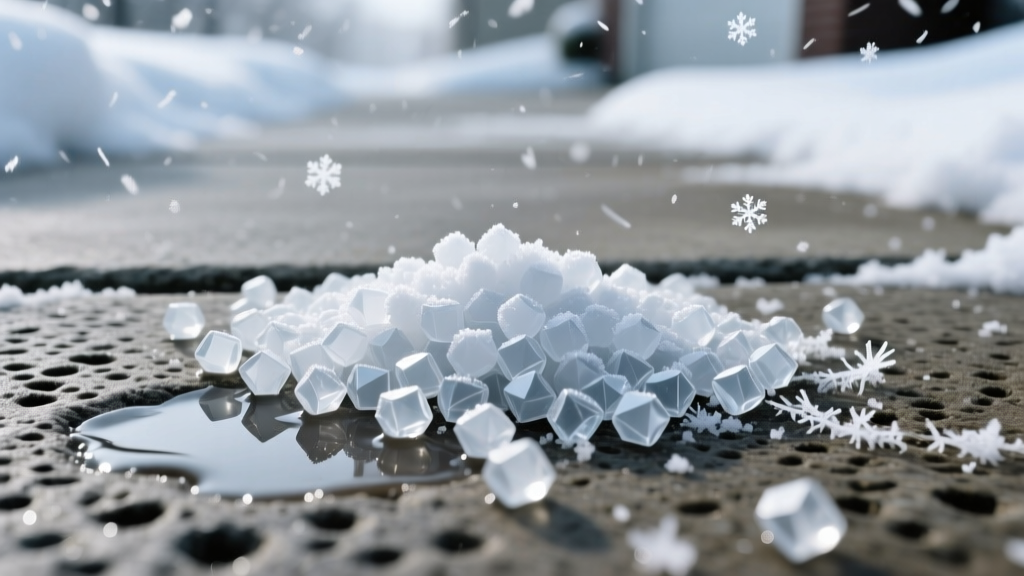
Relying solely on "safe" salts is a reactive strategy. The most effective method to protect concrete from deicer damage is to alter the surface tension of the concrete pores using penetrating sealers. According to research highlighted by Penn State Extension, preventing brine absorption is the key to eliminating freeze-thaw damage.
- Silane Sealers: Silane molecules are extremely small and penetrate deeply (up to 1/4 inch) into dense, machine-troweled concrete. They react with the silica in the cement to form a hydrophobic resin. Ideal for standard driveways and garage floors.
- Siloxane Sealers: Siloxane molecules are larger and remain closer to the surface. They are better suited for broom-finished, porous concrete, or exposed aggregate surfaces where deep penetration is difficult.
- Application Metrics: Look for sealers that meet ASTM C1585 (Standard Test Method for Measurement of Rate of Absorption of Water by Hydraulic-Cement Concretes). A high-quality DOT-approved silane/siloxane blend (such as Armor SX5000) will reduce water absorption by up to 95% and must be reapplied every 3 to 5 years depending on UV and abrasion exposure.
Step-by-Step Winter Traction Protocol
To minimize chemical dependency and physical wear, implement this operational sequence for winter maintenance:
- Pre-Treatment (Anti-Icing): Apply a light spray of liquid Potassium Acetate or CMA before the snowstorm begins. This prevents the ice from bonding to the concrete surface, reducing the mechanical force required to break the bond later.
- Mechanical Removal: Use a plastic-bladed snow shovel or a snowblower with rubber-tipped augers. Steel blades will micro-scratch the surface, creating channels for brine to penetrate deeper into the cement paste.
- Targeted Deicing: Apply granular CMA or MgCl2 only to remaining ice patches or high-risk inclines. Do not broadcast salt over bare concrete.
- Spring Wash-Down: As temperatures rise above 40°F in early spring, power wash the driveway with a surface cleaner attachment. This removes residual chloride salts and alkaline deposits that will continue to draw moisture into the concrete via osmosis throughout the summer months.
Ultimately, the safest salt for concrete is the one you use the least. By prioritizing mechanical removal, utilizing chloride-free acetates, and investing in ASTM-compliant penetrating sealers, you can maintain safe winter access without sacrificing the lifespan of your concrete infrastructure.
Written by
Marcus ChenMarcus Chen is a licensed structural engineer (PE) and building materials analyst with over 12 years of experience across residential, commercial, and industrial construction. He holds a Master of Science in Civil Engineering from UC Berkeley and spent six years at Thornton Tomasetti before transitioning to independent consulting and technical writing. Marcus specializes in material selection for seismic-prone regions, concrete reinforcement strategies, and lifecycle cost analysis. His work has been cited by the American Concrete Institute (ACI) and the Structural Engineers Association of California (SEAOC). When he is not on a job site or at his desk, you will find him hiking the Sierra Nevada or restoring a 1920s craftsman bungalow in Oakland, CA.
More from Marcus Chen
View all
Construction Cost
How Much Did the Eiffel Tower Cost to Build?
How much did the Eiffel Tower cost to build in 1889? We adjust for inflation and compare its budget to modern skyscraper construction.
Aug 4, 2026

Fire Resistance
What Is a Fire Resistant Material? Testing & Certification Guide
Discover what is a fire resistant material through ASTM and UL testing. Learn how fire ratings, certifications, and assemblies work in construction.
Aug 4, 2026

Construction Cost
How Much Did the Burj Khalifa Cost to Build?
How much did the Burj Khalifa cost to build? We break down the $1.5B project and extract 5 money-saving strategies for your next build.
Jul 30, 2026