2026 Concrete Slab Cost Guide: Brand & Mix Comparisons
Analyze 2026 concrete slab cost by brand and mix type. Compare Quikrete, Sakrete, and ready-mix pricing, PSI ratings, and hidden admixture expenses.
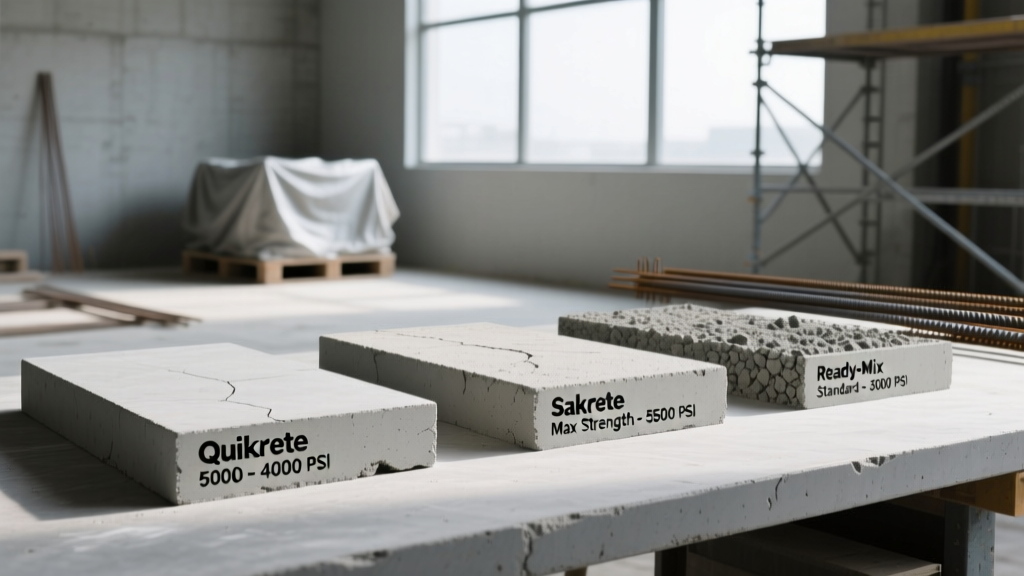
The True Cost of a Concrete Slab: Beyond the Per-Yard Price
Calculating an accurate concrete slab cost requires looking far beyond the basic per-square-foot or per-cubic-yard averages found in generic estimators. In 2026, material pricing is heavily dictated by the specific brand, the chemical admixture package, and the logistical realities of the job site. Whether you are pouring a 400-square-foot residential patio or a 5,000-square-foot commercial warehouse floor, the choice between bagged retail brands (like Quikrete and Sakrete) and regional ready-mix giants (like Cemex or Vulcan Materials) will drastically alter your final budget and the structural longevity of the slab.
This deep-dive analyzes the actual product lines, PSI ratings, and hidden cost multipliers that dictate modern slab pricing, providing a precise procurement framework for contractors and advanced DIYers.
Ready-Mix vs. Bagged Brands: The Crossover Point
The most common mistake in slab budgeting is assuming bagged concrete is cheaper for small pours. The financial crossover point where ready-mix becomes more economical than bagged concrete is surprisingly low: approximately 1.5 cubic yards.
The Math for a 20x20 Foot Slab (400 sq. ft., 4 inches thick):
- Volume Required: 2.47 cubic yards (order 2.75 yards to account for 10% waste and subgrade variations).
- Bagged Route: 2.75 yards requires roughly 124 bags (80 lb each). At an average 2026 retail price of $6.50 per bag, material costs alone hit $806. This excludes the labor of mixing 124 bags, which often necessitates renting a towable mixer ($85/day).
- Ready-Mix Route: 2.75 yards at $145/yard = $398.75. Add a $175 short-load fee and a $50 environmental/fuel surcharge. Total delivered: $623.75. You save nearly $200 and eliminate manual mixing labor.
Brand Deep-Dive: Bagged Mixes (Quikrete vs. Sakrete)
When site access prevents a ready-mix truck from reaching the pour location, bagged concrete is mandatory. The two dominant retail brands offer distinct product lines that affect both the upfront concrete slab cost and the curing timeline.
Quikrete (CRH / Oldcastle)
Quikrete dominates the retail space with highly specialized mixes. Their standard Quikrete Concrete Mix yields roughly 3,500 PSI at 28 days. However, for slabs subject to vehicular traffic or heavy point loads, contractors should specify Quikrete 5000 or Quikrete Fiber-Reinforced.
- Quikrete 5000: Formulated for early strength gain, reaching structural integrity faster than standard mixes. Costs approximately $0.80 to $1.00 more per bag.
- Quikrete Fiber-Reinforced: Contains micro-synthetic fibers that eliminate the need for wire mesh in residential slabs, saving roughly $0.45 per square foot in secondary material costs.
Sakrete (Sika)
Sakrete, backed by Sika's chemical expertise, often prices its standard High Strength mix slightly lower than Quikrete's equivalent, making it a favorite for budget-conscious volumetric pours. Their Sakrete Fiber-Force line competes directly with Quikrete's fiber offerings but utilizes a slightly different polymer blend that improves workability in high-heat environments, reducing the risk of plastic shrinkage cracking during summer pours.
Brand Deep-Dive: Ready-Mix Giants (Cemex, Holcim, Vulcan)
For commercial slabs or large residential foundations, ready-mix suppliers offer proprietary product lines that justify their premium pricing through reduced long-term maintenance and accelerated construction schedules.
According to the Portland Cement Association (PCA), specifying the correct shrinkage-compensating admixture at the batch plant can reduce slab joint spacing requirements by up to 50%, significantly lowering the labor cost of saw-cutting and sealing control joints.
Cemex: Promix and Shrinkage-Compensating Lines
Cemex's Promix line is engineered for high-slump, high-flow applications without sacrificing compressive strength. For warehouse slabs where flatness (F-numbers) is critical, Cemex offers shrinkage-compensating concrete (SCC) blends. While these blends add $15 to $25 per cubic yard to the base concrete slab cost, they virtually eliminate edge curling and reduce the need for post-tensioning or heavy rebar mats.
Holcim: Envirocore and Low-Carbon Blends
With 2026 building codes increasingly mandating embodied carbon reductions, Holcim's Envirocore line utilizes supplementary cementitious materials (SCMs) like slag and fly ash. These mixes often cost 5-8% more per yard but can qualify projects for LEED v5 material credits, offsetting the premium through overall project tax incentives and compliance savings.
2026 Pricing Matrix: Bagged vs. Ready-Mix by PSI Rating
The following matrix reflects average national pricing for Q1 2026. Regional variations (especially in the Northeast and West Coast) can add 15-20% to these baselines.
| Mix Type / Brand Line | Supplier | 28-Day PSI | Est. Cost / Cubic Yard | Best Application |
|---|---|---|---|---|
| Standard Concrete Mix | Quikrete (Bagged) | 3,500 | $315 (equiv.) | Small footings, post holes |
| High Strength 5000 | Quikrete (Bagged) | 5,000 | $365 (equiv.) | Driveways, heavy-load pads |
| Standard 3000 PSI Ready-Mix | Regional Batch Plant | 3,000 | $135 - $145 | Sidewalks, interior floors |
| 4000 PSI w/ Fiber Macro | Vulcan / Cemex | 4,000 | $155 - $165 | Garage slabs, patios |
| Shrinkage-Compensating | Cemex (Specialty) | 4,500+ | $175 - $190 | Large warehouse floors |
Hidden Cost Multipliers: Admixtures and Site Logistics
The base price per yard is only the starting point. To accurately forecast your concrete slab cost, you must account for chemical admixtures and logistical hurdles.
Chemical Admixtures
Batch plants charge per cubic yard for liquid admixtures added at the plant or job site. Common 2026 additions include:
- Water Reducers (Plasticizers): $8 - $12 per yard. Essential for achieving high workability without increasing the water-cement ratio, which weakens the slab.
- Accelerators (Calcium Chloride or Non-Chloride): $10 - $18 per yard. Non-chloride accelerators (required if rebar is present to prevent corrosion) are at the higher end of this range but drastically reduce finishing wait times in cold weather.
- Micro-Synthetic Fibers: $12 - $15 per yard. Added at the plant to provide secondary reinforcement against plastic shrinkage cracking.
Logistical Hurdles
If a standard ready-mix truck cannot back directly up to the forms, you will need a pump truck. A standard boom pump costs between $800 and $1,200 for a half-day rate, plus a $250 mobilization fee. For smaller pours where a boom pump is overkill, a trailer-mounted line pump rents for roughly $400 to $600, but requires a dedicated crew to manage the heavy rubber hoses.
Real-World Failure Modes: When Cheap Mixes Cost More
Value-engineering a concrete mix to lower the initial concrete slab cost often leads to catastrophic failure modes that cost thousands to remediate.
Plastic Shrinkage Cracking
Ordering a standard 3,000 PSI mix with a high water content (slump over 5 inches) on a hot, windy day guarantees surface crazing. The cost to grind and resurface a cracked slab exceeds $4.00 per square foot. Always specify a water-reducing admixture to maintain a low water-cement ratio (0.45 or lower) while achieving the necessary slump for finishing.
Alkali-Silica Reaction (ASR)
In regions with reactive aggregates (common in parts of the Midwest and Southwest), ASR causes the concrete to expand and map-crack from within. The American Concrete Institute (ACI) mandates the use of supplementary cementitious materials (like Class F fly ash or slag cement) to mitigate ASR. Ensuring your ready-mix supplier includes at least 20% fly ash replacement in their mix design adds virtually zero cost to the yardage but prevents multi-million dollar structural failures in large commercial slabs.
Final Procurement Strategy for Contractors and DIYers
Optimizing your concrete slab cost in 2026 requires matching the exact product line to the site constraints. For pours under 1.5 cubic yards in restricted-access backyards, utilize Quikrete Fiber-Reinforced to eliminate wire mesh labor. For any pour exceeding 2 cubic yards, absorb the short-load fee and order ready-mix, specifically requesting a 4,000 PSI mix with a mid-range water reducer and macro-synthetic fibers. By focusing on the chemical composition and logistical delivery method rather than just the base yardage price, you secure a slab that is both economically viable and structurally permanent.