Concrete Blocks vs Clay Bricks: Which Masonry Material Wins?
Compare concrete blocks vs clay bricks for structural load, thermal mass, and cost. Expert data on ASTM standards, R-values, and 2026 masonry labor rates.
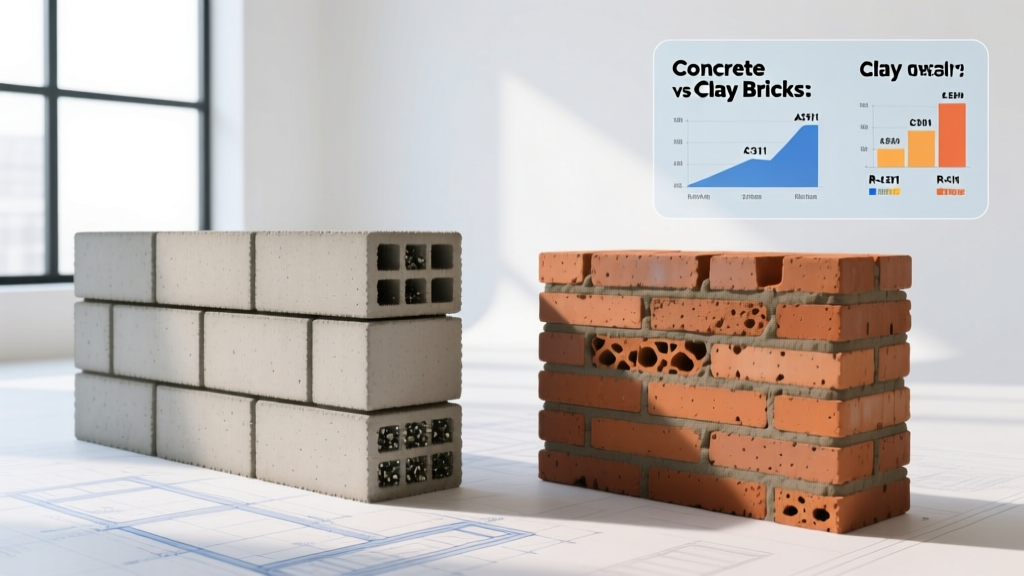
The Core Differences: CMU vs Fired Clay
When evaluating concrete blocks vs clay bricks for structural or veneer applications, the decision extends far beyond surface aesthetics. The fundamental divergence lies in their manufacturing processes and resulting physical properties. Concrete Masonry Units (CMUs) are cast from a mixture of Portland cement, aggregates (like gravel or crushed stone), and water, then cured in high-pressure steam kilns. Clay bricks are extruded or molded from natural shale and clay, then fired in kilns at temperatures exceeding 2,000°F (1,093°C), vitrifying the material into a dense, glass-like ceramic.
Quick Specification Matrix
- Standard CMU Dimensions: 8 in. x 8 in. x 16 in. (Nominal) | Actual: 7.625 in. x 7.625 in. x 15.625 in.
- Standard Modular Brick Dimensions: 4 in. x 2.67 in. x 8 in. (Nominal) | Actual: 3.625 in. x 2.25 in. x 7.625 in.
- Weight per Unit: CMU (~28-35 lbs) vs Modular Brick (~4.5 lbs)
- Units per 100 Sq Ft: 112.5 CMUs vs 680 Modular Bricks
Structural Integrity and Compressive Strength
A common misconception is that heavier materials inherently possess higher compressive strength. In the debate of concrete blocks vs clay bricks, fired clay actually boasts a significantly higher compressive strength per square inch, though CMUs offer superior load-bearing geometry for multi-story construction due to their hollow cores and vertical rebar integration.
| Material | Governing ASTM Standard | Typical Compressive Strength (psi) | Primary Structural Use |
|---|---|---|---|
| Concrete Block (Normal Weight) | ASTM C90 | 1,900 - 3,750 psi | Load-bearing walls, foundations, shear walls |
| Clay Face Brick | ASTM C216 | 3,000 - 10,000+ psi | Veneer, architectural facades, paving |
| Clay Building Brick | ASTM C62 | 2,500 - 4,500 psi | Backing for veneer, interior masonry |
To achieve maximum structural capacity with CMUs, the hollow cells must be filled with high-slump grout and reinforced with Grade 60 steel rebar. According to the National Concrete Masonry Association (NCMA), an 8-inch reinforced, grouted CMU wall can easily exceed 3,000 psi in net compressive strength, making it the default choice for commercial and multi-family structural shells. Clay bricks, despite their high individual psi, are rarely used for primary load-bearing in modern commercial construction due to the labor-intensive nature of laying hundreds of units and the difficulty of integrating continuous vertical steel reinforcement.
Thermal Performance and Energy Efficiency
Modern energy codes (such as the IECC) demand strict thermal envelopes. Neither bare concrete blocks nor solid clay bricks provide adequate standalone R-values to meet current insulation mandates without supplementary materials.
R-Values and Thermal Mass Explained
An uninsulated 8-inch hollow CMU wall yields an R-value of roughly 2.0. A solid 4-inch clay brick wythe offers an R-value of just 0.80. However, masonry excels in thermal mass—the ability to absorb, store, and slowly release heat. The U.S. Department of Energy highlights that high thermal mass can significantly reduce peak HVAC loads in climates with high diurnal temperature swings (hot days, cool nights).
Critical Insulation Strategy: To bring an 8-inch CMU wall up to code (R-15 to R-20+), builders must inject closed-cell polyurethane foam into the block cores and apply continuous rigid exterior insulation (like XPS or polyiso). For clay brick veneer, the brick acts purely as a weather shield; the actual thermal barrier must be a continuous layer of mineral wool or foam board installed behind the air cavity on the structural sheathing.
Cost Breakdown: Material vs Labor in 2026
When pricing concrete blocks vs clay bricks, analyzing the material cost in isolation leads to severe budget miscalculations. While clay bricks are cheaper per individual unit, the labor required to lay them is exponentially higher.
| Cost Metric | 8-inch CMU Wall (Structural) | Modular Clay Brick Veneer |
|---|---|---|
| Material Cost per Sq Ft | $2.50 - $4.00 | $3.50 - $6.00 |
| Mortar & Accessories per Sq Ft | $0.75 - $1.25 | $1.50 - $2.50 |
| Masonry Labor Rate (2026) | $12.00 - $18.00 / Sq Ft | $22.00 - $35.00 / Sq Ft |
| Total Installed Cost per Sq Ft | $15.25 - $23.25 | $27.00 - $43.50 |
Labor dominates masonry budgets. A skilled mason can lay 90 to 120 standard CMUs in an 8-hour shift. That same mason will lay roughly 500 to 700 bricks in the same timeframe. Because it takes 6.8 bricks to cover the same area as one CMU, the bricklayer is effectively working much slower per square foot of wall area. Furthermore, brick veneer requires the installation of corrugated metal wall ties, weep holes, and through-wall flashing, adding 15-20% to the overall veneer labor time.
Durability, Moisture, and Failure Modes
Both materials are highly durable, but they fail in distinctly different ways when exposed to moisture and freeze-thaw cycles.
Clay Brick: Spalling and Efflorescence
Clay bricks are categorized by weathering grades. For exterior applications in freezing climates, you must specify Grade SW (Severe Weathering) per ASTM C216. If Grade MW (Moderate Weathering) bricks are used in a freeze-thaw zone, trapped moisture expands upon freezing, causing the brick face to pop off—a catastrophic failure known as spalling. Additionally, soluble salts within the clay can migrate to the surface, leaving a white, powdery residue called efflorescence. While mostly cosmetic, it requires chemical cleaning (like muriatic acid dilutions) to remove.
Concrete Blocks: Moisture Migration and Parging
CMUs are highly porous. Unsealed concrete blocks will wick groundwater and wind-driven rain directly through the masonry. According to the Brick Industry Association's technical guidelines on moisture management, any single-wythe masonry wall requires rigorous water repellency. For below-grade CMU foundations, builders must apply a bituminous damp-proofing coat or a dimpled drainage mat. Above grade, CMUs intended for exterior exposure require a parge coat (a thin layer of Portland cement) followed by an elastomeric masonry sealer or a stucco finish to prevent water ingress.
Expert Insight on Mortar Selection: Never use a mortar that is stronger than the masonry unit. For high-strength clay bricks, Type N or Type S mortar is appropriate. For softer, historic-style bricks or standard CMUs, using a high-Portland cement Type M mortar will trap stress and cause the masonry units themselves to crack during thermal expansion. Always match the mortar's compressive strength and permeability to the specific ASTM unit rating.
The Decision Framework: When to Use Which
Use this practical framework to specify the correct material for your 2026 construction project:
- Choose Concrete Blocks (CMU) When:
- You are building a load-bearing structural shell for commercial, industrial, or multi-family residential projects.
- You need to integrate vertical rebar and horizontal bond beams for high seismic or high-wind (hurricane) zones.
- Budget constraints require minimizing masonry labor hours.
- The wall will be concealed behind drywall, EIFS, or stucco, making the architectural finish of the masonry irrelevant.
- Choose Clay Bricks When:
- You are designing an exterior architectural facade where color, texture, and traditional aesthetics are paramount.
- You are constructing a residential veneer over a wood-framed or steel-stud structural backup wall.
- You require a highly dense, low-porosity material for paving, retaining walls, or severe freeze-thaw environments (using Grade SW).
- The project budget can absorb the premium labor costs associated with detailed bricklaying and joint tooling.
Frequently Asked Questions
Can you use concrete blocks and clay bricks together on the same wall?
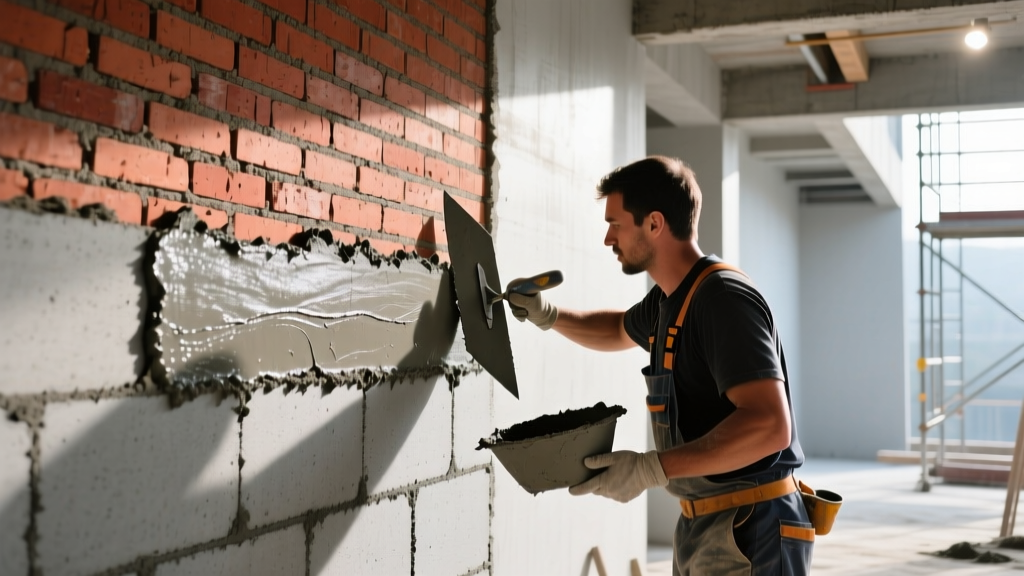
Yes, this is a standard practice in commercial construction. An 8-inch or 10-inch CMU wall is often erected as the structural backup and shear wall. A 1-inch to 2-inch air cavity is left, followed by a 4-inch clay brick veneer tied back to the CMU with adjustable wire ties. This combines the structural economy of CMU with the aesthetic and weather-resistant properties of clay brick.
Which material is better for soundproofing?
Concrete blocks generally provide superior Sound Transmission Class (STC) ratings due to their mass and thickness. A fully grouted 8-inch CMU wall yields an STC rating of roughly 50-54. A solid 4-inch clay brick wall yields an STC of about 45. For interior acoustic partitions in multi-family buildings, architects frequently specify sound-absorbing CMUs with fabric-wrapped acoustic inserts.
How do I calculate the mortar yield for both materials?
For standard 8x8x16 CMUs with 3/8-inch joints, expect to use approximately 8.5 cubic feet of mortar per 100 blocks. For modular clay bricks with 3/8-inch joints, you will need roughly 7.2 cubic feet of mortar per 1,000 bricks. Always order 10% additional mortar material to account for site waste, drop-board loss, and joint tooling variations.
Written by
David NakamuraDavid Nakamura is a licensed architect (AIA) and construction technology writer focused on sustainable building methods, mass timber engineering, and high-performance building envelopes. He holds a Master of Architecture from the University of Washington and is a certified Passive House Consultant (CPHC). David spent eight years at the Seattle firm Mithun, where he led the design of three LEED Platinum projects, before founding his own practice specializing in net-zero residential design. He serves on the editorial advisory board of GreenBuilder Magazine and has authored peer-reviewed papers on cross-laminated timber (CLT) connections for the Journal of Structural Engineering. In his spare time, David teaches woodworking at Pratt Fine Arts Center and kayaks the Puget Sound.
More from David Nakamura
View all
Construction Cost
Labor Cost to Build a Deck Per Sq Ft: 2026 Installation Guide
Discover the exact labor cost to build a deck per sq ft in 2026. This installation guide breaks down contractor rates, complexity factors, and hidden fees.
Aug 4, 2026

Construction Cost
How Much Does It Cost to Build a 3 Bedroom House? Financing Guide
Learn exactly how much it costs to build a 3 bedroom house and explore 2026 financing options, construction loan types, and budget frameworks for your build.
Aug 4, 2026

Construction Cost
Cost to Build a Tennis Court: 2026 Guide
How much does it cost to build a tennis court in 2026? Breakdowns for asphalt, concrete, and synthetic surfaces plus fencing and lighting.
Jul 30, 2026