Concrete Paint vs Stain: How Mix Design Dictates Your Choice
Discover how concrete mix design, fly ash, and w/c ratios determine the success of concrete paint vs stain. Expert guide on chemistry, costs, and failures.

The Chemistry of the Surface: How Mix Design Dictates Coating Choice
The debate between concrete paint vs stain is rarely just about aesthetics; it is fundamentally a question of surface chemistry and concrete mix design. When evaluating a slab, the water-cement (w/c) ratio, the presence of supplementary cementitious materials (SCMs) like fly ash or slag, and the air-entrainment levels will immediately dictate which coating system will survive and which will fail. According to the American Concrete Institute (ACI), the capillary porosity of hardened concrete is directly inversely proportional to its w/c ratio. A dense, low w/c mix (below 0.40) creates a nearly impermeable surface that rejects penetrating stains, while a high w/c mix (above 0.55) leaves a porous, friable surface that causes film-forming paints to blister under hydrostatic pressure.
If your concrete mix contains more than 15% Class F fly ash replacement, do not use reactive acid stains. Fly ash undergoes a pozzolanic reaction that consumes calcium hydroxide (Ca(OH)2). Because acid stains rely on reacting with free calcium hydroxide to create permanent color, high-fly-ash mixes will result in pale, blotchy, or completely non-existent color development.
Concrete Paint: Film-Forming Coatings and Mix Traps
Concrete paints—including 100% solids epoxies, polyurethanes, and acrylic latexes—sit on top of the slab, forming a continuous film. Their success depends entirely on mechanical adhesion and moisture vapor transmission (MVT) management. When comparing concrete paint vs stain for exterior or below-grade applications, paint requires rigorous moisture testing (such as the ASTM D4263 plastic sheet test) to ensure MVT does not exceed the manufacturer's limit, typically 3 to 5 lbs per 1,000 square feet per 24 hours.
Furthermore, air-entrained concrete (mandated by NRMCA guidelines for freeze-thaw durability in exterior flatwork) contains microscopic, intentionally induced air voids (typically 4% to 7% by volume). When applying high-build epoxy paints over air-entrained concrete, temperature fluctuations cause the air trapped in these voids to expand, resulting in hundreds of tiny outgassing bubbles that ruin the paint finish.
| Paint Type | Ideal Mix Profile | Primary Failure Mode |
|---|---|---|
| 100% Solids Epoxy | Non-air-entrained, low MVT, mechanically profiled (CSP 2-3) | Outgassing bubbles; hydrostatic blistering |
| Water-Based Acrylic | Standard w/c (0.45-0.50), etched surface | UV chalking; peeling under standing water |
| Aliphatic Polyurethane | Dense, hard-troweled finishes (used as a topcoat over epoxy) | Poor adhesion if applied over laitance |
Concrete Stains: Penetration, Porosity, and SCMs
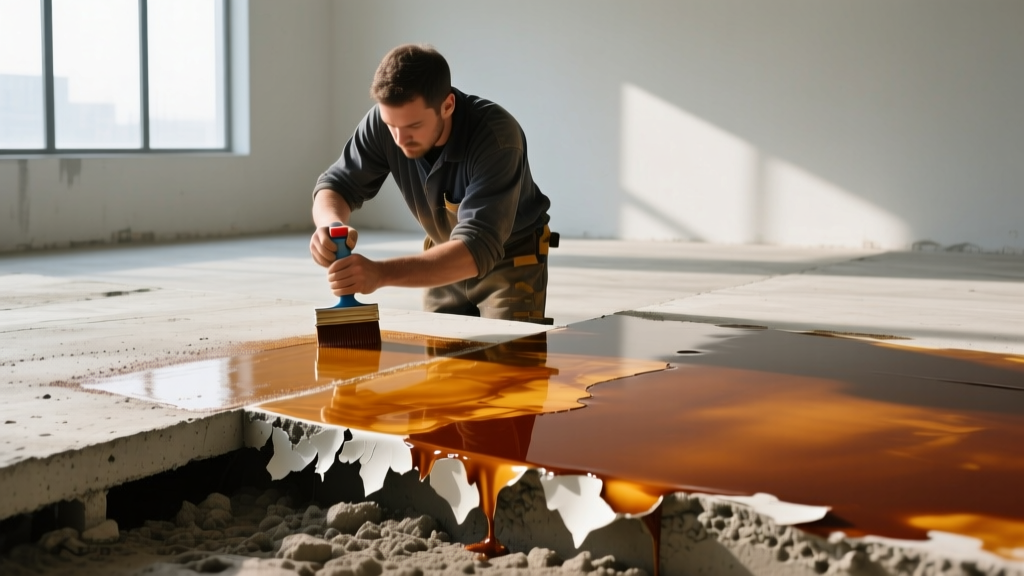
Unlike paint, stains do not form a surface film. They penetrate the capillary network of the concrete. However, the mechanism of penetration and coloration varies wildly between acid and water-based stains, making the concrete paint vs stain decision highly dependent on your specific mix design.
Reactive Acid Stains (Chemical Coloration)
Acid stains (such as Kemiko Stone Tone or L.M. Scofield Formula One) contain mild hydrochloric or phosphoric acid mixed with metallic salts (iron, copper, or chromium). The acid etches the surface, opening the pores, while the metallic salts react with the hydrated lime (calcium hydroxide) in the Portland cement matrix. This reaction produces insoluble, permanently colored metallic oxides.
The Mix Design Catch: Acid stains require a minimum of 250 psi of surface tensile strength and abundant free lime. Slabs finished with power trowels that trap bleed water create a weak, high w/c layer of laitance on top. If you acid stain over laitance, the color will develop beautifully but will flake off within months as the weak top layer delaminates. You must remove laitance via light grinding before application.
Water-Based Penetrating Stains (Physical Coloration)
Water-based stains utilize nano-pigments or acrylic polymers suspended in a water carrier. They do not rely on a chemical reaction; instead, the water carrier pulls the pigments deep into the concrete's capillary pores, where they become trapped as the water evaporates.
The Mix Design Catch: Because they rely on physical penetration, water-based stains fail on ultra-dense, low w/c mixes (e.g., 0.35 w/c used in high-performance industrial floors) unless the surface is aggressively opened via shotblasting or diamond grinding. Conversely, they are the only viable staining option for high-SCM (slag/fly ash) mixes where acid stains will not react.
Before committing to a stain, sprinkle clean water on the bare concrete. If the water beads up and sits on the surface for more than 60 seconds, the mix is too dense (or sealed with a curing compound) for any stain to penetrate. If it absorbs instantly and darkens the concrete within 10 seconds, the porosity is ideal for water-based stains, but you may need a densifier first to prevent acid stains from reacting too aggressively and burning the surface.
Cost, Longevity, and Maintenance Matrix (2026 Data)
When evaluating concrete paint vs stain, lifecycle cost often outweighs initial material expense. Stains generally require a secondary sealer (like a penetrating silane/siloxane or a sacrificial acrylic wax), while high-build paints act as their own wear course. Below is a breakdown of current market averages for material and professional installation.
| Coating System | Material Cost (per sq. ft.) | Installed Cost (per sq. ft.) | Expected Lifespan |
|---|---|---|---|
| Reactive Acid Stain + Sealer | $0.60 - $1.10 | $4.50 - $7.50 | 10-15+ years (color is permanent) |
| Water-Based Stain + Sealer | $0.50 - $0.90 | $3.50 - $6.00 | 5-10 years (pigments may UV fade) |
| Acrylic Latex Paint | $0.25 - $0.60 | $2.50 - $4.00 | 1-3 years (high traffic wear) |
| 100% Solids Epoxy Paint | $1.50 - $3.00 | $6.00 - $11.00 | 10-20 years (interior/garage) |
The Expert Decision Framework
Stop guessing based on color swatches. Use this technical decision tree to select the correct system based on your slab's physical properties:
- IF the slab is exterior, exposed to freeze-thaw cycles, and air-entrained → CHOOSE Penetrating Stain (Acid or Water-based) with a breathable silane/siloxane sealer. Avoid film-forming paints which will trap moisture and spall the surface.
- IF the slab is an interior garage or warehouse with heavy chemical/impact exposure → CHOOSE 100% Solids Epoxy Paint (with a polyurethane topcoat for UV resistance). Stains offer zero surface protection against dropped tools or oil spills.
- IF the concrete mix design includes >20% slag or fly ash (common in modern green building mixes) → CHOOSE Water-Based Nano-Stain. Acid stains will fail to react, and paints may suffer from MVT issues if the slab is on-grade.
- IF the slab is old, heavily weathered, and has a high w/c ratio with surface spalling → CHOOSE High-Build Acrylic or Epoxy Paint. Stains will highlight every flaw, crack, and patch mark, whereas opaque paint will unify the visual appearance of the damaged substrate.
Ultimately, the choice between concrete paint vs stain is not a matter of personal preference, but a strict adherence to the chemical and physical realities of the concrete mix beneath your feet. Test your moisture, profile your surface, and match the coating chemistry to the substrate's porosity.
Written by
Priya KapoorPriya Kapoor is a real estate market analyst and construction economics researcher with expertise in housing affordability, development feasibility, and infrastructure investment. She holds a Master of Regional Planning from Cornell University and previously worked as a senior analyst at CBRE's Investment Properties group, where she modeled returns for $4B in mixed-use development pipelines. Priya now runs an independent research practice advising developers, municipalities, and REITs on construction cost forecasting and market timing. She publishes the quarterly "BuildMat Market Pulse" report tracking material price indices across 12 commodity categories. Based in Austin, TX, Priya serves on the board of Habitat for Humanity Austin and is a marathon runner.
More from Priya Kapoor
View all
Construction Cost
Cost to Build a 1600 Sq Ft Home in 2026: Full Breakdown
Accurate 2026 cost to build a 1600 sq ft home—material, labor, and regional pricing breakdowns included. Plan your budget with real-time estimates.
Aug 11, 2026

Wood & Lumber
Name the Types of Wood for Pressure Treatment and Preservation
Learn how to name the types of wood best suited for pressure treatment. Compare species treatability, chemical retention levels, and 2026 preservation costs.
Aug 4, 2026

Stone & Masonry
Stone Veneer Suppliers Lindenhurst: 2026 Cost Analysis
Analyze 2026 stone veneer costs in Lindenhurst, NY. Compare local supplier pricing, delivery fees, and Suffolk County installation labor rates.
Aug 4, 2026