Concrete Stain vs Epoxy Flooring: Cost, Durability, and Best Uses
Compare concrete stain vs epoxy for garage floors and patios. Explore 2026 costs, durability, prep requirements, and the best finish for your space.

The Fundamental Physics: Penetration vs. Surface Build
Choosing between concrete stain and epoxy requires understanding a fundamental physical difference in how these materials interact with a cementitious substrate. Stains are penetrating treatments designed to alter the color of the concrete matrix without adding measurable surface thickness. Epoxies, conversely, are thermosetting polymer coatings that build a distinct, measurable physical film on top of the slab. This distinction dictates everything from moisture tolerance and UV stability to impact resistance and long-term maintenance.
When evaluating concrete stain vs epoxy for residential garages, commercial showrooms, or outdoor patios, the decision rarely comes down to simple aesthetics. It hinges on the slab's moisture vapor emission rate (MVER), the required Concrete Surface Profile (CSP), and the specific mechanical abuses the floor will endure.
Concrete Stain: Reactive Chemistry and Breathability
True acid stains do not rely on pigments. Instead, they utilize a mild hydrochloric acid solution mixed with metallic salts. When applied to cured concrete, the acid etches the surface, allowing the metallic salts to penetrate and react with the free hydrated lime (calcium hydroxide) in the concrete matrix. This chemical reaction produces permanent, variegated color variations unique to the slab's specific mineral composition.
Acid vs. Water-Based Stains
- Acid (Reactive) Stains: Produce earthy, translucent tones (browns, tans, terra cottas, soft blue-greens). Because they chemically alter the concrete, they are entirely UV stable and will not fade under direct sunlight. Products like Kemiko Stone Tone remain industry standards for this application.
- Water-Based (Non-Reactive) Stains: These are essentially penetrating dyes or acrylic-polymer blends that deposit color into the pores without a chemical reaction. They offer a vastly broader color palette, including bright reds, blues, and blacks, but generally require a UV-stable sealer to prevent fading in exterior applications.
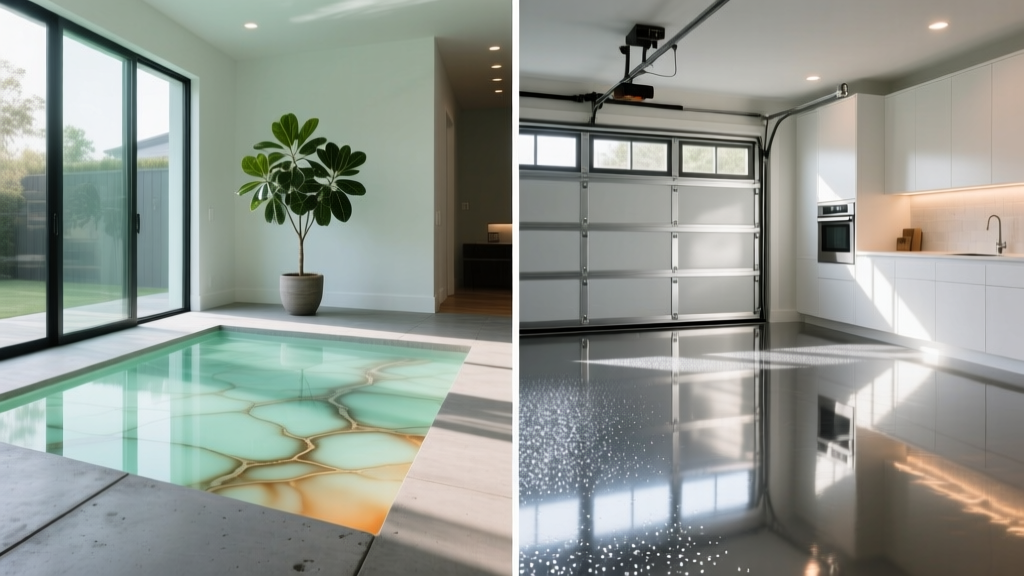
Epoxy Coatings: Thermosetting Polymers and Mil Thickness
Epoxy flooring is a two-part system consisting of a resin (typically Bisphenol-A or Bisphenol-F) and a polyamine hardener. When mixed, an exothermic chemical reaction occurs, cross-linking the molecules into a rigid, highly durable plastic surface. The performance of an epoxy floor is directly correlated to its volume of solids and resulting mil thickness.
The 100% Solids Standard
Big-box store epoxy kits are predominantly water-based or solvent-based, containing only 40% to 60% solids. When the water or solvent evaporates, the remaining coating is exceptionally thin (2 to 4 mils). Professional-grade 100% solids epoxies contain no volatile carriers; what goes on the floor stays on the floor. These systems build 10 to 20 mils per coat, providing superior chemical resistance, impact absorption, and mechanical bonding.
However, epoxies are notoriously moisture-sensitive. According to guidelines aligned with the American Concrete Institute (ACI), standard epoxies will blister, delaminate, or turn white (amine blush) if applied over slabs exceeding an MVER of 3 to 5 pounds per 1,000 square feet per 24 hours (tested via ASTM F1869 calcium chloride test).
Head-to-Head Comparison Matrix
| Feature | Acid / Water-Based Stain | 100% Solids Epoxy Coating |
|---|---|---|
| System Thickness | 0 mils (Penetrating) | 10 to 20+ mils (Surface build) |
| UV Stability | Excellent (Will not yellow) | Poor (Ambers under UV unless aliphatic) |
| Moisture Tolerance | High (Vapor permeable) | Low (Requires strict MVER testing) |
| Impact Resistance | Low (Dents/scratches like raw concrete) | High (Absorbs dropped tools/parts) |
| Chemical Resistance | Moderate (Dependent on topcoat sealer) | Exceptional (Resists oil, gas, solvents) |
| Required Surface Profile | CSP 1 to CSP 2 | CSP 3 to CSP 4 |
2026 Cost Breakdown: Material and Professional Labor
Pricing for decorative concrete has shifted with recent supply chain adjustments and labor market demands. Below represents the current national average for residential applications.
Concrete Stain Costs
- DIY Material Only: $1.50 to $3.00 per square foot. Includes acid stain, neutralizer, and a high-quality solvent-based acrylic sealer.
- Professional Installation: $5.00 to $9.00 per square foot. Includes diamond grinding, stain application, and a two-part polyurethane topcoat for enhanced scratch resistance.
Epoxy Flooring Costs
- DIY Water-Based Kits: $2.00 to $4.00 per square foot. High risk of premature failure in high-traffic or hot-tire environments.
- Professional 100% Solids System: $7.00 to $12.00 per square foot. Includes shot blasting to CSP 3, moisture mitigation primer (if needed), 100% solids base coat, vinyl flake broadcast, and a polyaspartic topcoat.
Critical Failure Points and Surface Preparation
The most common reason for decorative concrete failure is inadequate surface preparation. Both systems require the removal of laitance, curing compounds, and sealers, but the required aggressiveness differs vastly.
The International Concrete Repair Institute (ICRI) defines Concrete Surface Profiles (CSP) to standardize prep. Stains generally require a CSP 1 or 2, achievable with a planetary diamond grinder using 40-grit to 80-grit metal bonds. Epoxies demand a CSP 3 or 4 to provide adequate mechanical tooth for the thick polymer to grip. This almost always mandates shot blasting or aggressive scarification.
Environmental and VOC Considerations
When working in enclosed spaces like basements or attached garages, off-gassing is a critical factor. Traditional solvent-based epoxy primers and acid stains contain high levels of Volatile Organic Compounds (VOCs). The Environmental Protection Agency (EPA) strictly regulates VOC limits for architectural coatings. Modern 100% solids epoxies contain virtually zero VOCs because they do not rely on solvents for viscosity reduction, making them vastly superior for indoor air quality compared to solvent-based stain sealers or water-based epoxy kits that utilize glycol ethers.
Decision Framework: Which Finish Fits Your Slab?
Use this conditional framework to finalize your material selection:
- Is the slab outdoors or exposed to direct sunlight?
Choose Concrete Stain. Epoxies will amber and chalk under UV exposure unless topped with an expensive aliphatic urethane, and even then, thermal expansion in exterior environments often causes epoxy delamination. - Does the slab have a history of moisture issues or lack a vapor barrier?
Choose Concrete Stain with a breathable silane/siloxane sealer. Epoxy will trap the vapor, leading to osmotic blistering and catastrophic coating failure. - Is the space a working garage subject to dropped tools, jack stands, and chemical spills?
Choose 100% Solids Epoxy with a polyaspartic topcoat. Stained concrete will chip under heavy point-loads and etch when exposed to battery acid or harsh degreasers. - Are you seeking a low-maintenance, high-gloss showroom finish?
Choose Epoxy. Stained floors require periodic re-waxing or re-sealing every 2 to 5 years to maintain their sheen and scratch resistance, whereas a properly installed polyaspartic-epoxy system can last 15 to 20 years with basic cleaning.
By aligning the physical properties of the coating with the environmental realities of your specific concrete slab, you ensure a finish that is both structurally sound and visually enduring.
Written by
James ThorntonJames Thornton is a construction industry veteran with 25 years of hands-on experience in wood framing, lumber grading, and residential building codes. He started as a framing carpenter in rural Oregon, earned his ICC Residential Building Inspector certification, and eventually became a senior plan reviewer for the City of Portland Bureau of Development Services. James holds a B.S. in Wood Science & Technology from Oregon State University and is a certified lumber grader through the West Coast Lumber Inspection Bureau (WCLIB). He has inspected over 3,000 residential construction sites and authored the city's internal guide on advanced framing techniques (2x6 at 24" O.C.). James lives in Bend, OR, where he builds custom timber-frame cabins and competes in lumberjack sports.
More from James Thornton
View all
Insulation
Best Home Insulation Materials: Complete 2026 Guide
Compare top home insulation materials for 2026. Find R-values, installed costs per square foot, and best uses for fiberglass, spray foam, and mineral wool.
Aug 4, 2026

Sustainable Building
Certify Your Green Building Material for LEED and WELL
Step-by-step guide to certifying a green building material for LEED v5 and WELL v2. Master EPDs, HPDs, and VOC limits for 2026 project specifications.
Aug 4, 2026

Stone & Masonry
Veneer Stacked Stone Panels: Interior Design & Style Showcase
Discover how veneer stacked stone panels transform interiors. Explore modern design profiles, material pairings, and technical installation specs.
Aug 4, 2026