Sealed vs Polished Concrete: Cost, Durability & Use Cases
Compare sealed vs polished concrete for commercial and residential floors. Discover costs, durability, grit levels, and maintenance requirements.

The Fundamental Difference: Topical vs. Mechanical
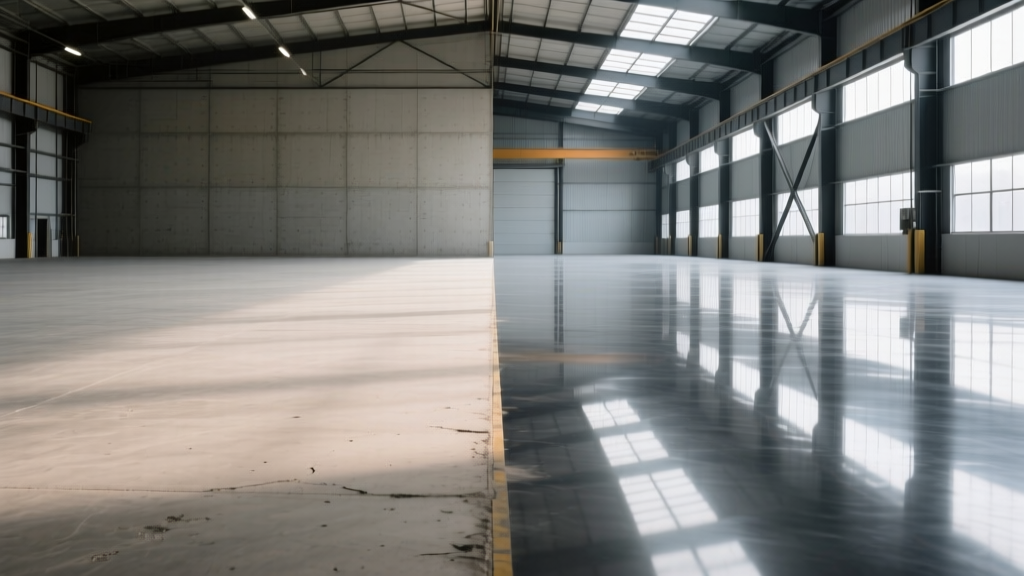
Choosing between sealed and polished concrete requires understanding a core material distinction: sealed concrete relies on an applied chemical barrier, while polished concrete relies on the mechanical alteration of the slab's physical surface matrix. Neither is inherently superior; rather, their performance diverges drastically based on traffic loads, chemical exposure, and lifecycle maintenance budgets.
The Chemistry of Sealed Concrete
Concrete sealers fall into two primary categories: film-forming and penetrating. Film-forming sealers (acrylics, epoxies, and polyurethanes) create a continuous physical layer on top of the slab. Acrylics offer basic protection and UV stability but degrade within 1 to 3 years under foot traffic. Epoxies provide high build and chemical resistance but will amber under UV exposure unless topped with an aliphatic polyurethane. Penetrating sealers (silanes, siloxanes, and siliconates) react chemically within the capillary network of the concrete to repel water and chlorides without altering the surface profile or traction.
The Physics of Polished Concrete
Polished concrete is not a coating; it is a multi-step mechanical grinding process. According to the American Society of Concrete Contractors (ASCC), true polishing requires progressively finer diamond tooling, typically starting at 30-grit metal-bonded diamonds to remove surface laitance, stepping through transitional grits, and finishing with resin-bonded diamonds up to 3000-grit. Crucially, this process requires chemical densification. Liquid hardeners—typically lithium, potassium, or sodium silicates—react with free lime (calcium hydroxide) in the concrete to form additional calcium silicate hydrate (C-S-H), permanently hardening the surface from the inside out.
Head-to-Head Comparison Matrix
| Feature | Penetrating Sealed | Film-Forming Sealed (Epoxy/PU) | Mechanically Polished |
|---|---|---|---|
| Upfront Cost (per sq ft) | $1.50 - $3.00 | $4.00 - $9.00 | $5.00 - $14.00 |
| Expected Lifespan | 3 - 7 years | 5 - 10 years | 20+ years |
| Slip Resistance (DCOF) | High (>0.60) | Low to Moderate (0.30 - 0.50) | Moderate to High (0.45 - 0.65) |
| Maintenance Requirement | Reapply every few years | Strip and recoat when worn | Daily dust mopping, periodic burnishing |
| UV Stability | Excellent | Poor (Epoxies amber) | Excellent |
Note: DCOF (Dynamic Coefficient of Friction) values are based on ANSI A326.3 standards. A DCOF of 0.42 or higher is generally required for level interior spaces expected to be walked on when wet.
Real-World Cost Breakdown and Grit Progression
The cost of polished concrete scales directly with the desired aggregate exposure and the final grit level. A 'salt and pepper' finish (Cream polish) requires less initial grinding than a heavily exposed aggregate finish, but achieving a mirror-like 3000-grit sheen requires significantly more labor than a matte 400-grit finish.
- Level 1 (400 Grit - Matte/Satin): $5.00 - $7.00 per sq ft. Ideal for warehouses and utility spaces. Stops at a low-sheen, easily maintained surface.
- Level 2 (800 Grit - Semi-Polished): $7.00 - $9.50 per sq ft. The standard for retail and commercial showrooms. Provides high light reflectance without being overly slippery.
- Level 3 (1500 - 3000 Grit - High Gloss): $9.50 - $14.00+ per sq ft. Reserved for high-end residential, luxury retail, and automotive showrooms. Requires precise floor flatness (FF/FL numbers) to avoid visible undulations in the reflection.
For sealed concrete, costs are driven by surface preparation. A simple penetrating silane sealer applied to a broom-finished exterior patio costs roughly $1.50 to $2.50 per square foot. However, a high-performance aliphatic polyurethane topcoat over an epoxy primer for a commercial kitchen requires shot-blasting, diamond grinding, and multiple coats, pushing costs to $7.00 - $9.00 per square foot.
Failure Modes: How Each System Degrades
Understanding how these floors fail is critical for long-term facility management. According to flooring experts at Bob Vila, improper maintenance is the leading cause of premature degradation for both systems.
Sealed Concrete Failure Modes
- Delamination and Peeling: Film-forming sealers fail when moisture vapor transmission (MVT) exceeds the coating's perm rating. If hydrostatic pressure builds beneath an epoxy or acrylic sealer, it will blister and peel.
- Hot Tire Pickup: In garages, plasticizers from hot vehicle tires can soften and bond with epoxy and acrylic sealers, ripping the coating off the slab when the vehicle moves.
- Micro-Scratching: High-gloss polyurethanes and epoxies show micro-scratches from foot traffic and dragged furniture far more readily than bare concrete.
Polished Concrete Failure Modes
- Chemical Etching: The C-S-H matrix created by densifiers is highly alkaline. Using acidic cleaning agents (like muriatic acid or harsh citrus degreasers) will chemically etch the surface, permanently destroying the polish and leaving dull, white stains.
- Efflorescence (Sodium Silicate Densifiers): If cheaper sodium silicate densifiers are used and not properly neutralized or washed, unreacted salts migrate to the surface, creating a stubborn white, powdery residue. Lithium silicates largely eliminate this risk due to their smaller molecular size and more complete reaction.
- Edge Spalling: Heavy machinery turning sharply near slab joints can cause micro-spalling if the concrete was not sufficiently densified during the polishing process.
Decision Framework: When to Choose Which
Use this practical framework to specify the correct floor system for your project:
Choose Penetrating Sealed Concrete When:
- The application is exterior (driveways, patios, pool decks) where freeze-thaw cycles and UV exposure are primary concerns.
- Budget is strictly limited, and a natural, matte, non-slip surface is acceptable.
- The concrete is heavily sloped or textured (stamped/broomed), making mechanical polishing impossible.
Choose Film-Forming Sealed (Epoxy/Urethane) When:
- The environment involves severe chemical spills (e.g., battery acid in automotive shops, harsh sanitizers in food processing).
- You need to incorporate heavy anti-slip aggregates (aluminum oxide or quartz sand) for OSHA compliance in wet areas.
- The existing concrete is heavily damaged, pitted, or spalled, requiring a thick build to hide imperfections.
Choose Mechanically Polished Concrete When:
- Lifecycle cost is a priority; you want a floor that will last 20+ years without requiring complete strip-and-recoat shutdowns.
- The space requires high ambient light reflectance (reducing lighting energy costs in big-box retail and warehouses).
- Heavy forklift and pallet jack traffic is expected, which would quickly grind away topical coatings.
Alternative Overlays: When Neither Works
There are extreme environments where both standard sealers and mechanical polishing will fail. In food and beverage manufacturing, pharmaceutical plants, or heavy industrial battery rooms, the combination of thermal shock, extreme chemical exposure, and heavy impact requires a polyurethane mortar overlay (often referred to by brand names like Ucrete). These systems are installed at thicknesses of 1/8 to 3/8 inch, offering thermal shock resistance up to 250°F and immunity to concentrated organic acids. While costing $12.00 to $22.00 per square foot, they are the only viable alternative when polished concrete would etch and epoxy would delaminate.
For comprehensive specifications on concrete floor finishes and densifier chemistry, facility managers should consult the guidelines provided by the American Concrete Institute (ACI) and manufacturer technical data sheets from industry leaders like PROSOCO. Proper specification upfront prevents catastrophic flooring failures and ensures the selected system meets both aesthetic and structural demands.
Written by
David NakamuraDavid Nakamura is a licensed architect (AIA) and construction technology writer focused on sustainable building methods, mass timber engineering, and high-performance building envelopes. He holds a Master of Architecture from the University of Washington and is a certified Passive House Consultant (CPHC). David spent eight years at the Seattle firm Mithun, where he led the design of three LEED Platinum projects, before founding his own practice specializing in net-zero residential design. He serves on the editorial advisory board of GreenBuilder Magazine and has authored peer-reviewed papers on cross-laminated timber (CLT) connections for the Journal of Structural Engineering. In his spare time, David teaches woodworking at Pratt Fine Arts Center and kayaks the Puget Sound.
More from David Nakamura
View all
Construction Cost
Labor Cost to Build a Deck Per Sq Ft: 2026 Installation Guide
Discover the exact labor cost to build a deck per sq ft in 2026. This installation guide breaks down contractor rates, complexity factors, and hidden fees.
Aug 4, 2026

Construction Cost
How Much Does It Cost to Build a 3 Bedroom House? Financing Guide
Learn exactly how much it costs to build a 3 bedroom house and explore 2026 financing options, construction loan types, and budget frameworks for your build.
Aug 4, 2026

Construction Cost
Cost to Build a Tennis Court: 2026 Guide
How much does it cost to build a tennis court in 2026? Breakdowns for asphalt, concrete, and synthetic surfaces plus fencing and lighting.
Jul 30, 2026