Concrete Truck vs Cement Truck: Troubleshooting Delivery and Mix Errors
Confused by a concrete truck vs cement truck delivery? Learn to troubleshoot jobsite mix failures, equipment errors, and wrong-truck arrivals.

The Terminology Trap: Transit Mixers vs. Pneumatic Tankers
On residential jobsites, the term "cement truck" is frequently misused to describe a concrete transit mixer. However, in commercial construction and batch plant logistics, the distinction between a concrete truck (transit mixer carrying wet, ready-mixed concrete) and a cement truck (pneumatic bulk tanker carrying dry cement powder) is critical. Confusing the two leads to severe scheduling errors, material contamination, and catastrophic structural failures. Troubleshooting delivery and mix anomalies requires identifying which vehicle type introduced the fault into the supply chain.
According to standards outlined by the National Ready Mixed Concrete Association (NRMCA), a transit mixer must comply with ASTM C94, maintaining specific drum rotation speeds to prevent segregation. Conversely, bulk cement tankers operate under entirely different pneumatic pressure systems to deliver dry powder to the batch plant silos. When a mix fails, the root cause often traces back to a mechanical or operational error specific to one of these two distinct vehicle classes.
Troubleshooting Matrix: Material Failures by Truck Origin
When fresh concrete fails slump, temperature, or air-entrainment tests on-site, the troubleshooting path diverges based on whether the fault originated in the transit mixer (concrete truck) or the batch plant's bulk delivery system (cement truck). Use this diagnostic matrix to isolate the failure point.
| Symptom on Jobsite | Originating Vehicle | Root Cause | Corrective Action |
|---|---|---|---|
| Rapid slump loss / Flash set | Cement Truck (Bulk Tanker) | Cross-contamination of Type III cement in a Type I silo; hot cement (>160°F) delivered from tanker. | Reject load. Flush plant silo. Verify tanker washout logs. |
| Severe segregation / Bleeding | Concrete Truck (Transit Mixer) | Over-mixing at high RPM (above 12 RPM) during transit; adding excess water at the site. | Reject load. Recalibrate truck water meter. Enforce drum RPM limits. |
| Low air content (<4%) | Concrete Truck (Transit Mixer) | Excessive drum agitation time; high-slump additions destroying air-entraining admixture (AEA) bubbles. | Dose with post-addition AEA per ASTM C260. Limit agitation to 2-6 RPM. |
| Unexplained color banding | Cement Truck (Bulk Tanker) | Supplementary cementitious materials (SCMs) like fly ash or slag improperly layered in the bulk tanker. | Reject load. Mandate dedicated tankers for SCMs vs. pure Portland cement. |
Scenario 1: The Wrong Truck Arrives on Site
A surprisingly common logistical error in fast-paced commercial projects is the dispatch of a pneumatic bulk cement tanker to a site expecting a transit mixer, or vice versa. This usually stems from miscommunication between the general contractor's procurement team and the batch plant dispatcher.
Immediate Jobsite Protocol: Wrong Vehicle Arrival
- Halt the Pour: Do not attempt to offload a bulk cement tanker into a concrete pump hopper or formwork. The dry powder will not hydrate correctly without the high-shear mixing of a batch plant.
- Verify the Bill of Lading (BOL): Check the BOL for material classification. A transit mixer BOL will list cubic yards of concrete and mix design (e.g., 4000 PSI, 3/4" aggregate). A bulk tanker BOL will list tons of dry cement (e.g., Type I/II).
- Secure the Perimeter: Bulk tankers require a 50-foot clearance radius for hose deployment and compressor noise (up to 85 dB). Keep non-essential personnel clear.
- Initiate Rerouting: Contact the plant dispatcher immediately. A misrouted transit mixer has a 90-minute window before the concrete begins initial set and must be rejected or diverted to a non-structural application.
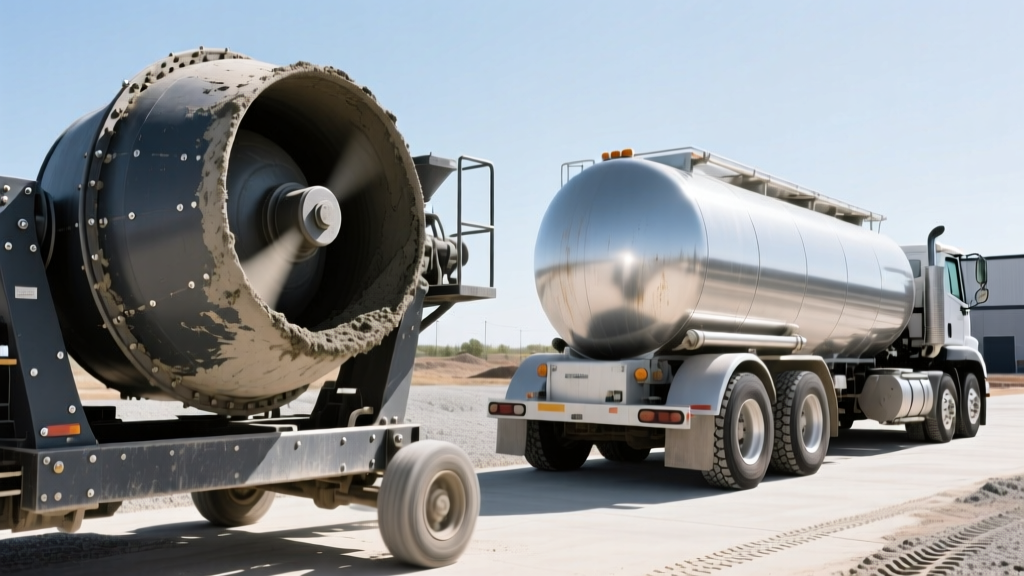
Scenario 2: Transit Mixer (Concrete Truck) Drum Failures
The transit mixer relies on a complex hydraulic system and helical steel blades to mix, agitate, and discharge concrete. Mechanical degradation directly impacts mix integrity.
Hydraulic and RPM Troubleshooting
ASTM C94 mandates specific drum rotation speeds. Charging and mixing require 12 to 15 RPM, while agitation during transit must be limited to 2 to 6 RPM. If a truck arrives with segregated aggregate at the bottom and a watery slurry at the top, the driver likely agitated the drum at mixing speeds to "keep it fresh." This over-mixing breaks down the aggregate structure and increases water demand.
- Diagnostic Check: Inspect the truck's cab-mounted tachometer or digital telematics display. Modern 2026 fleets utilize GPS-linked drum sensors that log RPM data to the cloud.
- Blade Wear: If the truck struggles to discharge low-slump mixes (e.g., 3-inch slump for paving), the helical blades may be worn down by more than 2 inches. Worn blades reduce the volumetric capacity and discharge efficiency, requiring the drum to be reversed at maximum RPM, which can cause severe splashing and segregation at the hopper.
Scenario 3: Pneumatic Tanker (Cement Truck) Delivery Faults
While the end-user rarely interacts with the bulk cement truck, its mechanical failures at the batch plant cause downstream concrete defects. Pneumatic tankers use compressed air to fluidize dry cement and push it through 4-inch hoses into plant silos.
Fluidization and Pressure Anomalies
The floor of a bulk tanker is lined with a porous fluidization canvas. When compressed air (typically at 15 to 20 PSI) is introduced, the cement behaves like a liquid. If the canvas is torn or clogged with moisture-hardened cement, the tanker will experience "rat-holing"—where only the cement directly above the discharge cone empties, leaving tons of material stranded.
Technical Insight: Moisture Ingress in Bulk Tankers
If a concrete mix exhibits unexplained flash setting or severe clumping during the batching process, the fault often lies in the cement truck's pressure relief valves. If these valves fail to seal after a delivery, ambient humidity enters the tanker. The Portland Cement Association (PCA) notes that even a 1% moisture absorption in bulk cement can cause pre-hydration, severely compromising the 28-day compressive strength of the final concrete product.
Financial Impact of Delivery and Equipment Errors in 2026
Misidentifying truck types or failing to troubleshoot their specific mechanical faults carries steep financial penalties. In the current construction economy, material waste and delay costs compound rapidly.
- Rejected Transit Mixer Load: A standard 10-cubic-yard load of 5000 PSI concrete costs between $1,600 and $2,100 in 2026. If rejected due to over-mixing or high temperatures, the contractor absorbs the material cost plus a $350 to $500 environmental washout fee.
- Pump Line Blockages: Segregated concrete from a faulty transit mixer drum will block a concrete pump line. Clearing a blocked pump line costs $1,200 in labor and downtime, and risks damaging the pump's S-valve or hydraulic cylinders.
- Silo Contamination: If a bulk cement tanker accidentally pumps Type III (high early strength) cement into a Type I silo, the entire 100-ton silo is compromised. The batch plant will pass the cost of silo evacuation and cleaning (often exceeding $8,000) onto the contractor or trucking company.
Environmental and Washout Troubleshooting
Both truck types present distinct environmental hazards that require strict troubleshooting and mitigation protocols on-site. Transit mixers carry highly alkaline washwater (pH 12-13) containing suspended solids and heavy metals. Cement tankers, while carrying dry material, generate massive dust plumes during silo filling if the plant's dust collectors fail.
When troubleshooting environmental compliance, always verify that the transit mixer is utilizing a closed-loop washout system or discharging into a designated, lined washout pit. For bulk cement deliveries at the plant, ensure the tanker's compressor is equipped with proper intake filters and that the silo overfill alarms are functional to prevent catastrophic "blowouts" that coat the surrounding site in hazardous particulate matter. Adhering to American Concrete Institute (ACI) guidelines for material handling ensures both structural integrity and regulatory compliance.
Written by
Marcus ChenMarcus Chen is a licensed structural engineer (PE) and building materials analyst with over 12 years of experience across residential, commercial, and industrial construction. He holds a Master of Science in Civil Engineering from UC Berkeley and spent six years at Thornton Tomasetti before transitioning to independent consulting and technical writing. Marcus specializes in material selection for seismic-prone regions, concrete reinforcement strategies, and lifecycle cost analysis. His work has been cited by the American Concrete Institute (ACI) and the Structural Engineers Association of California (SEAOC). When he is not on a job site or at his desk, you will find him hiking the Sierra Nevada or restoring a 1920s craftsman bungalow in Oakland, CA.
More from Marcus Chen
View all
Construction Cost
How Much Did the Eiffel Tower Cost to Build?
How much did the Eiffel Tower cost to build in 1889? We adjust for inflation and compare its budget to modern skyscraper construction.
Aug 4, 2026

Fire Resistance
What Is a Fire Resistant Material? Testing & Certification Guide
Discover what is a fire resistant material through ASTM and UL testing. Learn how fire ratings, certifications, and assemblies work in construction.
Aug 4, 2026

Construction Cost
How Much Did the Burj Khalifa Cost to Build?
How much did the Burj Khalifa cost to build? We break down the $1.5B project and extract 5 money-saving strategies for your next build.
Jul 30, 2026