Concrete Pool vs Fibreglass Pool Cost & Specs Guide 2026
Compare concrete pool vs fibreglass pool cost with 2026 technical specs, including gunite PSI, gelcoat thickness, and backfill engineering data.

The Core Material Specifications: Gunite vs. Isophthalic Gelcoat
When evaluating the concrete pool vs fibreglass pool cost, surface-level quotes often obscure the underlying engineering realities. The price differential is directly tied to the material science and structural specifications required for each shell type. Understanding these technical parameters is critical for architects, builders, and informed homeowners making long-term infrastructure decisions.
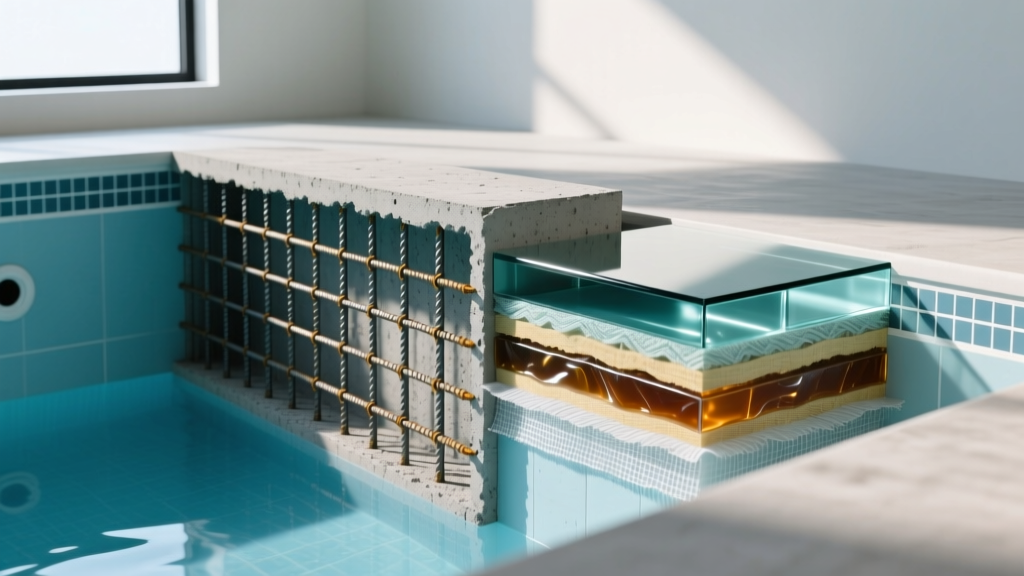
Modern concrete pools are predominantly constructed using shotcrete or gunite. According to standards outlined by the American Concrete Institute (ACI), a structurally sound pool shell requires a minimum compressive strength of 3,500 to 4,000 PSI at 28 days. The structural skeleton consists of #3 (3/8-inch) or #4 (1/2-inch) Grade 60 epoxy-coated steel rebar, typically tied on 12-inch centers (O.C.) in a bi-directional grid. The shell thickness must maintain a minimum of 10 to 12 inches to resist lateral soil loads and hydrostatic pressure.
Conversely, fibreglass pools rely on composite material engineering. High-quality manufacturers utilize an isophthalic gelcoat surface layer with a strict thickness of 20 to 25 mils to prevent water intrusion and UV degradation. Beneath the gelcoat, the structural laminate consists of chopped strand mat and woven roving fiberglass, saturated with vinylester resin. The American Composites Manufacturers Association (ACMA) notes that vinylester is critical for the inner layers to prevent osmotic blistering—a common failure mode in cheaper polyester resin builds. The total wall thickness of a premium fibreglass shell ranges from 3/8-inch to 1/2-inch, relying on its monolithic, flexible structure rather than sheer mass to handle ground movement.
During pneumatic application of shotcrete, aggregate particles that bounce off the rebar grid and formwork are known as "rebound." Rebound has a high sand-to-cement ratio and lacks structural integrity. If contractors fail to manually remove rebound and it becomes embedded in the shell, it creates weak planes prone to spalling and water penetration. Always specify a strict rebound-removal protocol in your concrete contract.
2026 Initial Installation Cost Matrix
The concrete pool vs fibreglass pool cost debate requires a phase-by-phase breakdown. While fibreglass shells are manufactured off-site and craned into place, concrete pools are built entirely in-situ, driving up labor and material logistics. Below is the 2026 technical cost matrix for a standard 14x28 foot rectangular footprint (approx. 392 sq. ft. of water surface).
| Construction Phase | Concrete (Gunite) Cost | Fibreglass Cost | Technical Variance Driver |
|---|---|---|---|
| Engineering & Permits | $2,500 - $4,000 | $1,500 - $2,500 | Concrete requires site-specific structural engineering stamps based on local soil bearing capacity; fibreglass relies on pre-engineered manufacturer specs. |
| Excavation & Haul-off | $8,000 - $12,000 | $10,000 - $15,000 | Fibreglass requires strict over-excavation (12-18 inches) to accommodate the mandatory gravel backfill envelope. |
| Shell Material & Labor | $35,000 - $50,000 | $25,000 - $40,000 | Concrete requires steel tying, plumbing rough-in before shoot, and pneumatic application. Fibreglass is a single-day crane drop. |
| Backfill & Coping | $6,000 - $9,000 | $12,000 - $18,000 | Fibreglass requires importing tons of clean 3/8-inch crushed stone. Concrete can utilize native soil or flowable fill in specific geotechnical conditions. |
| Interior Finish | $10,000 - $20,000 | $0 (Included) | Concrete requires a secondary interior finish (quartz, pebble, or glass bead). Fibreglass gelcoat is the final finish. |
| Total Estimated Base Cost | $85,000 - $135,000+ | $65,000 - $105,000 | Concrete offers infinite geometric customization; fibreglass is limited to manufacturer mold dimensions. |
Excavation Tolerances and Backfill Engineering
A critical hidden cost in the concrete pool vs fibreglass pool cost analysis is the backfill engineering. Fibreglass pools are non-load-bearing until they are backfilled. The Pool & Hot Tub Alliance (PHTA) strictly mandates that fibreglass shells be backfilled with clean, washed 3/8-inch crushed stone (gravel). This material allows for hydrostatic water to flow freely to the sump system and locks together when wet to provide lateral support.
Using native soil, sand, or pea gravel for fibreglass backfill is a catastrophic technical error. Sand retains water and turns to fluid under hydrostatic pressure, which can cause the fibreglass walls to buckle inward or the entire shell to "float" out of the ground during heavy rains. The requirement to purchase, transport, and manually place 40 to 60 tons of clean crushed stone adds significant material and labor costs to the fibreglass installation, narrowing the initial price gap between the two materials.
Long-Term Degradation and Lifecycle Costs
The initial installation is only the first half of the financial equation. The chemical and structural degradation rates of concrete and fibreglass dictate long-term lifecycle costs.
- Concrete Alkalinity and Etching: Concrete is highly alkaline. Water chemistry in concrete pools requires constant monitoring to prevent the water from becoming aggressive and leaching calcium hydroxide from the plaster. Over 10 to 15 years, the interior pebble or quartz finish will degrade, requiring a full drain, chip-out, and replastering. In 2026, a premium pebble replastering job costs between $12,000 and $18,000.
- Fibreglass Osmotic Blistering: If the 20-mil isophthalic gelcoat barrier is compromised, or if cheap polyester resin was used in the structural layers, water molecules can penetrate the laminate. This triggers a chemical reaction with trapped air pockets, creating osmotic blisters. While modern vinylester resins have nearly eliminated this issue in premium brands, repairing structural blisters requires draining, grinding, and applying new fiberglass patches, costing $3,000 to $6,000.
- Chemical Consumption: Because concrete is porous and reactive, it consumes significantly more chlorine and acid to maintain a balanced pH (7.4 - 7.6). Fibreglass is chemically inert, typically reducing annual chemical expenditures by 40% to 50% compared to a concrete shell.
Structural Load and Hydrostatic Pressure Handling
Geotechnical conditions heavily influence which material is technically superior for a specific site. In regions with high water tables or expansive clay soils, hydrostatic uplift is a primary engineering concern.
Hydrostatic Warning: When a pool is drained for maintenance, the surrounding groundwater exerts immense upward pressure on the empty shell. A standard 14x28 foot pool floor has a surface area of 392 sq. ft. If the water table is 3 feet above the pool floor, the hydrostatic uplift force exceeds 73,000 pounds.
Concrete pools handle this through sheer mass (a gunite shell can weigh over 80,000 lbs) and the integration of hydrostatic relief valves in the main drain sump, which allow groundwater to enter the pool and equalize pressure. Fibreglass pools, weighing only 2,000 to 4,000 lbs, rely entirely on the friction and interlocking weight of the 3/8-inch crushed stone backfill and the water inside the pool to resist uplift. In areas with severe, fluctuating water tables, structural engineers frequently specify concrete over fibreglass to mitigate the risk of shell flotation.
Decision Framework: When to Specify Which Material
To finalize your specification, apply the following technical decision matrix based on site constraints and project parameters:
Specify Concrete (Shotcrete/Gunite) When:
- The design requires negative edges, vanishing edges, or complex non-geometric shapes that exceed standard mold limitations.
- The site features severe access restrictions that prevent a 100-ton crane from positioning a pre-manufactured fibreglass shell.
- Geotechnical reports indicate highly expansive soils or extreme hydrostatic pressure that requires a heavily reinforced, engineer-stamped mass structure.
- The project budget exceeds $150,000 and prioritizes custom architectural integration (e.g., integrated concrete sun shelves, custom depth profiles, and attached spa spillways).
Specify Fibreglass When:
- The project demands a rapid installation timeline (weather permitting, fibreglass shells can be backfilled and filled with water within 5 to 7 days of delivery).
- The homeowner prioritizes low weekly maintenance and reduced chemical consumption due to the inert nature of the gelcoat surface.
- The design fits within standard manufacturer dimensions (typically up to 16 feet wide and 40 feet long) and utilizes a standard geometric footprint.
- Crane access is available, and the soil bearing capacity is sufficient to support the concentrated point-loads of the crane outriggers during the shell drop.
Written by
Marcus ChenMarcus Chen is a licensed structural engineer (PE) and building materials analyst with over 12 years of experience across residential, commercial, and industrial construction. He holds a Master of Science in Civil Engineering from UC Berkeley and spent six years at Thornton Tomasetti before transitioning to independent consulting and technical writing. Marcus specializes in material selection for seismic-prone regions, concrete reinforcement strategies, and lifecycle cost analysis. His work has been cited by the American Concrete Institute (ACI) and the Structural Engineers Association of California (SEAOC). When he is not on a job site or at his desk, you will find him hiking the Sierra Nevada or restoring a 1920s craftsman bungalow in Oakland, CA.
More from Marcus Chen
View all
Construction Cost
How Much Did the Eiffel Tower Cost to Build?
How much did the Eiffel Tower cost to build in 1889? We adjust for inflation and compare its budget to modern skyscraper construction.
Aug 4, 2026

Fire Resistance
What Is a Fire Resistant Material? Testing & Certification Guide
Discover what is a fire resistant material through ASTM and UL testing. Learn how fire ratings, certifications, and assemblies work in construction.
Aug 4, 2026

Construction Cost
How Much Did the Burj Khalifa Cost to Build?
How much did the Burj Khalifa cost to build? We break down the $1.5B project and extract 5 money-saving strategies for your next build.
Jul 30, 2026