Concrete Pool vs Fibreglass: 2026 Installation Cost Breakdown
Compare concrete pool vs fibreglass installation and lifetime costs. Detailed 2026 pricing, maintenance data, and material pros and cons for builders.

The True Cost of Ownership: Beyond the Initial Quote
When evaluating a concrete pool vs fibreglass for a residential or commercial build, the initial contractor quote rarely tells the full financial story. The decision between a custom gunite shell and a pre-manufactured fibreglass insert hinges on a complex matrix of upfront capital, site-specific engineering requirements, and decades of operational maintenance. In 2026, supply chain stabilizations have shifted the pricing dynamics, making fibreglass more competitive in standard sizes, while concrete remains the undisputed choice for bespoke, infinity-edge, or architecturally integrated designs.
Executive Cost Summary (14x28 ft Standard Pool)
- Concrete (Gunite/Shotcrete): $75,000 – $130,000+ upfront | $12,500 / decade in maintenance
- Fibreglass: $60,000 – $95,000 upfront | $4,500 / decade in maintenance
- Timeline: Concrete (60–90 days) vs. Fibreglass (14–30 days)
Upfront Installation Costs: Concrete vs Fibreglass
The initial capital expenditure varies wildly based on material sourcing, labor rates, and site accessibility. Below is a granular breakdown of average 2026 installation costs for a standard 14x28 foot rectangular pool, excluding premium hardscaping.
| Cost Category | Concrete Pool (Gunite) | Fibreglass Shell |
|---|---|---|
| Engineering & Permits | $1,500 – $3,500 | $800 – $1,500 |
| Excavation & Soil Haul | $4,000 – $9,000 | $4,500 – $10,000 |
| Shell Material & Install | $35,000 – $55,000 | $25,000 – $45,000 |
| Plumbing & Electrical | $6,000 – $12,000 | $5,500 – $10,000 |
| Coping & Basic Decking | $10,000 – $25,000 | $8,000 – $18,000 |
| Interior Finish (Plaster/Pebble) | $8,000 – $18,000 | N/A (Included in shell) |
| Total Estimated Range | $75,000 – $130,000+ | $60,000 – $95,000 |
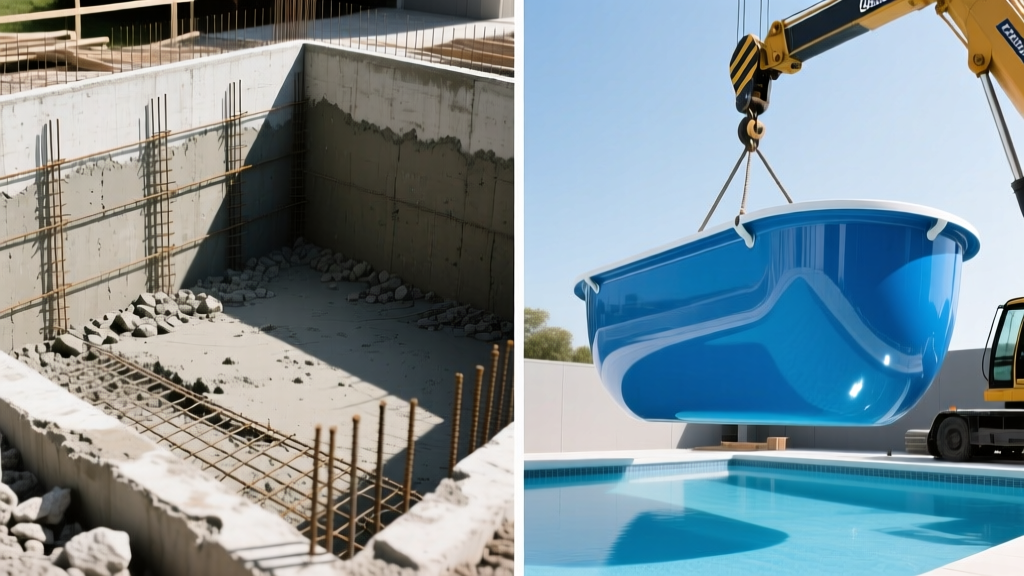
According to Angi's 2026 pool cost data, the primary driver of concrete's higher upfront cost is the labor-intensive nature of steel rebar tying, gunite application, and the mandatory 28-day curing period before interior finishes can be applied. Fibreglass shells, conversely, are craned into the excavation and backfilled within days, drastically reducing on-site labor hours.
Material Science: Gunite vs. Vinyl Ester Resin
To understand the long-term cost implications, builders must look at the structural chemistry of both materials.
Concrete (Gunite and Shotcrete)
Modern concrete pools rely on a 4,000 to 5,000 PSI mix design, pneumatically applied over a grid of #3 or #4 steel rebar spaced on 12-inch centers. Gunite (dry-mix) is combined with water at the nozzle, while shotcrete (wet-mix) is pre-mixed. The resulting 6-inch to 8-inch thick shell is incredibly rigid but inherently porous. This porosity mandates an interior waterproofing layer—typically white marcite plaster, quartz aggregate, or premium PebbleTec finishes. Because concrete is alkaline, it constantly leaches into the water, demanding rigorous chemical balancing.
Fibreglass Shell Construction
High-quality fibreglass pools are manufactured using a multi-layer process. The critical differentiator in 2026 is the use of vinyl ester resin rather than cheaper polyester resin. Vinyl ester provides superior impermeability, effectively eliminating the risk of fibreglass osmosis (water blisters). The shell is typically 3/16-inch to 3/8-inch thick, reinforced with chopped fibreglass strands and structural honeycomb ribbing. The interior gelcoat finish is non-porous, which inhibits algae growth and drastically reduces chemical consumption.
Long-Term Maintenance and Lifetime Cost Matrix
The true financial divergence between a concrete pool vs fibreglass emerges in years 5 through 20. The non-porous nature of fibreglass yields massive operational savings.
| 10-Year Operational Metric | Concrete Pool | Fibreglass Pool |
|---|---|---|
| Annual Chemicals (Chlorine, Acid, Algaecide) | $800 – $1,200 / year | $350 – $600 / year |
| Electricity (Pump run-time due to algae risk) | Higher (8-12 hrs/day) | Lower (4-6 hrs/day) |
| Acid Washing (Every 3-5 years) | $400 – $700 per wash | Not Required |
| 10-Year Resurfacing / Major Repair | $10,000 – $18,000 (Re-plastering) | $0 (Gelcoat lasts 20+ years) |
| Estimated 10-Year Maintenance Total | $18,000 – $32,000 | $4,000 – $7,500 |
As highlighted by the Latham Pool material comparison guides, fibreglass pools use up to 40% fewer chemicals over their lifespan simply because algae cannot anchor to the smooth gelcoat surface. Concrete pools, by contrast, require periodic acid washing to strip calcium scale and eventual chipping out and replacement of the interior plaster aggregate, which is a massive capital expense at the 12-to-15-year mark.
Hidden Costs and Site-Specific Failure Modes
Builders and homeowners must account for edge cases that can blow up a project budget. Both materials have distinct failure modes tied to environmental factors.
⚠️ Warning: Expansive Clay Soils and Hydrostatic Pressure
If your build site features highly expansive clay soils or a high water table, structural engineering costs will rise. Concrete pools in these environments require thicker shotcrete applications (up to 12 inches) and specialized hydrostatic relief valves to prevent the shell from cracking or 'popping' out of the ground. Fibreglass pools possess high tensile flexibility (up to 100,000 PSI) and can withstand minor soil shifting without structural fracture, but improper backfilling with the wrong material (e.g., using native clay instead of clean crushed gravel) will cause the sidewalls to bulge inward.
Concrete Vulnerabilities
- Spalling and Rebar Corrosion: If the gunite shell is applied too thin or the rebar lacks adequate concrete cover (minimum 2 inches), moisture will reach the steel, causing rust expansion that cracks the pool from the inside out.
- Delamination: Poor application techniques during the gunite phase can cause 'rebound' (bouncing material) to be trapped in the shell, leading to hollow spots and eventual delamination of the plaster finish.
Fibreglass Vulnerabilities
- Crane Access Premiums: Fibreglass shells are delivered in one piece. If the property lacks wide side-yard access, requiring a massive 100-ton crane to lift the shell over a two-story house, crane rental fees can add $3,000 to $8,000 to the project.
- Size Limitations: Because they are transported via highway, fibreglass pools are generally limited to 16 feet in width and 40 feet in length. Anything larger requires concrete.
Decision Framework: Which Material Fits Your Build?
Consulting the Pool & Hot Tub Alliance (PHTA) consumer guidelines reinforces that the choice ultimately depends on the project's architectural goals and the owner's maintenance tolerance.
Specify a Concrete Pool When:
- The design requires custom geometric shapes, vanishing edges, or integrated architectural features (like built-in tanning ledges or perimeter overflow troughs).
- The pool dimensions exceed standard highway shipping widths (over 16 feet wide).
- The site has severe crane access restrictions, making the delivery of a monolithic fibreglass shell impossible.
- The client prefers the aesthetic depth and customization of premium pebble or glass-bead interior finishes.
Specify a Fibreglass Pool When:
- The client demands a rapid installation timeline (under 30 days) and immediate usability.
- The project budget is strictly capped, and the client wants to avoid the $15,000+ resurfacing costs that concrete demands in its second decade.
- The design fits within standard rectangular or freeform kidney shapes (e.g., 12x24, 14x28, 16x32).
- The homeowner is a DIY-maintenance novice who needs the forgiveness of a non-porous, algae-resistant surface to minimize chemical balancing errors.
By analyzing both the immediate capital requirements and the 20-year operational reality, builders can accurately advise clients on whether the bespoke versatility of concrete or the low-maintenance economics of fibreglass best serves their specific property and lifestyle.
Written by
James ThorntonJames Thornton is a construction industry veteran with 25 years of hands-on experience in wood framing, lumber grading, and residential building codes. He started as a framing carpenter in rural Oregon, earned his ICC Residential Building Inspector certification, and eventually became a senior plan reviewer for the City of Portland Bureau of Development Services. James holds a B.S. in Wood Science & Technology from Oregon State University and is a certified lumber grader through the West Coast Lumber Inspection Bureau (WCLIB). He has inspected over 3,000 residential construction sites and authored the city's internal guide on advanced framing techniques (2x6 at 24" O.C.). James lives in Bend, OR, where he builds custom timber-frame cabins and competes in lumberjack sports.
More from James Thornton
View all
Insulation
Best Home Insulation Materials: Complete 2026 Guide
Compare top home insulation materials for 2026. Find R-values, installed costs per square foot, and best uses for fiberglass, spray foam, and mineral wool.
Aug 4, 2026

Sustainable Building
Certify Your Green Building Material for LEED and WELL
Step-by-step guide to certifying a green building material for LEED v5 and WELL v2. Master EPDs, HPDs, and VOC limits for 2026 project specifications.
Aug 4, 2026

Stone & Masonry
Veneer Stacked Stone Panels: Interior Design & Style Showcase
Discover how veneer stacked stone panels transform interiors. Explore modern design profiles, material pairings, and technical installation specs.
Aug 4, 2026