Pavers vs Concrete Around Pool: Real-World Application Showcase
Compare pavers vs concrete around pool decks with real-world application showcases, cost breakdowns, slip-resistance data, and maintenance insights.

When evaluating pavers vs concrete around pool decks, the decision extends far beyond basic aesthetics. The pool coping and deck environment subjects hardscape materials to extreme thermal cycling, constant chemical exposure from splashed chlorinated or salt water, and heavy barefoot traffic. Selecting the wrong material results in surface spalling, unrepairable cracks, or dangerously hot walking surfaces. This application showcase breaks down three distinct real-world installations, analyzing the structural, thermal, and economic performance of both poured concrete and interlocking pavers.
The Application Showcase: Three Real-World Pool Deck Scenarios
Scenario 1: The Modern Geometric Oasis (Poured Concrete with Broom Finish)
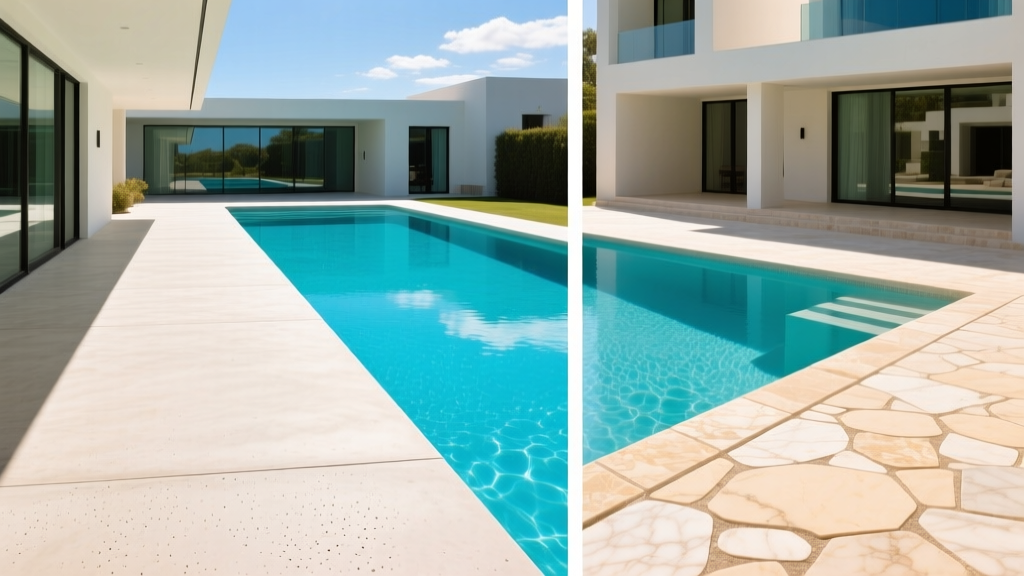
For a contemporary home with sharp architectural lines, a monolithic poured concrete deck offers a seamless, minimalist look. In this application, the contractor utilized a 4,000 PSI air-entrained concrete mix (essential for freeze-thaw resistance in northern climates) with an integral light-gray color hardener. The surface was finished with a light broom texture to achieve a Dynamic Coefficient of Friction (DCOF) above 0.42, ensuring slip resistance when wet. Control joints were saw-cut at 10-foot intervals to dictate where shrinkage cracks occur, keeping them straight and hidden within the geometric layout.
Scenario 2: The Classic Resort Retreat (Tumbled Travertine & Concrete Pavers)
For a high-end residential project mimicking a luxury resort, the builder installed 12x24-inch tumbled concrete pavers designed to replicate natural travertine. Unlike poured concrete, these pavers are laid over a compacted 4-inch crushed limestone base with a 1-inch bedding layer of coarse, sharp sand. The joints were filled with polymeric sand, which hardens upon water activation to lock the pavers in place while preventing weed growth and ant infiltration. The modular nature of the pavers allowed the installer to seamlessly integrate trench drains without the awkward saw-cut lines required in poured concrete.
Scenario 3: The High-Traffic Family Hub (Stamped Concrete vs. Permeable Pavers)
Stamping concrete with a slate or stone pattern is a popular mid-tier option, but it introduces significant maintenance variables around pools. The acrylic sealers required to protect stamped concrete and enhance its color become highly slippery when wet unless anti-skid additives (like SureGrip or SharkGrip) are broadcast into the sealer during application. Furthermore, pool water chemistry degrades topical sealers rapidly, requiring re-application every 18 to 24 months. In contrast, permeable concrete pavers used in adjacent splash zones allow chlorinated water to drain directly through the joints into a gravel sub-base, eliminating surface puddling and reducing chemical deterioration.
Head-to-Head Matrix: Pavers vs Concrete Around Pool
| Performance Metric | Poured / Stamped Concrete | Interlocking Concrete Pavers |
|---|---|---|
| Initial Installation Cost (per sq ft) | $9.00 - $16.00 | $18.00 - $28.00 |
| Surface Temp on 90°F Day (Light Color) | 105°F - 115°F | 95°F - 105°F |
| Surface Temp on 90°F Day (Dark Color) | 135°F - 150°F (Burn Risk) | 120°F - 135°F |
| Slip Resistance (Wet DCOF) | 0.45 - 0.55 (Broom finish only) | 0.50 - 0.65 (Textured surface) |
| Crack Repairability | Poor (Requires epoxy injection or full panel replacement) | Excellent (Lift, re-grade base, replace single unit) |
| Expected Lifespan (Pool Environment) | 15 - 25 Years | 30 - 50+ Years |
Thermal Dynamics & Slip Resistance: The Safety Data
The most critical factor in the pavers vs concrete around pool debate is thermal dynamics. Bare feet are highly sensitive to surface temperatures, and materials with high thermal mass and low albedo (solar reflectance) will absorb and radiate heat dangerously. According to the Interlocking Concrete Pavement Institute (ICPI), the joint gaps between pavers disrupt thermal conductivity, allowing heat to dissipate laterally rather than building up across a continuous slab.
Furthermore, light-colored concrete pavers (such as those in a 'Sand' or 'Alabaster' finish) reflect a significant portion of solar radiation. Dark-stamped concrete, particularly patterns mimicking dark flagstone or slate, absorbs up to 90% of solar energy. On a 95°F summer afternoon, a dark stamped concrete pool deck can easily exceed 145°F, causing second-degree contact burns to children's feet within seconds.
Cost Breakdown & Lifecycle Economics
While poured concrete wins on day-one costs, the 10-year lifecycle economics often narrow the gap significantly due to maintenance and repair requirements. Below is a projected cost analysis for a standard 1,200-square-foot pool deck.
| Cost Category | Poured Concrete (Broom Finish) | Stamped Concrete | Concrete Pavers |
|---|---|---|---|
| Initial Installation | $13,200 | $18,000 | $26,400 |
| 10-Year Maintenance (Sealing, Sand, Repairs) | $2,400 (Joint sealing, crack routing) | $6,500 (Bi-annual stripping and resealing) | $1,200 (Polymeric sand top-ups, occasional re-leveling) |
| Estimated Repair for Settlement/Cracking | $1,500 - $3,000 (Slab jacking or partial demo) | $2,500 - $4,500 (Pattern mismatch on patched areas) | $300 - $600 (Lift and re-base affected modules) |
| 10-Year Total Cost of Ownership | $17,100 - $18,600 | $27,000 - $29,000 | $27,900 - $28,200 |
As the data illustrates, stamped concrete is the most expensive option over a decade due to the relentless maintenance cycle required by topical acrylic sealers in a wet, UV-heavy environment. Pavers and basic broom-finished concrete offer vastly superior long-term value.
Expert Verdict: Which Should You Choose?
There is no universal 'best' material; the correct choice depends on your site conditions, budget, and tolerance for maintenance. Use this decision framework to finalize your selection:
- Choose Poured Concrete (Broom Finish) If: Your budget is strictly capped below $15 per square foot, you prefer a seamless modern aesthetic, and your soil base is highly stable with minimal expansive clay. Ensure you use integral color and a penetrating sealer to avoid the maintenance trap of topical coatings.
- Choose Concrete Pavers If: Barefoot comfort is a top priority, you have a saltwater pool, or your region experiences significant freeze-thaw cycles. Pavers are the superior choice for expansive soils because their flexible, unbound base system moves with the earth without cracking. The ability to lift and re-lay pavers also makes future plumbing repairs to pool lines vastly cheaper and cleaner.
- Avoid Stamped Concrete Around Pools Unless: You are willing to commit to a strict, bi-annual maintenance schedule of cleaning, stripping, and re-applying anti-slip acrylic sealers, and you are installing in a shaded or cooler climate where surface heat absorption is less of a burn hazard.
Ultimately, when comparing pavers vs concrete around pool environments, interlocking pavers provide the highest margin of safety, the easiest long-term maintenance, and the most forgiving structural performance, justifying their higher initial premium for most residential applications.
Written by
Sarah WhitfieldSarah Whitfield is a chartered quantity surveyor (MRICS) and construction cost analyst with 15 years of experience in material pricing, procurement strategy, and project budgeting. She earned her degree in Construction Management from the University of Reading (UK) and has worked on projects ranging from $2M custom homes to $180M mixed-use developments across North America and Europe. Sarah currently leads cost estimating for BuildMat Insight, maintaining a proprietary database of 4,000+ material price points updated quarterly. She is a frequent contributor to RSMeans cost data panels and has presented at the International Cost Engineering Council (ICEC) congress. Based in Denver, CO, Sarah is an avid trail runner and volunteer mentor for Women in Construction.
More from Sarah Whitfield
View all
Wood & Lumber
What Are the Different Types of Wood? A Builder's Guide
Compare structural softwoods, finish hardwoods, and engineered lumber. Analyze Janka ratings, MOE values, and 2026 pricing for construction.
Aug 4, 2026

Walls & Panels
Steel Framing vs Wood Framing: Corrosion and Moisture Defense
Compare steel framing vs wood framing for moisture resistance. Learn about galvanized coatings, condensation risks, and corrosion protection strategies.
Jul 21, 2026

Stone & Masonry
How to Cut Stone Veneer: Wet Saw vs Grinder Comparison
Compare the best tools for cutting stone veneer. We review wet saws, angle grinders, and chop saws to help you achieve clean, chip-free cuts.
Jul 21, 2026