Cost of Paver Driveway vs Concrete: Complete Pricing Breakdown
Analyze the true cost of paver driveway vs concrete installations, including 2026 material rates, labor, base prep, and 20-year lifecycle maintenance.

The Financial Reality of Driveway Surfacing
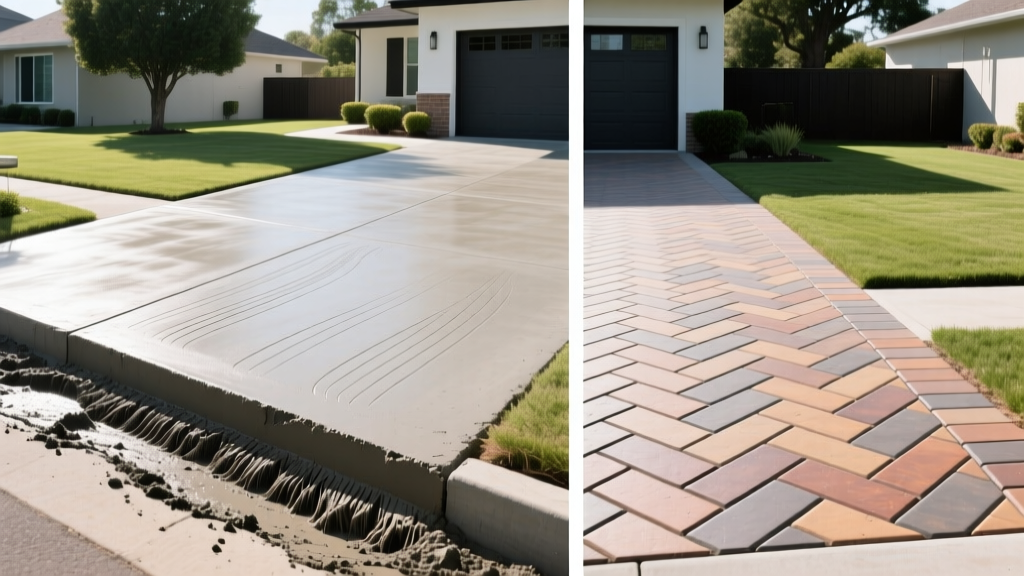
Choosing between interlocking pavers and poured concrete is rarely just an aesthetic decision; it is a complex capital allocation problem. While poured concrete generally wins on initial upfront costs, pavers offer superior long-term repair economics and structural flexibility. To accurately evaluate the cost of paver driveway vs concrete, homeowners and contractors must look beyond the per-square-foot installation quote and analyze base preparation requirements, regional material availability, and 20-year lifecycle maintenance.
Quick Cost Snapshot (2026 National Averages)
- Standard Broom-Finish Concrete: $9.00 – $13.00 per sq. ft.
- Stamped/Decorative Concrete: $15.00 – $22.00 per sq. ft.
- Standard Concrete Pavers: $14.00 – $20.00 per sq. ft.
- Premium Brick/Natural Stone Pavers: $18.00 – $32.00+ per sq. ft.
Note: These figures assume a standard 600 sq. ft. driveway with moderate site grading. Steep slopes or poor soil conditions will increase base preparation costs by 15-30%.
Deep Dive: Poured Concrete Driveway Economics
The price of a concrete driveway is heavily dictated by the mix design, slab thickness, and finishing technique. For a durable residential driveway, the American Concrete Institute (ACI) recommends a minimum compressive strength of 4,000 PSI. In regions experiencing freeze-thaw cycles, the mix must include 5% to 7% air entrainment to prevent surface spalling.
Material and Labor Breakdown
Labor typically accounts for 50% to 60% of the total concrete installation cost. The physical pouring and finishing process is time-sensitive; a crew must screed, float, and broom-finish the slab before the concrete begins its initial set, usually within 90 to 120 minutes depending on ambient temperature and humidity.
- Formwork & Framing: $1.50 – $2.50 per linear foot.
- Concrete Material (4,000 PSI): $140 – $170 per cubic yard (delivered).
- Reinforcement: Wire mesh adds $0.40 per sq. ft.; #4 rebar on a 2-foot grid adds $0.85 per sq. ft.
- Finishing & Sealing: Basic broom finish is included in base labor; acrylic curing compounds or penetrating silane/siloxane sealers add $0.50 – $1.25 per sq. ft.
The Hidden Costs: Control Joints and Stamping
Concrete will crack; the goal is to control where it cracks. Saw-cut control joints must be placed every 10 feet and at all re-entrant corners. If a homeowner opts for stamped concrete to mimic stone or brick, the cost structure changes dramatically. Stamping requires a slower-setting mix, color hardeners broadcast across the surface ($1.50/sq. ft.), and an antiquing release agent. The specialized labor for stamping pushes the total cost well past the $18.00/sq. ft. threshold.
Deep Dive: Paver Driveway Economics
Interlocking concrete pavers function as a flexible pavement system. According to engineering guidelines published by the National Concrete Masonry Association (NCMA), the structural integrity of a paver driveway relies entirely on the underlying base and edge restraints, not the pavers themselves.
The Base Preparation Factor (Where Budgets Bleed)
Unlike a concrete slab that bridges minor subgrade inconsistencies, pavers telegraph every flaw in the base. Proper installation requires excavating 10 to 12 inches of native soil. For heavy vehicle loads, the base must consist of 6 to 8 inches of compacted, angular Class II road base (crushed aggregate), followed by a 1-inch bedding layer of ASTM C33 concrete sand.
If your property has expansive clay soil, you must install a non-woven geotextile fabric between the subgrade and the aggregate base. Skipping this $0.35/sq. ft. material will result in clay migrating into the aggregate during wet seasons, destroying the base's drainage capacity and causing severe paver settlement within three years.
Material Tiers and Pattern Complexity
The cost of paver driveway vs concrete shifts significantly based on the paver material and the laying pattern. A simple running bond pattern requires minimal cutting and standard labor. However, a 90-degree herringbone pattern—which offers the highest structural interlock for vehicular traffic—requires cutting almost every paver at the edges, increasing labor time and material waste by up to 12%.
- Concrete Pavers (Standard): $2.50 – $4.50 per sq. ft. (material only).
- Clay Brick Pavers: $4.00 – $7.00 per sq. ft. (material only).
- Polymeric Jointing Sand: $0.60 – $0.90 per sq. ft. (crucial for locking pavers and preventing weed growth).
- Edge Restraints: Snap-edge plastic or poured concrete curbing ($3.00 – $5.00 per linear foot).
Head-to-Head Comparison Matrix
| Feature | Poured Concrete | Interlocking Pavers |
|---|---|---|
| Initial Cost (Basic) | $9.00 - $13.00 / sq. ft. | $14.00 - $20.00 / sq. ft. |
| Installation Time | 3-5 days (includes 7-day cure) | 5-8 days (ready for use immediately) |
| Load Bearing | Excellent (rigid slab) | Excellent (flexible load distribution) |
| Freeze-Thaw Resistance | Moderate (requires air-entrainment) | Superior (joints allow expansion) |
| Utility Access | Destructive (must saw-cut and patch) | Non-destructive (lift and replace) |
Maintenance and Repair Economics: The 20-Year Horizon
The initial cost of paver driveway vs concrete only tells half the story. Evaluating the 20-year lifecycle cost reveals why many civil engineers and landscape architects favor flexible pavement systems for high-end residential projects.
Concrete Repair Scenarios
When a concrete slab fails, the repair options are limited and visually disruptive. If a tree root heaves a section of the driveway, or if the subgrade washes out causing a void, the slab will snap.
- Slabjacking / Mudjacking: Pumping a cementitious slurry under a sunken slab costs $4.00 – $7.00 per sq. ft. It fixes the trip hazard but does not repair the cracked concrete.
- Section Replacement: Saw-cutting and removing a damaged 10x10 foot section and pouring new concrete costs $1,500 – $2,200. The new concrete will never perfectly match the faded color of the 10-year-old existing slab.
- Resurfacing: Applying a polymer-modified concrete overlay costs $5.00 – $9.00 per sq. ft., but requires rigorous surface preparation and may delaminate if moisture is trapped beneath.
Paver Repair Scenarios
Pavers do not crack; they shift. If a base failure occurs, or if you need to access underground irrigation or utility lines, the repair economics heavily favor pavers.
- Utility Trenching: Pulling up pavers, digging the trench, and reinstalling the exact same pavers costs roughly $3.00 – $5.00 per linear foot in labor. There is zero material waste and zero color-matching issues.
- Settlement Repair: If a localized area sinks, a contractor can remove the affected pavers, add and compact new base aggregate, and relay the pavers. This targeted repair rarely exceeds $400 for a standard 4x4 foot depression.
- Routine Maintenance: Re-sanding joints with polymeric sand and applying a wet-look acrylic sealer is required every 3 to 5 years, costing $1.25 – $1.75 per sq. ft.
Decision Framework: Which Should You Choose?
Use this practical framework to finalize your material selection based on your specific site conditions and budget parameters.
Choose Poured Concrete If:
- Your budget is strictly capped below $12.00 per sq. ft.
- You have a very long, straight driveway where aesthetic pattern variations are less critical.
- You live in a mild climate with minimal freeze-thaw cycles and stable, well-draining sandy loam soil.
- You prefer a low-maintenance surface and are willing to accept eventual random cracking as a natural characteristic of the material.
Choose Pavers If:
- Your property features mature trees with aggressive root systems near the driveway footprint.
- You reside in a region with severe winter freezing, where rigid slabs are prone to frost heave and spalling.
- You anticipate needing underground utility access (irrigation, lighting, or data lines) in the future.
- You view the driveway as a primary architectural feature that must match high-end masonry or landscaping elements.
Final Procurement Advice
When soliciting bids, do not simply ask for a 'price per square foot.' For concrete, demand that the contractor specifies the PSI rating, the slump (ideally 4 to 5 inches for driveways), and the exact spacing of control joints. For pavers, require a written guarantee on the depth of the compacted aggregate base and the use of geotextile fabric if soil tests indicate high clay content. The Portland Cement Association provides extensive technical literature on proper subgrade preparation that you can reference to hold your contractor accountable to industry standards. By focusing on the structural specifications rather than just the surface finish, you ensure your investment survives the decades.
Written by
James ThorntonJames Thornton is a construction industry veteran with 25 years of hands-on experience in wood framing, lumber grading, and residential building codes. He started as a framing carpenter in rural Oregon, earned his ICC Residential Building Inspector certification, and eventually became a senior plan reviewer for the City of Portland Bureau of Development Services. James holds a B.S. in Wood Science & Technology from Oregon State University and is a certified lumber grader through the West Coast Lumber Inspection Bureau (WCLIB). He has inspected over 3,000 residential construction sites and authored the city's internal guide on advanced framing techniques (2x6 at 24" O.C.). James lives in Bend, OR, where he builds custom timber-frame cabins and competes in lumberjack sports.
More from James Thornton
View all
Insulation
Best Home Insulation Materials: Complete 2026 Guide
Compare top home insulation materials for 2026. Find R-values, installed costs per square foot, and best uses for fiberglass, spray foam, and mineral wool.
Aug 4, 2026

Sustainable Building
Certify Your Green Building Material for LEED and WELL
Step-by-step guide to certifying a green building material for LEED v5 and WELL v2. Master EPDs, HPDs, and VOC limits for 2026 project specifications.
Aug 4, 2026

Stone & Masonry
Veneer Stacked Stone Panels: Interior Design & Style Showcase
Discover how veneer stacked stone panels transform interiors. Explore modern design profiles, material pairings, and technical installation specs.
Aug 4, 2026